Irwin C R, Ferguson M W
Department of Anatomy, Queen's University of Belfast.
J Anat. 1986 Jun;146:53-64.
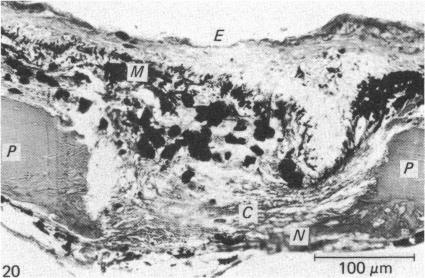
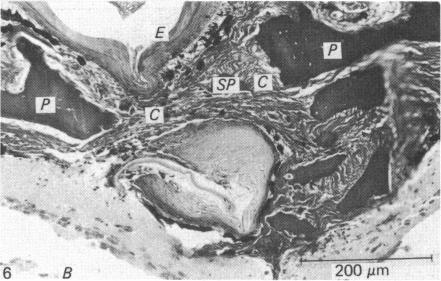
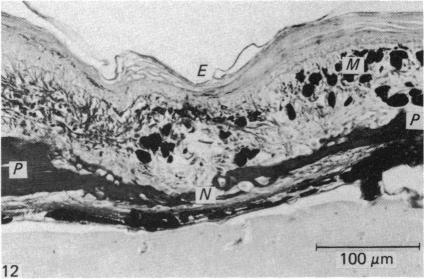
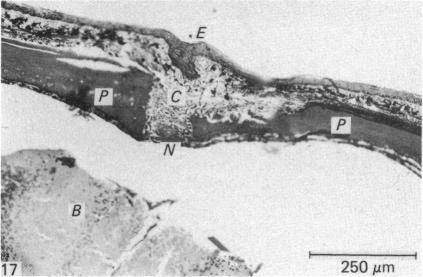
The fracture repair of reptilian dermal bones has not previously been reported. Moreover, repair of fractured dermal bones in birds and mammals involves secondary chondrogenesis whereas that of amphibians does not. Therefore an investigation into the repair of fractured reptilian dermal bones could reveal the stage during vertebrate evolution at which the process of secondary chondrogenesis appeared. Experimental incisions were made in the parietal bones of seventeen lizards (3 species) and 2 snakes (1 species). These resulted in a fracture environment of limited vascularity and increased movement--two known stimuli of secondary chondrogenesis in birds and mammals. Re-epithelialisation was rapid and dead bony fragments quickly sequestered. The blood blot was quickly organised into connective tissue, the dural periostea proliferated, osteoblasts differentiated and bony union was effected after 18 days. The width of the fracture gap was the principal variable affecting the chronology of fracture repair. Secondary cartilage was not detected in any specimen, of any species, at any stage of the fracture repair. It therefore appears that the progenitor cells on reptilian dermal bones are not capable of forming secondary cartilage and that this tissue arose comparatively late in vertebrate evolution.
此前尚未有关于爬行动物真皮骨骨折修复的报道。此外,鸟类和哺乳动物真皮骨骨折的修复涉及继发性软骨形成,而两栖动物则不然。因此,对爬行动物真皮骨骨折修复的研究可能会揭示在脊椎动物进化过程中继发性软骨形成过程出现的阶段。在17只蜥蜴(3个物种)和2条蛇(1个物种)的顶骨上进行了实验性切口。这些切口造成了血管有限和活动增加的骨折环境——这是鸟类和哺乳动物继发性软骨形成的两个已知刺激因素。上皮再形成迅速,死骨碎片很快被隔离。血凝块很快被组织成结缔组织,硬脑膜骨膜增殖,成骨细胞分化,18天后实现骨愈合。骨折间隙的宽度是影响骨折修复时间的主要变量。在任何物种的任何标本中,在骨折修复的任何阶段都未检测到继发性软骨。因此,似乎爬行动物真皮骨上的祖细胞无法形成继发性软骨,并且这种组织在脊椎动物进化过程中出现得相对较晚。