
揭示巴西应对新冠疫情的相互冲突策略:一项运用功能共振分析方法的横断面研究
Unveiling conflicting strategies in the Brazilian response to COVID-19: A cross-sectional study using the Functional Resonance Analysis Method.
作者信息
Jatobá Alessandro, Bellas Hugo, Viana Jaqueline, de Castro Nunes Paula, Leal Raquel, Bulhões Bárbara, Arcuri Rodrigo, de Carvalho Paulo Victor Rodrigues
机构信息
Centro de Estudos Estratégicos Antônio Ivo de Carvalho (CEE), Fundação Oswaldo Cruz, Rio de Janeiro, Brazil.
Instituto de Medicina Social Hésio Cordeiro (IMS), Universidade do Estado do Rio de Janeiro (UERJ), Rio de Janeiro, Brazil.
出版信息
Dialogues Health. 2022 Dec;1:100056. doi: 10.1016/j.dialog.2022.100056. Epub 2022 Oct 6.
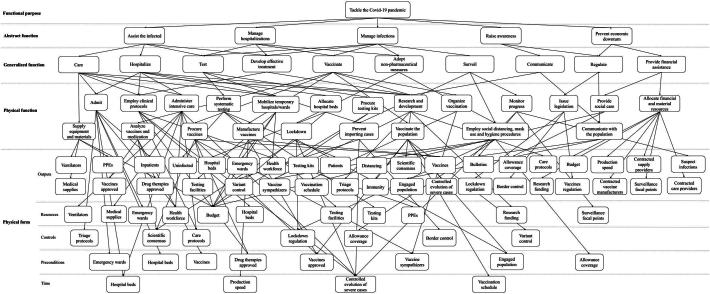
By the time the present study was completed, Brazil had been the second epicenter of COVID-19. In addition, the actions taken to respond to the pandemic in Brazil were the subject of extensive debate, since some diverged from recommendations from health authorities and scientists. Since then, the resulting political and social turmoil showed conflicting strategies to tackle the pandemic in Brazil, with visible consequences in the numbers of casualties, but also with effects on the resilience of the overall health system. Thus, this article explores the actions taken in Brazil to cope with the pandemic from a systems analysis perspective. The structure of the domain was analyzed using Work Domain Analysis, and the activated functions were analyzed using the Functional Resonance Analysis Method, identifying the variability resulting from the conflicting strategies carried out and the consequences to the capacity of the Brazilian health system to respond resiliently to the pandemic. Results of the study show that functions that overlapped the operation of the overall system were introduced, causing the health system to operate under conflicting objectives, in which functions were created to restrict the outcomes of each other during the entire COVID-19 crisis.
在本研究完成时,巴西已成为新冠疫情的第二个中心。此外,巴西为应对疫情所采取的行动成为了广泛辩论的主题,因为其中一些行动与卫生当局和科学家的建议存在分歧。自那时起,由此产生的政治和社会动荡显示出巴西应对疫情的相互冲突的策略,这在伤亡人数上有明显体现,同时也对整个卫生系统的恢复力产生了影响。因此,本文从系统分析的角度探讨了巴西为应对疫情所采取的行动。使用工作领域分析对该领域的结构进行了分析,并使用功能共振分析方法对激活的功能进行了分析,确定了因实施相互冲突的策略而产生的变异性以及对巴西卫生系统弹性应对疫情能力的影响。研究结果表明,引入了与整个系统运行重叠的功能,导致卫生系统在相互冲突的目标下运行,即在整个新冠疫情危机期间,各功能相互制约彼此的结果。




 Zotero 插件