
太阳能抛物面碟式集热器的腔体接收器及基于内置网络的流道拓扑优化方法
Topology Optimization Method of a Cavity Receiver and Built-In Net-Based Flow Channels for a Solar Parabolic Dish Collector.
作者信息
Liu Jun, Li Renfu, Chen Yuxuan, Zheng Jianguo, Wang Kun
机构信息
School of Aerospace Engineering, Huazhong University of Science and Technology, Wuhan 430074, China.
Wuhan Secondary Ship Design & Research Institute, Wuhan 430064, China.
出版信息
Entropy (Basel). 2023 Feb 22;25(3):398. doi: 10.3390/e25030398.
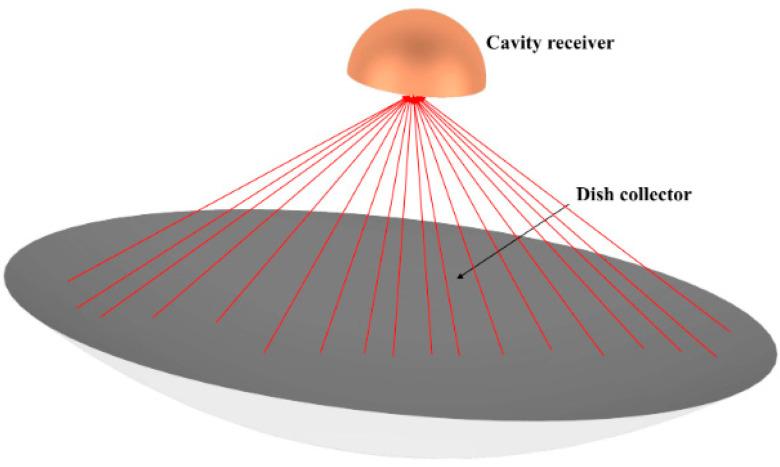
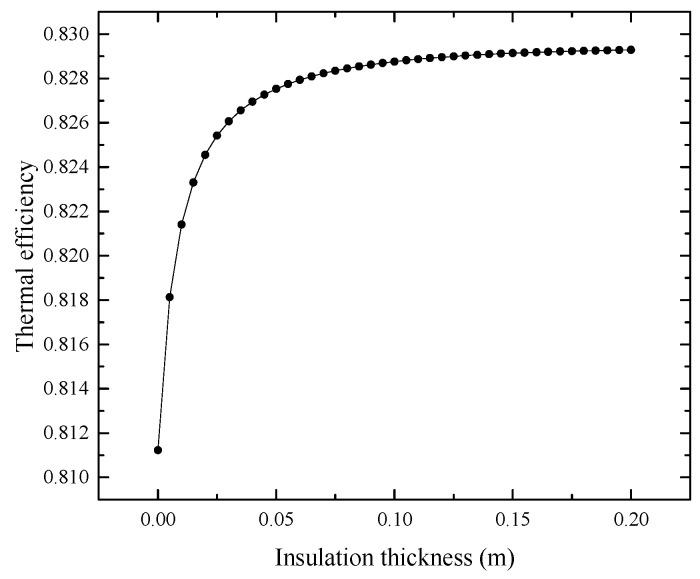
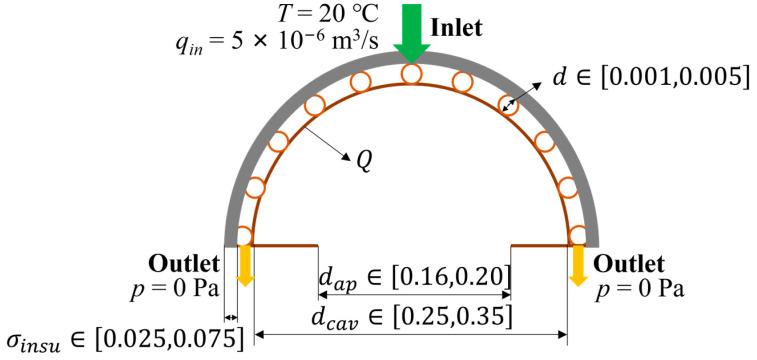
The design of a thermal cavity receiver and the arrangement of the fluid flow layout within it are critical in the construction of solar parabolic dish collectors, involving the prediction of the thermal-fluid physical field of the receiver and optimization design. However, the thermal-fluid analysis coupled with a heat loss model of the receiver is a non-linear and computationally intensive solving process that incurs high computational costs in the optimization procedure. To address this, we implement a net-based thermal-fluid model that incorporates heat loss analysis to describe the receiver's flow and heat transfer processes, reducing computational costs. The physical field results of the net-based thermal-fluid model are compared with those of the numerical simulation, enabling us to verify the accuracy of the established thermal-fluid model. Additionally, based on the developed thermal-fluid model, a topology optimization method that employs a genetic algorithm (GA) is developed to design the cavity receiver and its built-in net-based flow channels. Using the established optimization method, single-objective and multi-objective optimization experiments are conducted under inhomogeneous heat flux conditions, with objectives including maximizing temperature uniformity and thermal efficiency, as well as minimizing the pressure drop. The results reveal varying topological characteristics for different optimization objectives. In comparison with the reference design (spiral channel) under the same conditions, the multi-objective optimization results exhibit superior comprehensive performance.
热腔接收器的设计及其内部流体流动布局的安排在太阳能抛物面碟式集热器的构建中至关重要,这涉及到接收器热流体物理场的预测和优化设计。然而,将热流体分析与接收器的热损失模型相结合是一个非线性且计算密集的求解过程,在优化过程中会产生高昂的计算成本。为了解决这个问题,我们实现了一个基于网络的热流体模型,该模型纳入了热损失分析来描述接收器的流动和传热过程,从而降低计算成本。将基于网络的热流体模型的物理场结果与数值模拟结果进行比较,使我们能够验证所建立的热流体模型的准确性。此外,基于所开发的热流体模型,开发了一种采用遗传算法(GA)的拓扑优化方法,用于设计腔式接收器及其内置的基于网络的流动通道。使用所建立的优化方法,在非均匀热通量条件下进行单目标和多目标优化实验,目标包括最大化温度均匀性和热效率,以及最小化压降。结果揭示了不同优化目标的不同拓扑特征。与相同条件下的参考设计(螺旋通道)相比,多目标优化结果具有更优的综合性能。






 Zotero 插件