Kids Cancer Centre, Sydney Childrens Hospital, Randwick, Sydney, NSW, 2031, Australia.
Behavioural Sciences Unit, Kids Cancer Centre, Sydney Childrens Hospital, Sydney, NSW, Australia.
J Cancer Surviv. 2024 Aug;18(4):1201-1210. doi: 10.1007/s11764-023-01349-6. Epub 2023 Mar 29.
Cancer survivors may experience infertility and sexual dysfunction following cancer treatment. Survivors report significant gaps in oncofertility care and consider these issues important, yet they are rarely discussed. The aims of this study were to evaluate survivors' sexual and reproductive complications across age groups and to identify specific groups of survivors at risk for sexual and reproductive complications.
We report data collected from survivors of cancers diagnosed in childhood, adolescence and adulthood following the development and piloting of a reproductive survivorship patient reported outcome measure (RS-PROM).
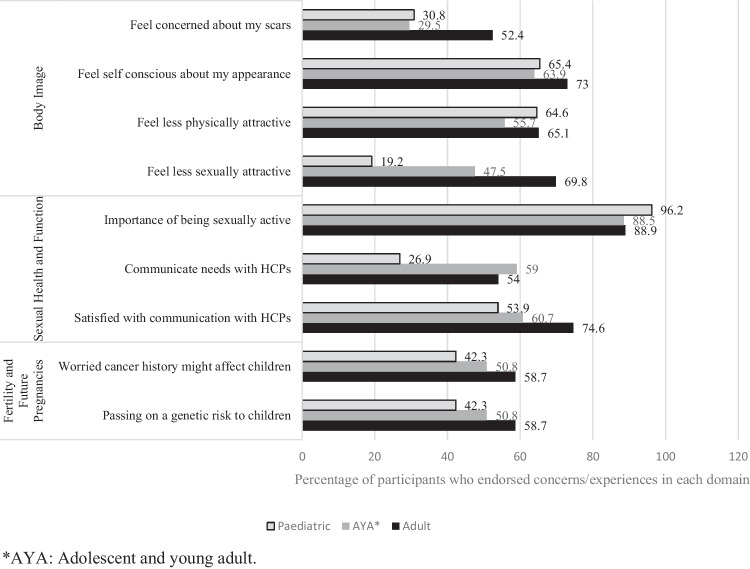
One hundred and fifty survivors participated in the study (mean age at cancer diagnosis was 23.2 years [SD, 10.3 years]). About 68% of participants expressed concerns about their sexual health and function. Survivors (50%) expressed at least one body image concern, with the female gender the most common risk factor for all subgroups. A total of 36% of participants reported at least one concern regarding their fertility, with more male than female survivors reporting fertility preservation prior to treatment. Females compared with male participants were more likely to feel less physically attractive after treatment (OR = 3.83, 95% CI = 1.84-7.95, p < 0.001). More females than males were also more likely to feel dissatisfied with the appearance of a scar(s) after treatment (OR = 2.36, 95% CI = 1.13-4.91, p = 0.02).
The RS-PROM identified multiple reproductive complications and concerns for cancer survivors in the survivorship period.
Utilising the RS-PROM in conjunction with a clinic appointment could help identify and address cancer patients' concerns and symptoms.
癌症幸存者在癌症治疗后可能会经历不孕和性功能障碍。幸存者报告称,他们在肿瘤生育护理方面存在明显差距,并认为这些问题很重要,但这些问题很少被讨论。本研究的目的是评估不同年龄组幸存者的性和生殖并发症,并确定有生殖并发症风险的特定幸存者群体。
我们报告了从儿童、青少年和成年期癌症幸存者中收集的数据,这些数据是在生殖生存患者报告结局测量(RS-PROM)的开发和试点后获得的。
共有 150 名幸存者参加了这项研究(癌症诊断时的平均年龄为 23.2 岁[标准差,10.3 岁])。约 68%的参与者对自己的性健康和功能表示关注。幸存者(50%)表达了至少一种身体形象担忧,其中女性是所有亚组的最常见危险因素。共有 36%的参与者报告了至少一个关于生育能力的担忧,在接受治疗前进行生育力保存的男性幸存者多于女性幸存者。与男性参与者相比,治疗后女性更有可能觉得自己缺乏吸引力(OR=3.83,95%CI=1.84-7.95,p<0.001)。与男性相比,治疗后更多的女性也更有可能对疤痕(s)的外观不满意(OR=2.36,95%CI=1.13-4.91,p=0.02)。
RS-PROM 在生存期间确定了癌症幸存者的多种生殖并发症和担忧。
在诊所预约时使用 RS-PROM 可以帮助识别和解决癌症患者的问题和症状。