Teikyo University Graduate School of Public Health, 2-11-1 Kaga, Itabashi-Ku, Tokyo, Japan.
Department of Nephrology, Dokkyo Medical University Saitama Medical Center, Saitama, Japan.
BMC Nephrol. 2023 Apr 3;24(1):85. doi: 10.1186/s12882-023-03137-x.
The relationship between obesity and nonalcoholic fatty liver disease and renal hyperfiltration is controversial. This study aimed to assess the correlations of body mass index and fatty liver index, respectively, with renal hyperfiltration in non-diabetic subjects, considering age, sex, and body surface area.
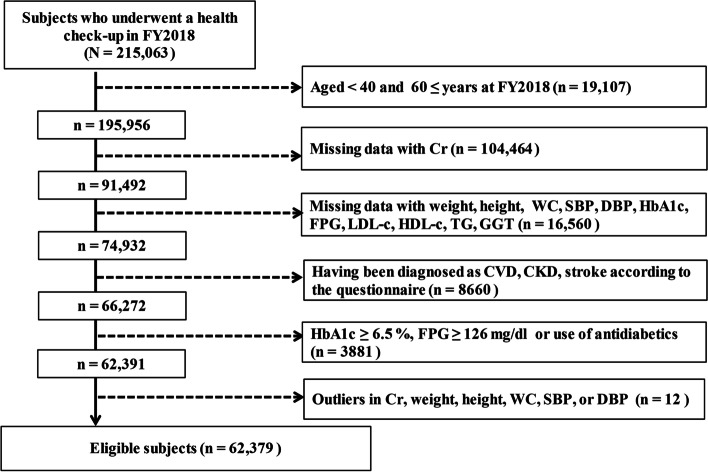
This cross-sectional study assessed the Japanese health check-up data (FY2018) of 62,379 non-diabetic individuals from a health insurance database. Renal hyperfiltration is the ≥ 95th percentile of estimated glomerular filtration rate (derived by Chronic Kidney Disease Epidemiology Collaboration formula) by gender and age in healthy subjects. After adjusting for potential confounders, multiple logistic regression models were applied to evaluate the correlation of renal hyperfiltration with body mass index categories and fatty liver index (10 equal parts).
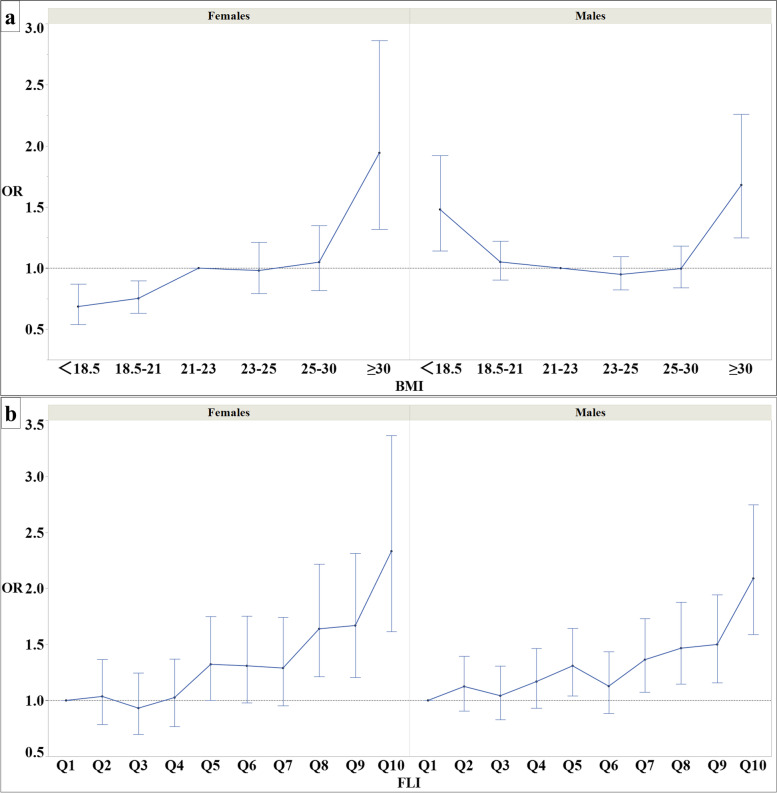
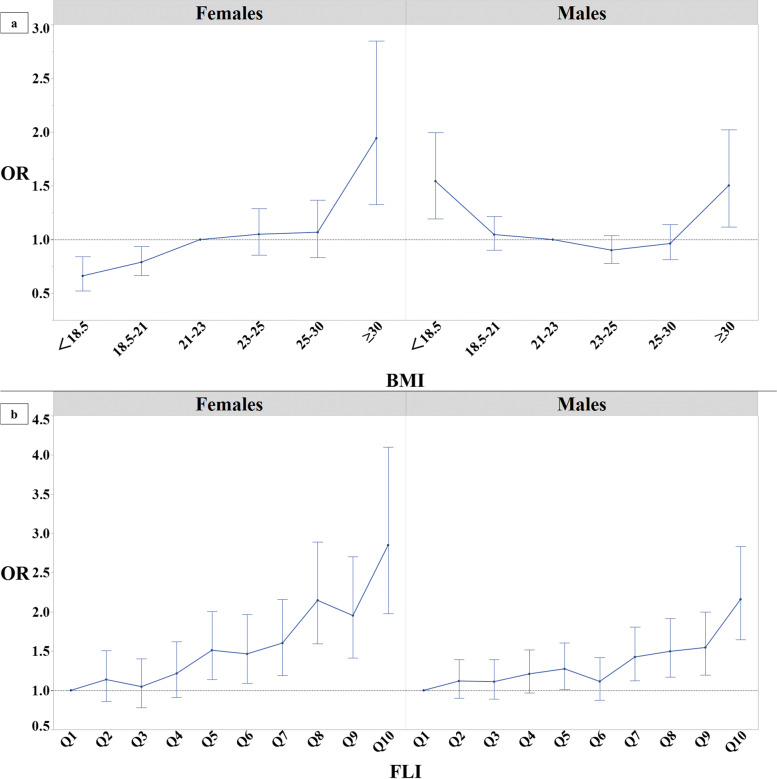
A negative and positive correlation, respectively, were noted when the body mass index was < 21 and ≥ 30 in women; however, a positive correlation was noted for BMI < 18.5 and ≥ 30 in men. Renal hyperfiltration prevalence increased when fatty liver index increased for both sexes; the cutoff value for fatty liver index was 14.7 for women and 30.4 for men.
Body mass index and renal hyperfiltration correlated linearly in women; however, in men, the correlation was U-shaped; therefore, differing by sex. However, fatty liver index correlated linearly with renal hyperfiltration in both sexes. Non-alcoholic fatty liver disease might be associated with renal hyperfiltration; Fatty liver index is a simple marker that can be obtained from health check-ups. Since a high fatty liver index correlated with renal hyperfiltration, it may be beneficial to monitor the renal function in such a population.
肥胖与非酒精性脂肪肝和肾脏高滤过之间的关系存在争议。本研究旨在评估体质指数和脂肪肝指数分别与非糖尿病患者肾脏高滤过的相关性,同时考虑年龄、性别和体表面积。
本横断面研究评估了来自健康保险数据库的 62379 名非糖尿病个体的日本健康检查数据(2018 财年)。肾脏高滤过是指健康受试者中按性别和年龄计算的肾小球滤过率(来源于慢性肾脏病流行病学合作公式)的≥第 95 百分位数。在调整了潜在混杂因素后,采用多因素逻辑回归模型评估了肾脏高滤过与体质指数分类和脂肪肝指数(10 等分)的相关性。
女性体质指数<21 和≥30 时分别呈负相关和正相关,而男性体质指数<18.5 和≥30 时呈正相关。对于男女两性,脂肪肝指数增加时,肾脏高滤过的患病率增加;女性的脂肪肝指数临界值为 14.7,男性为 30.4。
在女性中,体质指数与肾脏高滤过呈线性相关;然而,在男性中,相关性呈 U 型,因此存在性别差异。然而,在男女两性中,脂肪肝指数与肾脏高滤过呈线性相关。非酒精性脂肪性肝病可能与肾脏高滤过有关;脂肪肝指数是一种可以从健康检查中获得的简单标志物。由于高脂肪肝指数与肾脏高滤过相关,因此在这类人群中监测肾功能可能是有益的。