
纳布啡在全身麻醉手术患者中的群体药代动力学。
Population pharmacokinetics of nalbuphine in patients undergoing general anesthesia surgery.
作者信息
Nie Xuyang, Gao Xiaonan, Gao Jinglin, Heng Tianfang, Zhang Yuqi, Sun Yaqi, Feng Zhangying, Jia Li, Wang Mingxia
机构信息
Department of Clinical Pharmacology, The Fourth Hospital of Hebei Medical University, Shijiazhuang, China.
Department of Anesthesiology, The Fourth Hospital of Hebei Medical University, Shijiazhuang, China.
出版信息
Front Pharmacol. 2023 Mar 21;14:1130287. doi: 10.3389/fphar.2023.1130287. eCollection 2023.
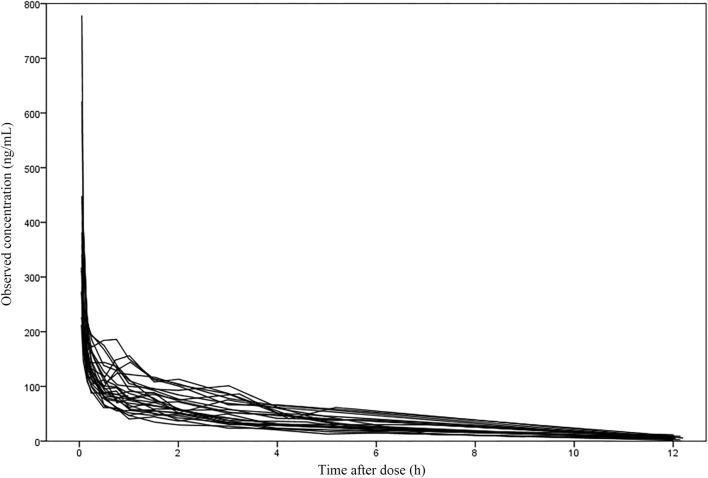
The aim of this study was to build a population pharmacokinetics (PopPK) model of nalbuphine and to estimate the suitability of bodyweight or fixed dosage regimen. Adult patients who were undergoing general anesthetic surgery using nalbuphine for induction of anesthesia were included. Plasma concentrations and covariates information were analyzed by non-linear mixed-effects modeling approach. Goodness-of-fit (GOF), non-parametric bootstrap, visual predictive check (VPC) and external evaluation were applied for the final PopPK model evaluation. Monte Carlo simulation was conducted to assess impact of covariates and dosage regimens on the plasma concentration to nalbuphine. 47 patients aged 21-78 years with a body weight of 48-86 kg were included in the study. Among them, liver resection accounted for 14.8%, cholecystectomy for 12.8%, pancreatic resection for 36.2% and other surgeries for 36.2%. 353 samples from 27 patients were enrolled in model building group; 100 samples from 20 patients were enrolled in external validation group. The results of model evaluation showed that the pharmacokinetics of nalbuphine was adequately described by a two-compartment model. The hourly net fluid volume infused (HNF) was identified as a significant covariate about the intercompartmental clearance (Q) of nalbuphine with objective function value (OFV) decreasing by 9.643 ( < 0.005, = 1). Simulation results demonstrated no need to adjust dosage based on HNF, and the biases of two dosage methods were less than 6%. The fixed dosage regimen had lower PK variability than the bodyweight regimen. A two-compartment PopPK model adequately described the concentration profile of nalbuphine intravenous injection for anesthesia induction. While HNF can affect the Q of nalbuphine, the magnitude of the effect was limited. Dosage adjustment based on HNF was not recommended. Furthermore, fixed dosage regimen might be better than body weight dosage regimen.
本研究的目的是建立纳布啡的群体药代动力学(PopPK)模型,并评估体重或固定剂量方案的适用性。纳入了使用纳布啡进行麻醉诱导的全身麻醉手术成年患者。采用非线性混合效应建模方法分析血浆浓度和协变量信息。最终的PopPK模型评估采用拟合优度(GOF)、非参数自举法、可视化预测检查(VPC)和外部评估。进行蒙特卡罗模拟以评估协变量和剂量方案对纳布啡血浆浓度的影响。本研究纳入了47例年龄在21 - 78岁、体重在48 - 86 kg的患者。其中,肝切除术占14.8%,胆囊切除术占12.8%,胰腺切除术占36.2%,其他手术占36.2%。来自27例患者的353个样本纳入模型构建组;来自20例患者的100个样本纳入外部验证组。模型评估结果表明,两室模型能充分描述纳布啡的药代动力学。每小时净输液量(HNF)被确定为与纳布啡室间清除率(Q)相关的显著协变量,目标函数值(OFV)降低了9.643(<0.005, = 1)。模拟结果表明无需根据HNF调整剂量,两种给药方法的偏差均小于6%。固定剂量方案的药代动力学变异性低于体重方案。两室PopPK模型充分描述了纳布啡静脉注射用于麻醉诱导的浓度曲线。虽然HNF可影响纳布啡的Q,但影响程度有限。不建议根据HNF进行剂量调整。此外,固定剂量方案可能优于体重给药方案。



 Zotero 插件