
摩擦耗能复合弦杆在准静态试验下滞回性能的试验与理论研究
Experimental and Theoretical Studies on Hysteretic Behavior of Friction Energy Dissipation Composite Chord under Quasi-Static Tests.
作者信息
Zhou Qishi, He Wenwu, Zhou Zhibin, Guo Wenxuan, Liu Shuaishuai
机构信息
School of Civil Engineering, Central South University, Changsha 410075, China.
出版信息
Materials (Basel). 2023 Apr 4;16(7):2885. doi: 10.3390/ma16072885.
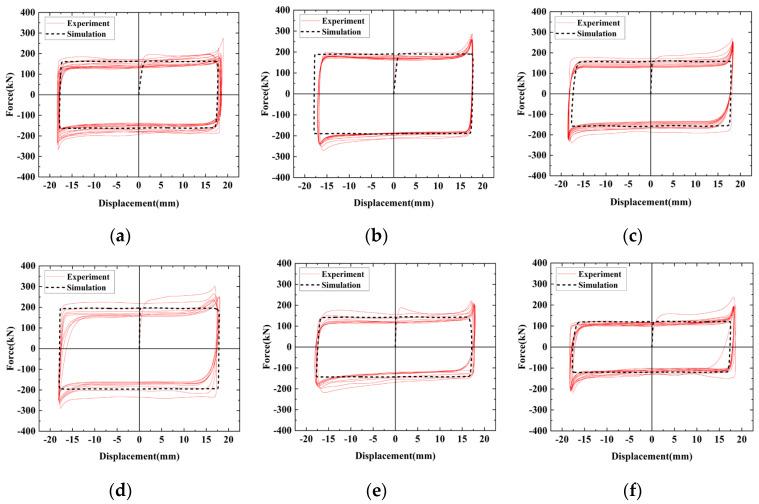
To improve the seismic performance of a staggered truss steel framing system, the basic force unit in the truss system is replaced by a friction energy dissipation truss. The difference between a friction energy dissipation truss and an ordinary truss is that the upper chord is a friction energy dissipation composite chord. In this paper, we investigate the effects of the number of bolts and the friction surface on the energy dissipation capacity of the chord by a quasi-static test on six composite chord specimens at a scale of 1:2. The results show that the hysteresis curves of friction energy dissipation composite chords are ideal rectangles, and the energy dissipation capacity is excellent. The more bolts there are in the specimen, the slower the energy dissipation capacity of the chord decreases. Among the different friction surface specimens, the energy dissipation capacity of the aluminum friction plate specimen decays the fastest, while the energy dissipation capacity of the shot-blasted treated specimen decays substantially after the first cycle. Friction plates can improve the stability of the hysteresis properties. Based on the test results, this paper proposes a calculation method for the ultimate bearing capacity of the composite chord, which provides a basis for the design of a friction energy dissipation truss. In addition, we studied the effects of different bolt clamping forces and slotted bolt hole lengths on the energy dissipation capacity of composite chords by establishing a finite element analysis. It was shown that as the clamping force of the bolt increases, the energy dissipation capacity of the specimen becomes stronger but the stability decreases. The energy dissipation capacity of the chord is close to a linear relationship with the slotted bolt hole lengths; thus, increasing the slotted bolt hole lengths within the allowable range of inter-story drifts can enhance the energy dissipation capacity of the chord. Finally, we propose the design method of the angle steel by analyzing the force of the chord.
为提高交错桁架钢框架体系的抗震性能,将桁架体系中的基本受力单元替换为摩擦耗能桁架。摩擦耗能桁架与普通桁架的区别在于,其上弦杆为摩擦耗能组合弦杆。本文通过对6个1:2比例的组合弦杆试件进行拟静力试验,研究了螺栓数量和摩擦面等因素对弦杆耗能能力的影响。结果表明,摩擦耗能组合弦杆的滞回曲线为理想矩形,耗能能力优异。试件中螺栓数量越多,弦杆耗能能力下降越慢。在不同摩擦面试件中,铝摩擦板试件的耗能能力衰减最快,而喷砂处理试件的耗能能力在第一个循环后大幅衰减。摩擦板可提高滞回性能的稳定性。基于试验结果,本文提出了组合弦杆极限承载力的计算方法,为摩擦耗能桁架的设计提供了依据。此外,通过建立有限元分析,研究了不同螺栓夹紧力和螺栓开槽孔长度对组合弦杆耗能能力的影响。结果表明,随着螺栓夹紧力的增加,试件的耗能能力增强,但稳定性降低。弦杆的耗能能力与螺栓开槽孔长度近似呈线性关系;因此,在层间位移允许范围内增加螺栓开槽孔长度可提高弦杆的耗能能力。最后,通过对弦杆受力分析提出了角钢的设计方法。




 Zotero 插件