
溶血磷脂酸调控卵巢癌细胞信号转导网络及其在肌动球蛋白动态、细胞迁移和细胞吞噬中的作用。
The lysophosphatidic acid-regulated signal transduction network in ovarian cancer cells and its role in actomyosin dynamics, cell migration and entosis.
机构信息
Department of Translational Oncology, Center for Tumor Biology and Immunology, Philipps University, Marburg, Germany.
Biomolecular Mass Spectrometry, Max-Planck-Institute for Heart and Lung Research, Bad Nauheim, Germany.
出版信息
Theranostics. 2023 Mar 21;13(6):1921-1948. doi: 10.7150/thno.81656. eCollection 2023.
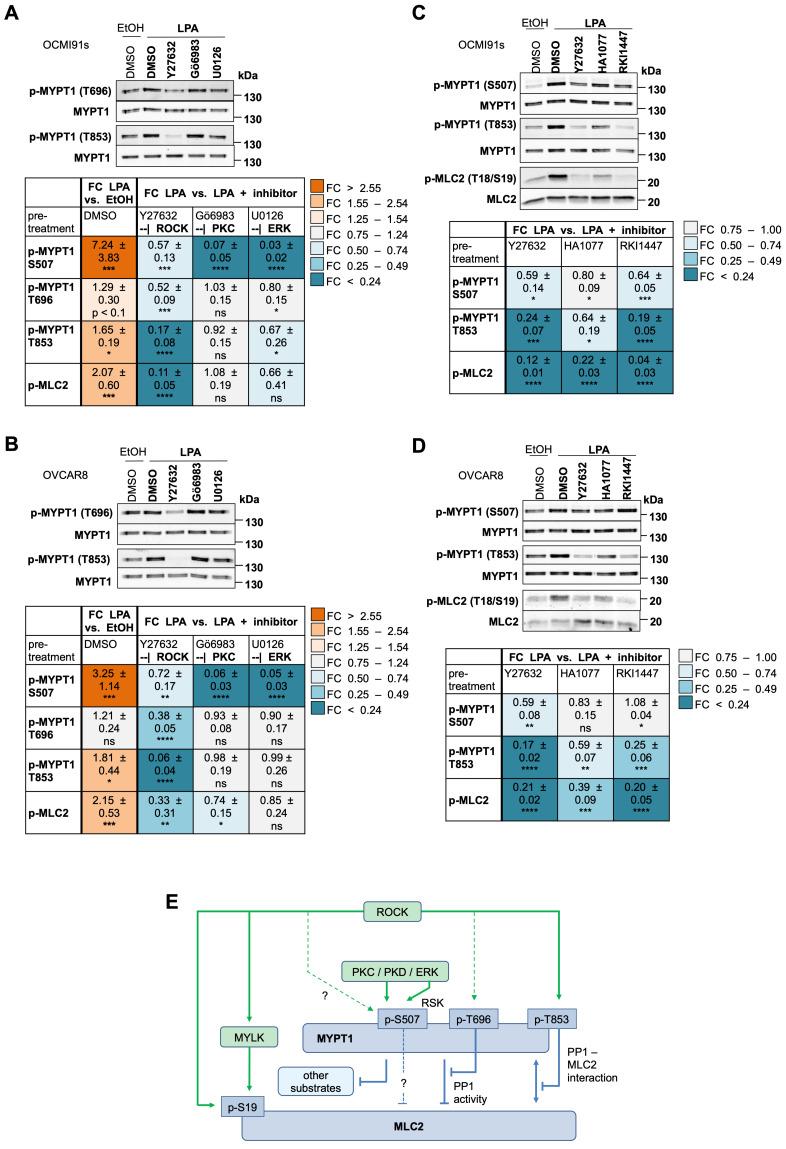
Lysophosphatidic acid (LPA) species accumulate in the ascites of ovarian high-grade serous cancer (HGSC) and are associated with short relapse-free survival. LPA is known to support metastatic spread of cancer cells by activating a multitude of signaling pathways via G-protein-coupled receptors of the LPAR family. Systematic unbiased analyses of the LPA-regulated signal transduction network in ovarian cancer cells have, however, not been reported to date. LPA-induced signaling pathways were identified by phosphoproteomics of both patient-derived and OVCAR8 cells, RNA sequencing, measurements of intracellular Ca and cAMP as well as cell imaging. The function of LPARs and downstream signaling components in migration and entosis were analyzed by selective pharmacological inhibitors and RNA interference. Phosphoproteomic analyses identified > 1100 LPA-regulated sites in > 800 proteins and revealed interconnected LPAR1, ROCK/RAC, PKC/D and ERK pathways to play a prominent role within a comprehensive signaling network. These pathways regulate essential processes, including transcriptional responses, actomyosin dynamics, cell migration and entosis. A critical component of this signaling network is MYPT1, a stimulatory subunit of protein phosphatase 1 (PP1), which in turn is a negative regulator of myosin light chain 2 (MLC2). LPA induces phosphorylation of MYPT1 through ROCK (T853) and PKC/ERK (S507), which is majorly driven by LPAR1. Inhibition of MYPT1, PKC or ERK impedes both LPA-induced cell migration and entosis, while interference with ROCK activity and MLC2 phosphorylation selectively blocks entosis, suggesting that MYPT1 figures in both ROCK/MLC2-dependent and -independent pathways. We finally show a novel pathway governed by LPAR2 and the RAC-GEF DOCK7 to be indispensable for the induction of entosis. We have identified a comprehensive LPA-induced signal transduction network controlling LPA-triggered cytoskeletal changes, cell migration and entosis in HGSC cells. Due to its pivotal role in this network, MYPT1 may represent a promising target for interfering with specific functions of PP1 essential for HGSC progression.
溶血磷脂酸(LPA)在卵巢高级别浆液性癌(HGSC)的腹水中积累,与无复发生存时间短有关。已知 LPA 通过激活 LPAR 家族的 G 蛋白偶联受体,激活多种信号通路,从而支持癌细胞的转移扩散。然而,迄今为止,尚未有关于系统地、无偏倚地分析卵巢癌细胞中 LPA 调节的信号转导网络的报道。通过对患者来源的和 OVCAR8 细胞进行磷酸蛋白质组学分析、RNA 测序、细胞内 Ca 和 cAMP 测量以及细胞成像,鉴定了 LPA 诱导的信号通路。通过选择性药理学抑制剂和 RNA 干扰分析了 LPAR 和下游信号转导成分在迁移和侵入中的作用。磷酸蛋白质组学分析鉴定了 > 1100 个 LPA 调控的位点,涉及 > 800 种蛋白质,并揭示了相互连接的 LPAR1、ROCK/RAC、PKC/D 和 ERK 通路在一个全面的信号网络中发挥着重要作用。这些通路调节转录反应、肌动球蛋白动力学、细胞迁移和侵入等重要过程。该信号网络的一个关键组成部分是 MYPT1,它是蛋白磷酸酶 1(PP1)的一个刺激亚基,而 PP1 又是肌球蛋白轻链 2(MLC2)的负调节剂。LPA 通过 ROCK(T853)和 PKC/ERK(S507)诱导 MYPT1 磷酸化,主要由 LPAR1 驱动。抑制 MYPT1、PKC 或 ERK 会阻碍 LPA 诱导的细胞迁移和侵入,而干扰 ROCK 活性和 MLC2 磷酸化则选择性地阻断侵入,表明 MYPT1 参与了 ROCK/MLC2 依赖和非依赖途径。我们最后发现 LPAR2 和 RAC-GEF DOCK7 调控的一条新通路对于诱导侵入是必不可少的。我们已经确定了一个全面的 LPA 诱导的信号转导网络,该网络控制着 HGSC 细胞中 LPA 触发的细胞骨架变化、细胞迁移和侵入。由于 MYPT1 在该网络中的关键作用,它可能成为干扰对 HGSC 进展至关重要的 PP1 特定功能的有前途的靶点。




 Zotero 插件