
拮抗 FcαR1(CD89)治疗 IgA 介导的慢性炎症和自身免疫。
Antagonizing FcαR1 (CD89) as treatment in IgA-mediated chronic inflammation and autoimmunity.
机构信息
Molecular Cell Biology and Immunology, Amsterdam University Medical Center (UMC) location Vrije Universiteit Amsterdam, Amsterdam, Netherlands.
Inflammatory Diseases, Amsterdam Institute for Infection and Immunity, Amsterdam, Netherlands.
出版信息
Front Immunol. 2023 Apr 4;14:1118539. doi: 10.3389/fimmu.2023.1118539. eCollection 2023.
INTRODUCTION
Immunoglobulin A (IgA) is mostly considered as a non-inflammatory regulator at mucosal areas. However, previous work of our group showed that IgA can also be involved in disease pathology, because it provides a potent stimulus to activate neutrophils after crosslinking of surface CD89 (FcaRI), resulting in chronic inflammation and tissue damage. IgA (auto)antibodies and neutrophils are key players in various diseases, including blistering skin diseases and rheumatoid arthritis. Therefore, we generated an array of anti-CD89 monoclonal antibodies (mAbs) for therapeutic targeting of CD89. The biological activity of newly developed anti-human CD89 mAbs and their potential therapeutic capacity were investigated.
METHODS
Human neutrophils were isolated from heparinized healthy donor blood. The ability of anti-CD89 mAbs to bind human neutrophils was investigated by flow cytometry. Furthermore, the capacity of these anti-CD89 mAbs to inhibit IgA-mediated phagocytosis, neutrophil extracellular trap (NET) release and migration was studied. To this end, neutrophils were pre-incubated with/without anti-CD89 mAbs after which they were stimulated with IgA-coated beads. The amount of phagocytosed beads, NET release and migrated neutrophils were subsequently analysed. In parallel, chemoattractant leukotriene B4 and lactoferrin (as a measure for degranulation) release were determined. Finally, the therapeutic potential of our prototypic anti-CD89 mAb clone 10E7 was in vivo tested in anti-mouse collagen XVII human IgA-treated transgenic CD89 mice, a preclinical model for autoimmune linear IgA bullous disease (LABD).
RESULTS
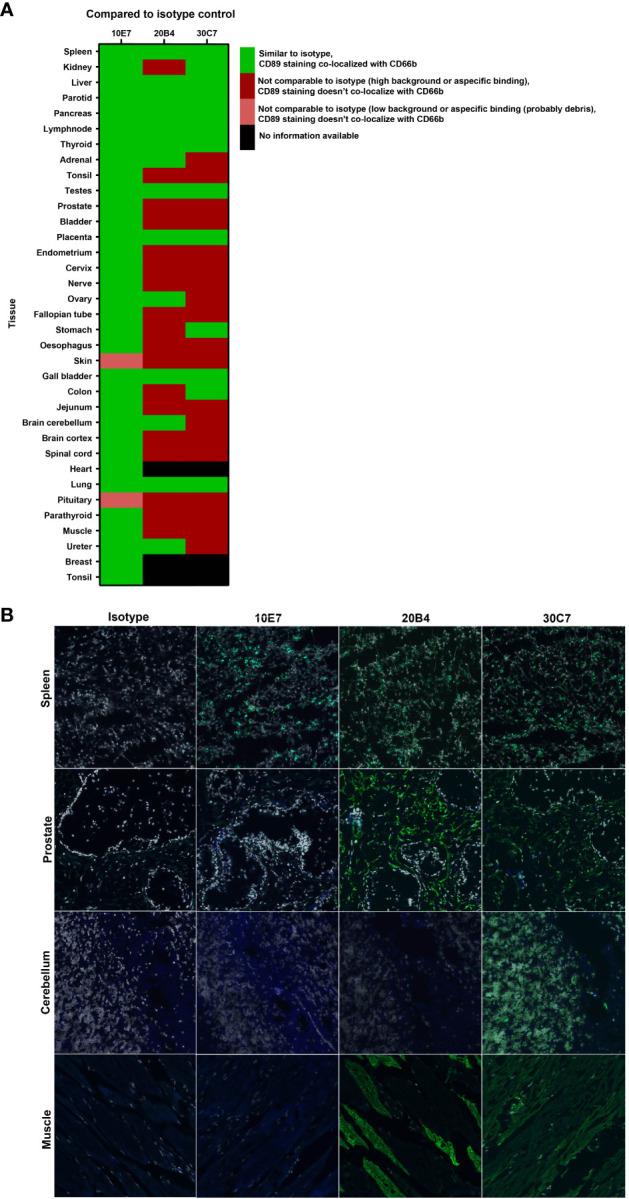
Our results show that all generated anti-CD89 mAbs bound surface CD89 on neutrophils. Although these anti-CD89 mAbs bind to different epitopes on EC1 of CD89, they all have the capacity to inhibit IgA-mediated phagocytosis, neutrophil extracellular trap (NET) release and neutrophil migration. Moreover, IgA mediated leukotriene B4 and lactoferrin release are decreased in supernatant from anti-CD89 mAbs-treated neutrophils. Finally, anti-CD89 mAb clone 10E7, that was selected based on its selective binding profile on tissue micro arrays, reduced anti-mouse collagen XVII hIgA-induced neutrophil influx in an in vivo linear IgA bullous disease (LABD) mice model.
CONCLUSION
This study clearly indicates that our newly developed anti-CD89 mAbs inhibited IgA-induced neutrophil activation and reduced anti-autoantigen IgA-induced neutrophil influx in vivo, supporting further clinical development for the treatment of LABD.
简介
免疫球蛋白 A(IgA)主要被认为是黏膜部位的非炎症调节因子。然而,我们小组之前的工作表明,IgA 也可能参与疾病病理过程,因为它在交联表面 CD89(FcaRI)后为激活中性粒细胞提供了一个有力的刺激,导致慢性炎症和组织损伤。IgA(自身)抗体和中性粒细胞是各种疾病的关键参与者,包括水疱性皮肤病和类风湿关节炎。因此,我们生成了一系列抗 CD89 单克隆抗体(mAbs),用于靶向 CD89 的治疗。研究了新开发的抗人 CD89 mAbs 的生物学活性及其潜在的治疗能力。
方法
从肝素化的健康供体血液中分离人中性粒细胞。通过流式细胞术研究抗 CD89 mAbs 与人中性粒细胞结合的能力。此外,研究了这些抗 CD89 mAbs 抑制 IgA 介导的吞噬作用、中性粒细胞胞外陷阱(NET)释放和迁移的能力。为此,用/不用抗 CD89 mAb 预孵育中性粒细胞,然后用 IgA 包被的珠刺激它们。随后分析吞噬的珠的数量、NET 释放和迁移的中性粒细胞。同时,测定趋化性白细胞三烯 B4 和乳铁蛋白(作为脱颗粒的衡量标准)的释放。最后,在抗小鼠胶原 XVII 人 IgA 处理的转基因 CD89 小鼠(自身免疫性线性 IgA 大疱性皮肤病(LABD)的临床前模型)中体内测试了我们原型抗 CD89 mAb 克隆 10E7 的治疗潜力。
结果
我们的结果表明,所有生成的抗 CD89 mAbs 均与中性粒细胞表面的 CD89 结合。尽管这些抗 CD89 mAbs 结合 CD89 的 EC1 上的不同表位,但它们都具有抑制 IgA 介导的吞噬作用、中性粒细胞胞外陷阱(NET)释放和中性粒细胞迁移的能力。此外,IgA 介导的白细胞三烯 B4 和乳铁蛋白释放减少上清液中的抗 CD89 mAb 处理的中性粒细胞。最后,基于其在组织微阵列上的选择性结合谱选择的抗 CD89 mAb 克隆 10E7,减少了体内抗小鼠胶原 XVII hIgA 诱导的中性粒细胞浸润在自身免疫性线性 IgA 大疱性皮肤病(LABD)小鼠模型中。
结论
这项研究清楚地表明,我们新开发的抗 CD89 mAbs 抑制了 IgA 诱导的中性粒细胞活化,并减少了体内抗自身抗原 IgA 诱导的中性粒细胞浸润,支持进一步的临床开发用于治疗 LABD。


 Zotero 插件