
脑膜炎奈瑟菌尿道株簇获得淋病奈瑟菌 AniA-NorB 途径,赋予其泌尿生殖道适应的反硝化和微需氧呼吸优势。
Acquisition of Gonococcal AniA-NorB Pathway by the Neisseria meningitidis Urethritis Clade Confers Denitrifying and Microaerobic Respiration Advantages for Urogenital Adaptation.
机构信息
Division of Infectious Diseases, Department of Medicine, Emory University School of Medicine, Atlanta, Georgia, USA.
Department of Biology, University of York, Heslington, York, United Kingdom.
出版信息
Infect Immun. 2023 May 16;91(5):e0007923. doi: 10.1128/iai.00079-23. Epub 2023 Apr 24.
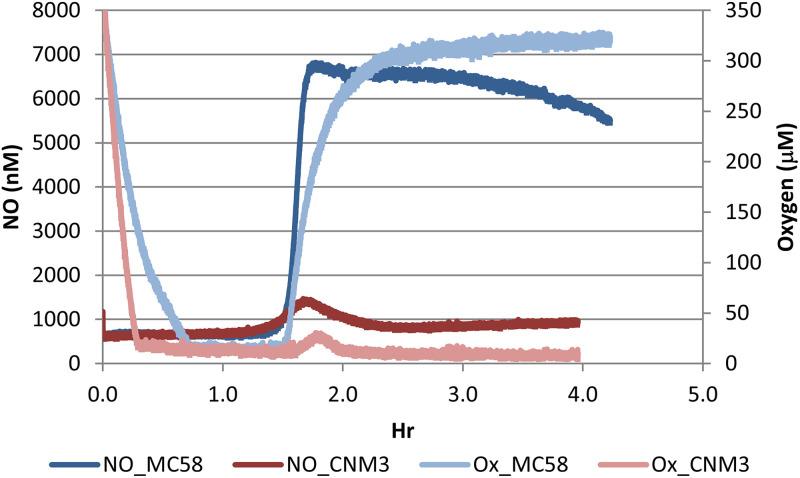
Neisseria meningitidis historically has been an infrequent and sporadic cause of urethritis and other urogenital infections. However, a nonencapsulated meningococcal clade belonging to the hyperinvasive clonal complex 11.2 lineage has recently emerged and caused clusters of urethritis cases in the United States and other countries. One of the genetic signatures of the emerging N. meningitidis urethritis clade (UC) is a chromosomal gene conversion event resulting in the acquisition of the Neisseria gonorrhoeae denitrification apparatus-the N. gonorrhoeae alleles encoding the nitrite reductase AniA, the nitric oxide (NO) reductase NorB, and the intergenic promoter region. The biological importance of the N. gonorrhoeae AniA-NorB for adaptation of the UC to a new environmental niche is investigated herein. We found that oxygen consumption, nitrite utilization, and NO production were significantly altered by the conversion event, resulting in different denitrifying aerobic and microaerobic growth of the clade. Further, transcription of and in UC isolates differed from canonical N. meningitidis, and important polymorphisms within the intergenic region, which influenced promoter activity of the UC, were identified. The contributions of three known meningococcal regulators (NsrR, FNR, and NarQP) in controlling the denitrification pathway and endogenous NO metabolism were distinct. Overall, transcription of was dampened relative to canonical N. meningitidis, and this correlated with the lower NO accumulation in the clade. Denitrification and microaerobic respiration were bolstered, and protection against host-derived NO was likely enhanced. The acquisition of the N. gonorrhoeae denitrification pathway by the UC supports the clade's adaptation and survival in a microaerobic urogenital environment.
脑膜炎奈瑟菌历史上是尿道炎症和其他泌尿生殖系统感染的罕见和散发性原因。然而,最近出现了一种无荚膜的脑膜炎奈瑟菌分支,属于高侵袭性克隆复合体 11.2 谱系,导致了美国和其他国家的尿道炎症病例群。新兴的脑膜炎奈瑟菌尿道炎症分支(UC)的遗传特征之一是染色体基因转换事件,导致获得淋病奈瑟菌脱硝装置-淋病奈瑟菌编码亚硝酸盐还原酶 AniA、一氧化氮(NO)还原酶 NorB 和基因间启动子区域的等位基因。本文研究了淋病奈瑟菌 AniA-NorB 对 UC 适应新环境小生境的生物学重要性。我们发现,转换事件显著改变了氧消耗、亚硝酸盐利用和 NO 产生,导致该分支的不同脱硝需氧和微需氧生长。此外,UC 分离株中 和 的转录与典型的脑膜炎奈瑟菌不同,并且在影响 UC 基因间区域启动子活性的重要多态性被鉴定出来。三个已知的脑膜炎奈瑟菌调节剂(NsrR、FNR 和 NarQP)在控制脱硝途径和内源性 NO 代谢中的作用是不同的。总的来说,相对于典型的脑膜炎奈瑟菌, 的转录被抑制,这与该分支中 NO 积累量较低有关。脱硝和微需氧呼吸得到增强,并且可能增强了对宿主来源的 NO 的保护。UC 获得淋病奈瑟菌脱硝途径支持该分支在微需氧泌尿生殖环境中的适应和生存。


 Zotero 插件