
非综合征性唇裂和/或腭裂患者的流行病学和时空描述性分析:伊朗南部 12 年回顾性研究。
Epidemiological and Spatiotemporal Descriptive Analysis of Patients with Nonsyndromic Cleft Lip and/or Palate: A 12-Year Retrospective Study in Southern Iran.
机构信息
Orthodontic Research Center, School of Dentistry, Shiraz University of Medical Sciences, Shiraz, Iran.
Student Research Committee, Shiraz University of Medical Sciences, Shiraz, Iran.
出版信息
Biomed Res Int. 2023 Apr 19;2023:7624875. doi: 10.1155/2023/7624875. eCollection 2023.
OBJECTIVES
The current study is aimed at evaluating epidemiological characteristics and spatiotemporal distribution of cleft lip and/or palate (CL/P) in the south of Iran.
METHODS
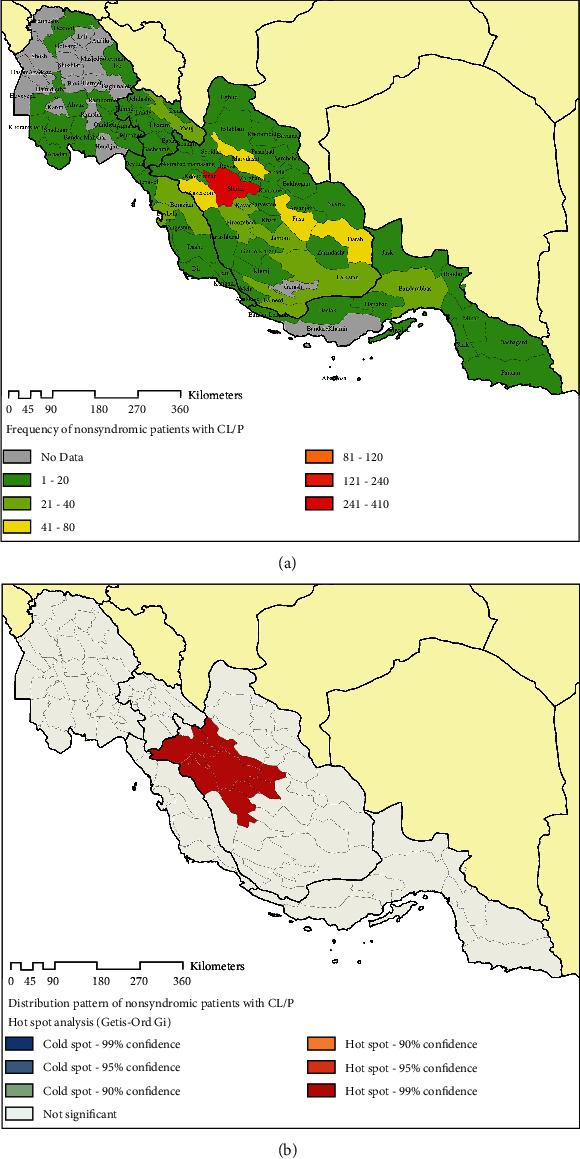
Data were extracted from the 1840 medical records of patients who were referred to the Cleft Lip and Palate Center of Shiraz University of Medical Sciences, from January 1, 2011, to September 1, 2022. The collected variables included demographic data (gender, birth date and season, place, birth order, and weight), cleft types and the subtypes, parental information (health status, education level, marital status, and age during the pregnancy), and other basic parameters. The chi-square test at a significance level of 0.05 was used to analyze collected data. The geographic information system (GIS) analysis was also used for analyzing the spatial distribution of CL/P patients.
RESULTS
Based on our inclusion criteria, 1281 nonsyndromic patients were included in this study. The most common type was cleft lip and palate (CLP) with 48.32%, whereas cleft palate (CP) and cleft lip (CL) accounted for 40.75% and 10.93% of the patients, respectively. There was a progressive increase in the frequency of all types of clefts, and most of them were male ( ≤ 0.001). The urban population outnumbered the rural ones in all provinces. Parents were mostly healthy (>80%) with low educational status (47.5%). Most born CL/P patients were from consanguineous marriages (58.9%), especially between first-degree relatives. A majority of CL/P patients (73.1%) were born in the first two gestations with a birth weight of 2500-4000 g (77.4%). Most infants with CL/P (84.3%) were born from mothers who had at least one of the predisposing factors.
CONCLUSION
In this study, the frequency of cleft types and subtypes was similar to the existing literature. However, high rate of consanguineous marriage, especially between first-degree relatives, was the most notable feature of this population.
目的
本研究旨在评估伊朗南部唇腭裂(CL/P)的流行病学特征和时空分布。
方法
本研究从 2011 年 1 月 1 日至 2022 年 9 月 1 日,从 Shiraz 大学医学科学唇腭裂中心的 1840 份病历中提取数据。收集的变量包括人口统计学数据(性别、出生日期和季节、地点、出生顺序和体重)、唇腭裂类型和亚型、父母信息(健康状况、教育水平、婚姻状况和怀孕期间的年龄)和其他基本参数。采用卡方检验(显著性水平为 0.05)对收集的数据进行分析。还使用地理信息系统(GIS)分析来分析 CL/P 患者的空间分布。
结果
根据我们的纳入标准,本研究纳入了 1281 例非综合征患者。最常见的类型是唇腭裂(CLP),占 48.32%,而腭裂(CP)和唇裂(CL)分别占 40.75%和 10.93%。所有类型的唇腭裂频率均呈递增趋势,且大多数为男性(≤0.001)。所有省份的城市人口均多于农村人口。父母大多健康(>80%),受教育程度低(47.5%)。大多数唇腭裂患儿(58.9%)来自近亲婚姻,尤其是一级亲属之间。大多数唇腭裂患儿(73.1%)出生于头两个孕期,出生体重为 2500-4000g(77.4%)。大多数患有唇腭裂的婴儿(84.3%)的母亲至少有一种易感因素。
结论
在本研究中,唇腭裂类型和亚型的频率与现有文献相似。然而,近亲,尤其是一级亲属之间的高比例的近亲婚姻是该人群最显著的特征。




 Zotero 插件