
新型趋化因子受体家族配体及其孤儿受体的鉴定——生理和临床相关性。
New pairings and deorphanization among the atypical chemokine receptor family - physiological and clinical relevance.
机构信息
Immuno-Pharmacology and Interactomics,Department of Infection and Immunity, Luxembourg Institute of Health, Esch-sur-Alzette, Luxembourg.
Faculty of Science, Technology and Medicine, University of Luxembourg, Esch-sur-Alzette, Luxembourg.
出版信息
Front Immunol. 2023 Apr 20;14:1133394. doi: 10.3389/fimmu.2023.1133394. eCollection 2023.
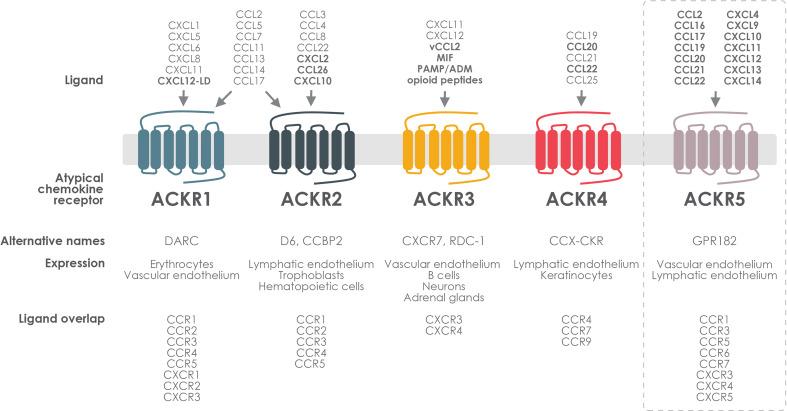
Atypical chemokine receptors (ACKRs) form a small subfamily of receptors (ACKR1-4) unable to trigger G protein-dependent signaling in response to their ligands. They do, however, play a crucial regulatory role in chemokine biology by capturing, scavenging or transporting chemokines, thereby regulating their availability and signaling through classical chemokine receptors. ACKRs add thus another layer of complexity to the intricate chemokine-receptor interaction network. Recently, targeted approaches and screening programs aiming at reassessing chemokine activity towards ACKRs identified several new pairings such as the dimeric CXCL12 with ACKR1, CXCL2, CXCL10 and CCL26 with ACKR2, the viral broad-spectrum chemokine vCCL2/vMIP-II, a range of opioid peptides and PAMP-12 with ACKR3 as well as CCL20 and CCL22 with ACKR4. Moreover, GPR182 (ACKR5) has been lately proposed as a new promiscuous atypical chemokine receptor with scavenging activity notably towards CXCL9, CXCL10, CXCL12 and CXCL13. Altogether, these findings reveal new degrees of complexity of the chemokine network and expand the panel of ACKR ligands and regulatory functions. In this minireview, we present and discuss these new pairings, their physiological and clinical relevance as well as the opportunities they open for targeting ACKRs in innovative therapeutic strategies.
非典型趋化因子受体(ACKR)形成了一个受体(ACKR1-4)的小亚家族,它们不能对其配体产生依赖 G 蛋白的信号转导。然而,它们通过捕获、清除或转运趋化因子,在趋化因子生物学中发挥着至关重要的调节作用,从而调节其通过经典趋化因子受体的可用性和信号转导。因此,ACKR 为复杂的趋化因子-受体相互作用网络增加了另一层复杂性。最近,针对 ACKR 的重新评估趋化因子活性的靶向方法和筛选计划,确定了一些新的配对,例如二聚体 CXCL12 与 ACKR1、CXCL2、CXCL10 和 CCL26 与 ACKR2、广谱病毒趋化因子 vCCL2/vMIP-II、一系列阿片肽和 PAMP-12 与 ACKR3 以及 CCL20 和 CCL22 与 ACKR4。此外,GPR182(ACKR5)最近被提议为一种新的非典型趋化因子受体,具有明显的趋化因子清除活性,特别是针对 CXCL9、CXCL10、CXCL12 和 CXCL13。总的来说,这些发现揭示了趋化因子网络的新的复杂性,并扩展了 ACKR 配体和调节功能的范围。在这篇综述中,我们介绍和讨论了这些新的配对、它们的生理和临床相关性以及它们为在创新治疗策略中靶向 ACKR 提供的机会。

 Zotero 插件