
透析诊所与医院中心之间的协作模式可提高血液透析患者血管通路护理及干预的质量。
A collaborative model between dialysis clinics and a hospital center improves the quality of vascular access care and intervention for hemodialysis patients.
作者信息
Wu Chung-Kuan, Fang Yu-Wei, Lin Chia-Hsun
机构信息
Division of Nephrology, Shin Kong Wu Ho-Su Memorial Hospital, Taipei, Taiwan.
Dialysis Access Management Center, Shin Kong Wu Ho-Su Memorial Hospital, Taipei, Taiwan.
出版信息
Kidney Res Clin Pract. 2024 Mar;43(2):216-225. doi: 10.23876/j.krcp.22.175. Epub 2023 May 11.
BACKGROUND
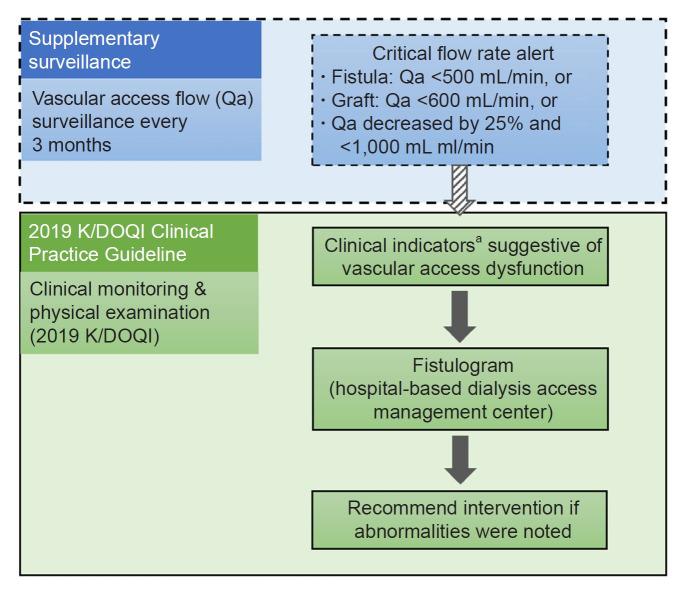
This study reports the outcomes of a collaborative program between dialysis clinics and a referral hospital, which consisted of clinical monitoring and supplementary routine surveillance, for improving the quality of vascular access care.
METHODS
This retrospective observational study was performed at five dialysis clinics as part of a 2-year collaborative program (2019-2020) in conjunction with a hospital-based dialysis access management center. A total of 392 hemodialysis patients (arteriovenous fistula [AVF], n = 339 and arteriovenous graft [AVG], n = 53) were included. Outcome measures included the prognosis of vascular access, clinic satisfaction, and referral rate to the hospital.
RESULTS
Increased vascular access flow was observed and critical flow events decreased from the first to the second year (AVF: 18.3% vs. 12.7%, p < 0.001; AVG: 26.2% vs. 20.1%, p = 0.30). There were fewer percutaneous transluminal angioplasty events in the AVG group (0.77 per person-year vs. 0.51 per person-year, p = 0.005). New AVF or AVG creation events also remained low. All dialysis clinics were satisfied with the program. The overall referral rate from the participating clinics increased (65.7% vs. 72.0%) during the study period independently of the physical distance between the dialysis clinic and the hospital.
CONCLUSION
The collaboration between dialysis clinics and a referral hospital for improving the quality of vascular access care was successful in this study, and the model can be used by other clinics and hospitals looking to improve care coordination in dialysis patients.
背景
本研究报告了透析诊所与一家转诊医院之间合作项目的成果,该项目包括临床监测和补充常规监测,旨在提高血管通路护理质量。
方法
这项回顾性观察研究在五家透析诊所进行,作为一项为期两年(2019 - 2020年)的合作项目的一部分,该项目与一家医院的透析通路管理中心联合开展。共纳入392例血液透析患者(动静脉内瘘[AVF],n = 339例;动静脉移植物[AVG],n = 53例)。结局指标包括血管通路的预后、诊所满意度以及转诊至医院的比率。
结果
观察到血管通路血流量增加,从第一年到第二年关键血流事件减少(AVF:18.3%对12.7%,p < 0.001;AVG:26.2%对20.1%,p = 0.30)。AVG组经皮腔内血管成形术事件较少(0.77人次/年对0.51人次/年,p = 0.005)。新的AVF或AVG创建事件也保持在较低水平。所有透析诊所对该项目都很满意。在研究期间,参与诊所的总体转诊率有所提高(65.7%对72.0%),且与透析诊所和医院之间的实际距离无关。
结论
在本研究中,透析诊所与转诊医院之间为提高血管通路护理质量而开展的合作取得了成功,该模式可供其他希望改善透析患者护理协调的诊所和医院使用。



 Zotero 插件