
通过激活Toll样受体2(TLR2)、Toll样受体4(TLR4)和NLRP3炎性小体信号通路,增加奶牛嗜中性粒细胞中前列腺素E的分泌。
increases Prostaglandin E secretion in cow neutrophils by activating TLR2, TLR4, and NLRP3 inflammasome signaling pathways.
作者信息
Zhang Kai, Jia Yan, Qian Yinghong, Jiang Xueying, Zhang Shuangyi, Liu Bo, Cao Jinshan, Song Yongli, Mao Wei
机构信息
College of Veterinary Medicine, Inner Mongolia Agricultural University, Huhhot, China.
Key Laboratory of Animal Clinical Treatment Technology, Ministry of Agriculture, Huhhot, China.
出版信息
Front Microbiol. 2023 Apr 24;14:1163261. doi: 10.3389/fmicb.2023.1163261. eCollection 2023.
INTRODUCTION
In clinical settings, dairy cows are often attacked by pathogenic bacteria after delivery, especially (). Neutrophils have long been regarded as essential for host defense against . Prostaglandin E (PGE) can additionally be used as an inflammatory mediator in pathological conditions to promote the repair of inflammatory injuries. However, whether can promote the accumulation of PGE after the infection of neutrophils in cows and its mechanism remain unclear. Lipoprotein is an important immune bioactive ingredient of .
METHODS
In this study, the changes in neutrophils were monitored in dairy cows infected with wild-type (SA113) and an lipoprotein-deficient strain (Δ); meanwhile, we established whether pattern recognition receptors mediate this process and whether lipoproteins are necessary for causing the release of PGE from cow neutrophils.
RESULTS
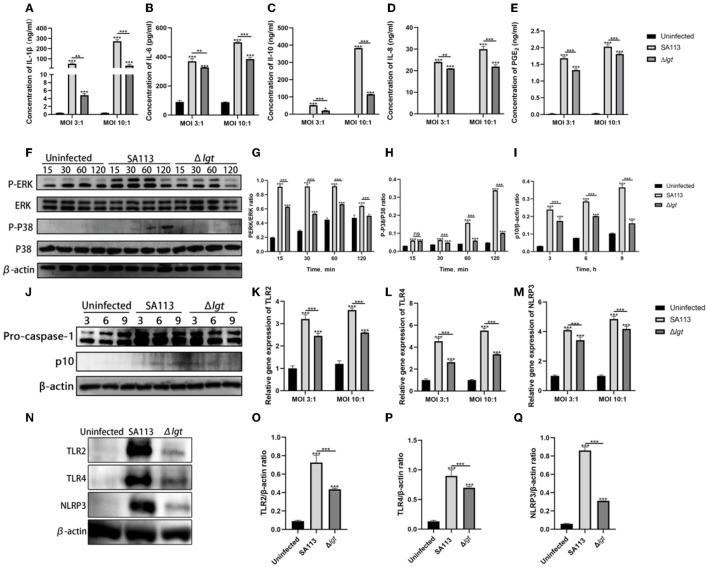
The results showed that Δ was less effective than SA113 in inducing the production of IL-1β, IL-6, IL-8, IL-10, and PGE within neutrophils; furthermore, TLR2, TLR4, and NLRP3 receptors were found to mediate the inducible effect of lipoprotein on the above inflammation mediators and cytokines, which depended on MAPK and Caspase-1 signaling pathways. In addition, TLR2, TLR4, and NLRP3 inhibitors significantly inhibited PGE and cytokine secretion, and PGE was involved in the interaction of and neutrophils in dairy cows, which could be regulated by TLR2, TLR4, and NLRP3 receptors. We also found that was more likely to be killed by neutrophils when it lacked lipoprotein and TLR2, TLR4, and NLRP3 were involved, but PGE seemed to have no effect.
DISCUSSION
Taken together, these results suggest that lipoprotein is a crucial component of in inducing cytokine secretion by neutrophils as well as killing within neutrophils, which could be accomplished by the accumulation of PGE by activating MAPK and the Caspase-1 signaling pathways through TLR2, TLR4, and NLRP3 receptors. These results will contribute to a better understanding of the interaction between and host immune cells in dairy cows.
引言
在临床环境中,奶牛产后常受到病原菌侵袭,尤其是(此处原文缺失具体内容)。长期以来,中性粒细胞被认为是宿主抵御(此处原文缺失具体内容)的关键因素。前列腺素E(PGE)在病理状态下还可作为炎症介质促进炎症损伤的修复。然而,(此处原文缺失具体内容)感染奶牛中性粒细胞后是否能促进PGE的积累及其机制尚不清楚。脂蛋白是(此处原文缺失具体内容)的一种重要免疫生物活性成分。
方法
在本研究中,监测感染野生型(SA113)和脂蛋白缺陷菌株(Δ)的奶牛中性粒细胞的变化;同时,我们确定模式识别受体是否介导这一过程以及脂蛋白是否是奶牛中性粒细胞释放PGE所必需的。
结果
结果表明,Δ在诱导中性粒细胞内IL-β、IL-6、IL-8、IL-10和PGE产生方面比SA113效果更差;此外,发现Toll样受体2(TLR2)、Toll样受体4(TLR4)和NLR家族含pyrin结构域蛋白3(NLRP3)受体介导脂蛋白对上述炎症介质和细胞因子的诱导作用,这依赖于丝裂原活化蛋白激酶(MAPK)和半胱天冬酶-1(Caspase-1)信号通路。此外,TLR2、TLR4和NLRP3抑制剂显著抑制PGE和细胞因子分泌,且PGE参与了奶牛中(此处原文缺失具体内容)与中性粒细胞的相互作用,这可由TLR2、TLR4和NLRP3受体调节。我们还发现,当(此处原文缺失具体内容)缺乏脂蛋白且涉及TLR2、TLR4和NLRP3时,其更易被中性粒细胞杀灭,但PGE似乎无作用。
讨论
综上所述,这些结果表明脂蛋白是(此处原文缺失具体内容)诱导中性粒细胞分泌细胞因子以及在中性粒细胞内杀灭(此处原文缺失具体内容)的关键成分,这可通过TLR2、TLR4和NLRP3受体激活MAPK和Caspase-1信号通路使PGE积累来实现。这些结果将有助于更好地理解奶牛中(此处原文缺失具体内容)与宿主免疫细胞之间的相互作用。



 Zotero 插件