
将科技产品用作助眠手段:青少年是否在使用应用程序来分散自己对负面想法的注意力?
Technology use as a sleep-onset aid: are adolescents using apps to distract themselves from negative thoughts?
作者信息
Daniels Alexandra, Pillion Meg, Rullo Benita, Mikulcic Jessica, Whittall Hannah, Bartel Kate, Kahn Michal, Gradisar Michael, Bauducco Serena V
机构信息
College of Education, Psychology & Social Work, Flinders University, Adelaide, Australia.
WINK Sleep, Adelaide, Australia.
出版信息
Sleep Adv. 2022 Dec 22;4(1):zpac047. doi: 10.1093/sleepadvances/zpac047. eCollection 2023.
STUDY OBJECTIVES
The aim of this study was to; (1) explore whether adolescents use technology as distraction from negative thoughts before sleep, (2) assess whether adolescents who perceive having a sleep problem use technology as distraction more compared to adolescents without sleep complaints, and (3) collect qualitative information about which devices and apps adolescents use as a distraction.
METHODS
This study used a mixed-methods cross-sectional design, where 684 adolescents ( = 15.1, = 1.2, 46% female) answered both quantitative and qualitative questions about their sleep (perceived sleep problem, sleep onset time (SOT), and sleep onset latency [SOL]) and technology use as distraction from negative thoughts.
RESULTS
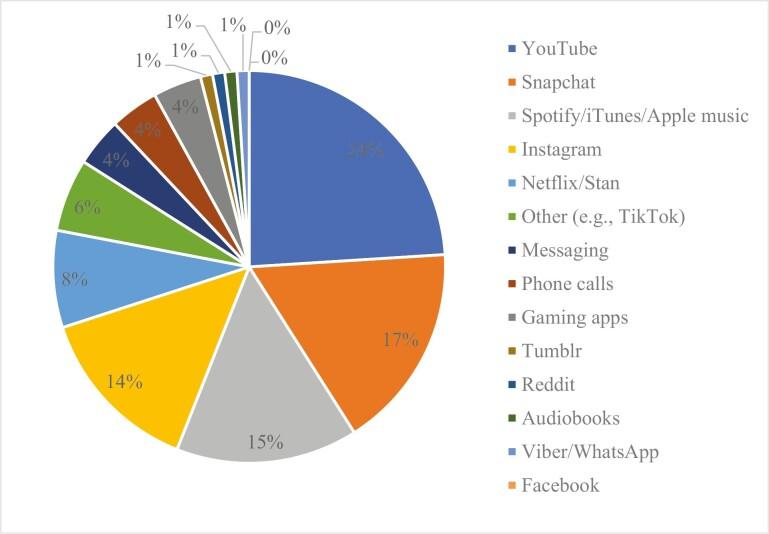
The majority of adolescents answered "yes" or "sometimes" using technology as a distraction from negative thoughts (23.6% and 38.4%). Adolescents who answered "yes" to using technology as distraction were more likely to report having a sleep problem, longer SOL, and later SOT, compared to adolescents who answered "no". The most popular device to distract was the phone, because of its availability, and the most common apps used for distraction included YouTube, Snapchat, and music apps.
CONCLUSIONS
This study shows that many adolescents use technology to distract themselves from negative thoughts, which may help them manage the sleep-onset process. Thus, distraction may be one mechanism explaining how sleep affects technology use, rather than vice versa.
研究目的
本研究旨在;(1)探讨青少年睡前是否使用科技产品来分散对负面想法的注意力,(2)评估与没有睡眠问题的青少年相比,认为自己有睡眠问题的青少年是否更多地使用科技产品来分散注意力,以及(3)收集关于青少年用作分散注意力的设备和应用程序的定性信息。
方法
本研究采用混合方法横断面设计,684名青少年(平均年龄 = 15.1岁,标准差 = 1.2岁,46%为女性)回答了关于他们的睡眠(感知到的睡眠问题、入睡时间[SOT]和入睡潜伏期[SOL])以及用作分散对负面想法注意力的科技产品使用情况的定量和定性问题。
结果
大多数青少年回答“是”或“有时”会使用科技产品来分散对负面想法的注意力(分别为23.6%和38.4%)。与回答“否”的青少年相比,回答“是”使用科技产品来分散注意力的青少年更有可能报告有睡眠问题、更长的SOL和更晚的SOT。最常用于分散注意力的设备是手机,因为其便利性,最常用于分散注意力的应用程序包括YouTube、Snapchat和音乐应用程序。
结论
本研究表明,许多青少年使用科技产品来分散自己对负面想法的注意力,这可能有助于他们入睡。因此,分散注意力可能是解释睡眠如何影响科技产品使用的一种机制,而不是相反。

 Zotero 插件