
接受经导管生物瓣衰败后三尖瓣瓣中瓣置换术患者的中长期超声心动图随访:伊朗首个单中心报告
Mid to Long-Term Echocardiographic Follow-up of Patients Undergoing Transcatheter Tricuspid Valve-in-Valve Replacement for Degenerated Bioprosthetic Valves: First Single-Center Report from Iran.
作者信息
Sahebjam Mohammad, Haji Zeinali Alimohammad, Abbasi Kyomars, Borjian Solmaz
机构信息
Tehran Heart Center, Tehran University of Medical Sciences, Tehran, Iran.
出版信息
J Tehran Heart Cent. 2022 Jul;17(3):112-118. doi: 10.18502/jthc.v17i3.10843.
BACKGROUND
Transcatheter tricuspid valve-in-valve (TTViV) replacement has become an alternative treatment in high-risk patients with bioprosthetic valve degeneration. This is the first report on the mid to long-term echocardiographic findings of patients who underwent TTViV replacement in a cardiac referral center in Iran.
METHODS
Data of 12 patients, consisting of 11 women and 1 man, who underwent TTViV replacement between 2015 and 2021 were reviewed retrospectively. The patients underwent echocardiography before the procedure and at a mean follow-up time of 3.17±1.75 years.
RESULTS
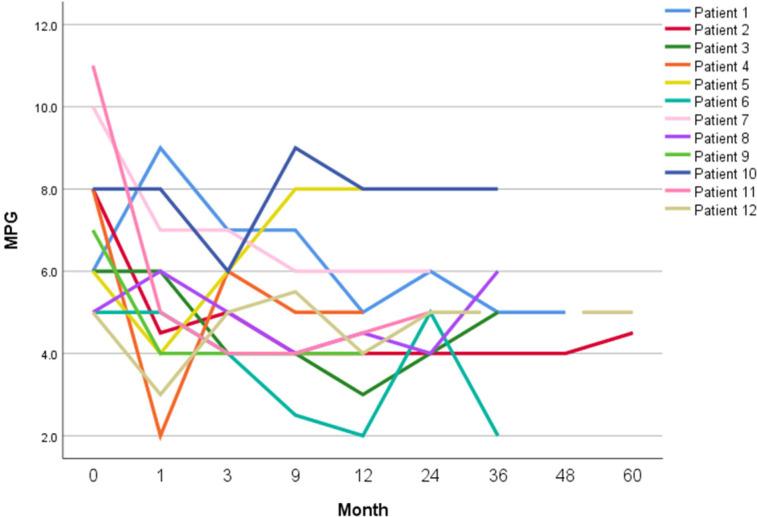
All the patients had New York Heart Association (NYHA) function class III/IV before TTViV. Six patients had tricuspid regurgitation, 1 had tricuspid stenosis, and 5 had both. All the patients had successful TTViV. The mean time from the initial valve surgery to TTViV was 6.25±2.45 years. At follow-up, 2 patients had died: 1 due to COVID-19 pneumonia and 1 without a known cause. The remaining 10 patients experienced improvements in the NYHA functional class. Echocardiographic measures showed significant improvements. Transvalvular mean gradient pressure decreased from 7.08±1.98 mm Hg to 5.29±1.63 mm Hg (P=0.028), tricuspid valve pressure half time decreased from 245.00±49.46 ms to 158.64±57.41 ms (P=0.011), tricuspid regurgitation gradient decreased from 39.91±7.31 mm Hg to 26.72±8.99 mm Hg, and left ventricular ejection fraction increased from 47.71±4.70% to 49.79±4.58% (P=0.046). There was no significant paravalvular or transvalvular leakage at follow-up.
CONCLUSION
This is a single-center report on the mid and long-term echocardiographic follow-up of patients after TTViV replacement. Our study showed that TTViV was a safe and efficient method in treating high-risk patients with degenerated bioprosthetic tricuspid valves and had favorable echocardiographic and clinical results.
背景
经导管三尖瓣瓣中瓣(TTViV)置换术已成为生物瓣退变高危患者的一种替代治疗方法。这是伊朗一家心脏转诊中心对接受TTViV置换术患者的中长期超声心动图检查结果的首份报告。
方法
回顾性分析了2015年至2021年间接受TTViV置换术的12例患者的数据,其中包括11名女性和1名男性。患者在手术前及平均随访3.17±1.75年时接受了超声心动图检查。
结果
所有患者在TTViV置换术前纽约心脏协会(NYHA)心功能分级均为III/IV级。6例患者有三尖瓣反流,1例有三尖瓣狭窄,5例两者均有。所有患者TTViV置换术均成功。从初次瓣膜手术到TTViV置换术的平均时间为6.25±2.45年。随访时,2例患者死亡:1例死于COVID-19肺炎,1例死因不明。其余10例患者NYHA心功能分级有所改善。超声心动图测量结果显示有显著改善。跨瓣平均梯度压力从7.08±1.98 mmHg降至5.29±1.63 mmHg(P=0.028),三尖瓣压力减半时间从245.00±49.46 ms降至158.6±57.41 ms(P=0.011),三尖瓣反流梯度从39.91±7.31 mmHg降至26.72±8.99 mmHg,左心室射血分数从47.71±4.70%升至49.79±4.58%(P=0.046)。随访时无明显瓣周或跨瓣漏。
结论
这是一份关于TTViV置换术后患者中长期超声心动图随访的单中心报告。我们的研究表明,TTViV是治疗生物瓣退变高危患者的一种安全有效的方法,具有良好的超声心动图和临床结果。

 Zotero 插件