
超声辅助提取对菜豆作物蛋白功能和生物学性质的修饰。
Modifications to functional and biological properties of proteins of cowpea pulse crop by ultrasound-assisted extraction.
机构信息
Food Processing Business Incubation Centre, National Institute of Food Technology, Entrepreneurship and Management, Thanjavur, India; College of Indigenous Food Technology, Council for Food Research and Development, Konni, Pathanamthitta, Kerala, India.
Food Processing Business Incubation Centre, National Institute of Food Technology, Entrepreneurship and Management, Thanjavur, India; Centre of Excellence in Non-Thermal Processing, National Institute of Food Technology, Entrepreneurship and Management, Thanjavur, India.
出版信息
Ultrason Sonochem. 2023 Jul;97:106448. doi: 10.1016/j.ultsonch.2023.106448. Epub 2023 May 23.
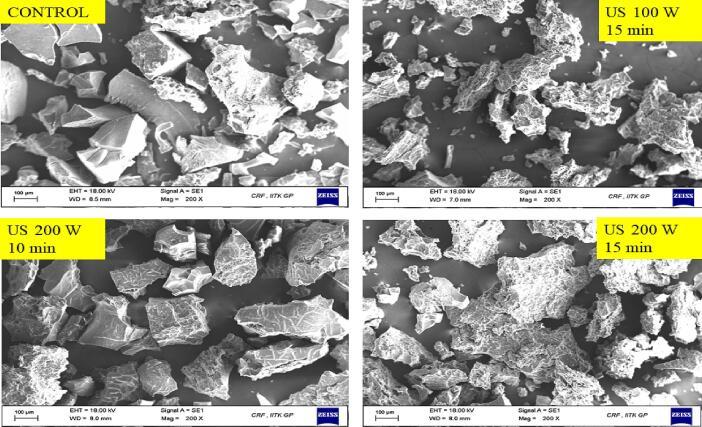
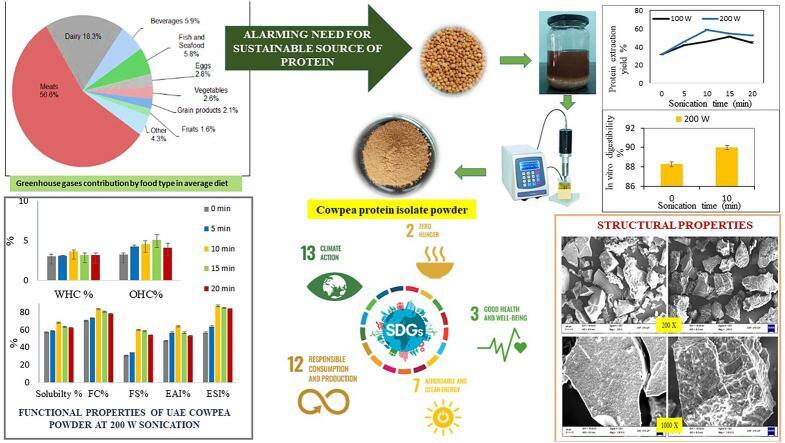
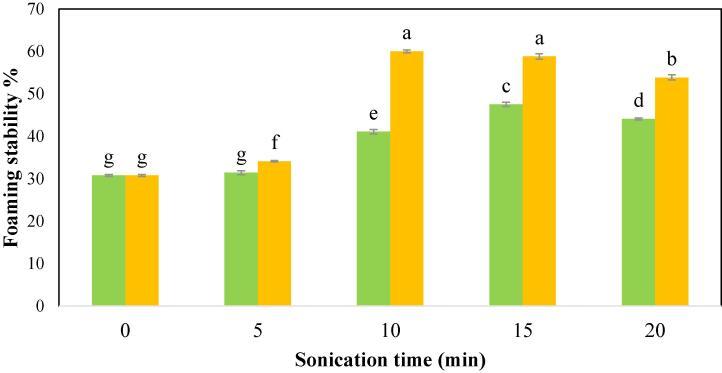
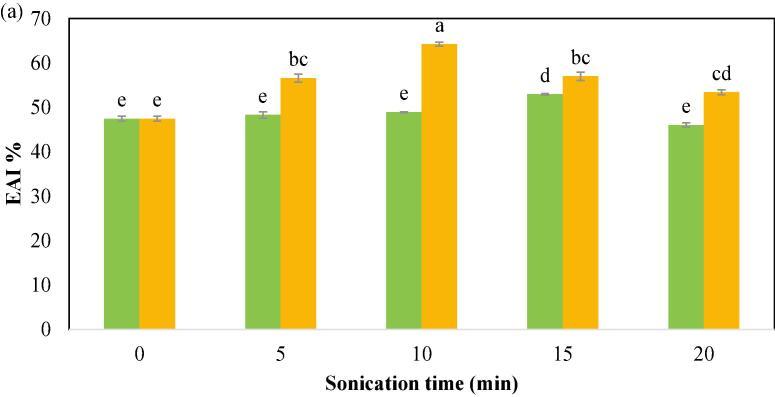
Natural resource depletion, negative environmental effects and the challenge to secure global food security led to the establishment of the Sustainable Development Goals (SDGs). In need to explore underutilized sustainable protein sources, this study aims at isolating protein from cowpea by ultrasound-assisted extraction (UAE), where the techno-functional characteristics of the protein isolates were studied at different sonication conditions i.e., 100 W and 200 W at processing times ranging from 5 to 20 min. The US at 200 W-10 min produced the optimal results for all properties. In this process combination, there was an increase in protein yield, solubility, water-holding capacity, foaming capacity and stability, emulsion activity and stability, zeta-potential, and in-vitro protein digestibility from 31.78% to 58.96%, 57.26% to 68.85%, 3.06 g/g to 3.68 g/g 70.64% to 83.74%, 30.76% to 60.01%, 47.48% to 64.26%, 56.59% to 87.71%, -32.9 mV to -44.2 mV and 88.27% to 89.99%, respectively and particle size dropped from 763 nm to 559 nm in comparison to control. The microstructure and secondary-structure alterations of proteins caused by sonication were validated by SEM images, SDS-PAGE, and FTIR analyses. Sonication leads to acoustic cavitation and penetrate the cell walls, improving extraction from the solid to liquid phase. After sonication, the hydrophobic protein groups were exposed and proteins were partially denatured which increased its functionality. The findings demonstrated that UAE of cowpea protein improved yield, modify characteristics to fit the needs of the food industry, and contribute to achieving SDGs 2, 3, 7, 12, and 13.
自然资源枯竭、负面环境影响以及确保全球粮食安全的挑战促使可持续发展目标 (SDGs) 的建立。为了探索未充分利用的可持续蛋白质来源,本研究旨在通过超声辅助提取 (UAE) 从豇豆中分离蛋白质,研究了不同超声条件(处理时间为 5-20 分钟,功率分别为 100W 和 200W)下蛋白质分离物的功能特性。在 200W-10 分钟的超声条件下,所有性质均达到最佳效果。在此过程组合中,蛋白质产率、溶解度、持水力、起泡能力和稳定性、乳化活性和稳定性、Zeta 电位和体外蛋白质消化率分别从 31.78%增加到 58.96%、57.26%增加到 68.85%、3.06g/g 增加到 3.68g/g、70.64%增加到 83.74%、30.76%增加到 60.01%、47.48%增加到 64.26%、56.59%增加到 87.71%、-32.9mV 增加到-44.2mV 和 88.27%增加到 89.99%,粒径从 763nm 减小到 559nm,与对照相比。通过 SEM 图像、SDS-PAGE 和 FTIR 分析验证了超声引起的蛋白质微观结构和二级结构的变化。超声导致声空化并穿透细胞壁,从而将提取从固相改善到液相。超声后,疏水性蛋白质基团暴露,蛋白质部分变性,从而提高了其功能。研究结果表明,豇豆蛋白的 UAE 提高了产量,改变了特性以满足食品工业的需求,并有助于实现可持续发展目标 2、3、7、12 和 13。




 Zotero 插件