Prakash Priya, Manchanda Palak, Paouri Evi, Bisht Kanchan, Sharma Kaushik, Rajpoot Jitika, Wendt Victoria, Hossain Ahad, Wijewardhane Prageeth R, Randolph Caitlin E, Chen Yihao, Stanko Sarah, Gasmi Nadia, Gjojdeshi Anxhela, Card Sophie, Fine Jonathan, Jethava Krupal P, Clark Matthew G, Dong Bin, Ma Seohee, Crockett Alexis, Thayer Elizabeth A, Nicolas Marlo, Davis Ryann, Hardikar Dhruv, Allende Daniela, Prayson Richard A, Zhang Chi, Davalos Dimitrios, Chopra Gaurav
Department of Chemistry, Purdue University, West Lafayette, IN 47907, USA.
Department of Neurosciences, Lerner Research Institute, Cleveland Clinic, Cleveland, OH 44106, USA.
bioRxiv. 2024 Dec 4:2023.06.04.543525. doi: 10.1101/2023.06.04.543525.
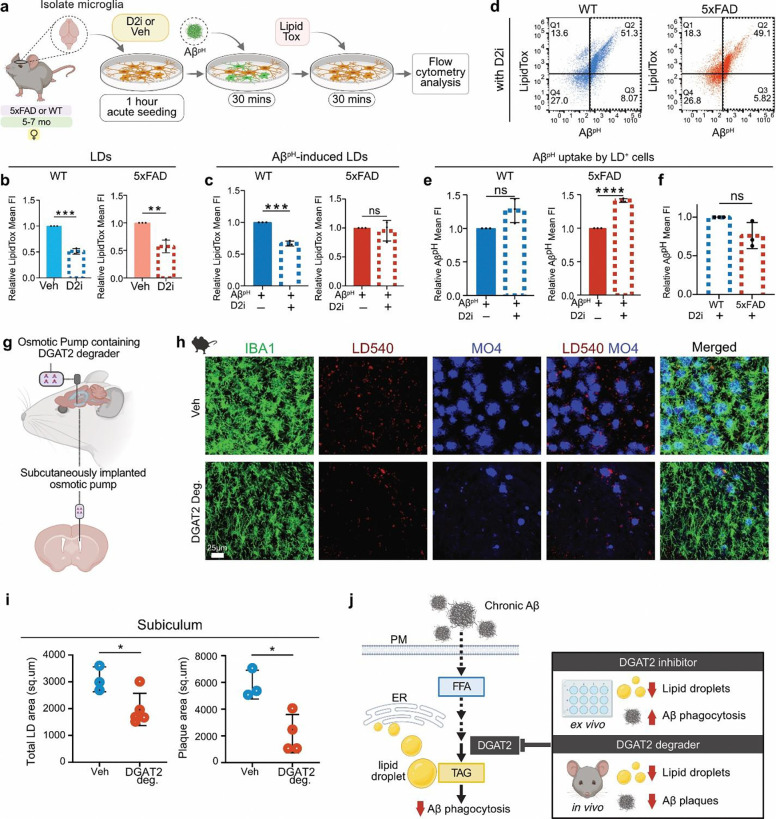
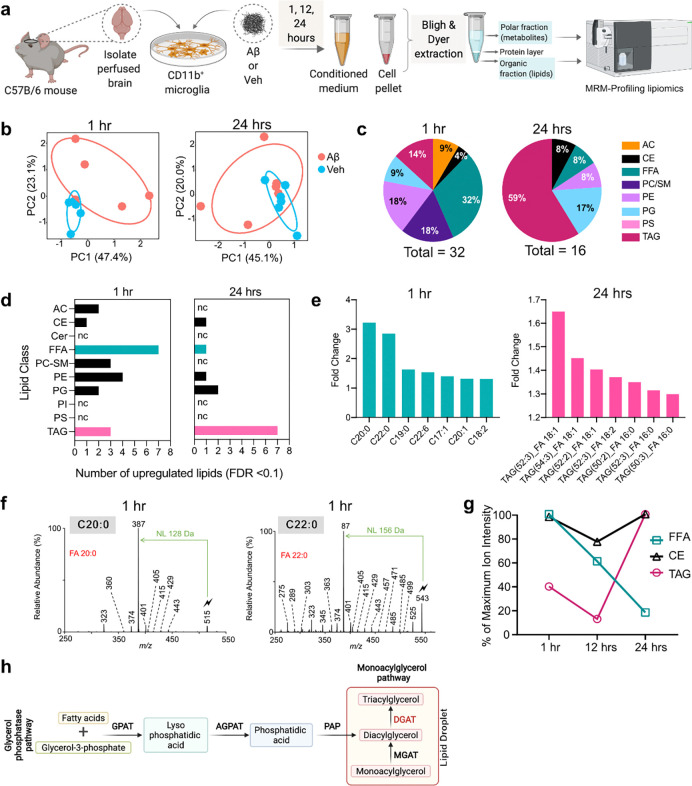
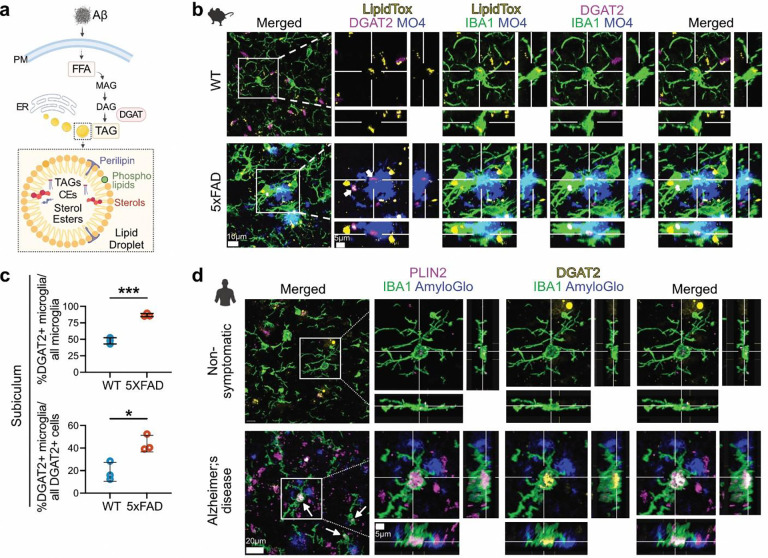
Several microglia-expressed genes have emerged as top risk variants for Alzheimer's disease (AD). Impaired microglial phagocytosis is one of the main proposed outcomes by which these AD-risk genes may contribute to neurodegeneration, but the mechanisms translating genetic association to cellular dysfunction remain unknown. Here we show that microglia form lipid droplets (LDs) upon exposure to amyloid-beta (Aβ), and that their LD load increases with proximity to amyloid plaques in brains from human patients and the AD mouse model 5xFAD. LD formation is dependent on age and disease progression and is prominent in the hippocampus in mice and humans. Despite differences in microglial LD load between brain regions and sexes in mice, LD-laden microglia exhibited a deficit in Aβ phagocytosis. Unbiased lipidomic analysis identified a decrease in free fatty acids (FFAs) and a parallel increase in triacylglycerols (TGs) as the key metabolic transition underlying LD formation. DGAT2, a key enzyme for converting FFAs to TGs, promotes microglial LD formation and is increased in 5xFAD and human AD brains. Inhibition or degradation of DGAT2 improved microglial uptake of Aβ and drastically reduced plaque load in 5xFAD mice, respectively. These findings identify a new lipid-mediated mechanism underlying microglial dysfunction that could become a novel therapeutic target for AD.
几种小胶质细胞表达的基因已成为阿尔茨海默病(AD)的主要风险变异体。小胶质细胞吞噬功能受损是这些AD风险基因可能导致神经退行性变的主要推测结果之一,但将基因关联转化为细胞功能障碍的机制仍不清楚。在这里,我们表明小胶质细胞在暴露于β淀粉样蛋白(Aβ)时会形成脂滴(LDs),并且在人类患者和AD小鼠模型5xFAD的大脑中,它们的LD负荷随着与淀粉样斑块的接近程度而增加。LD的形成取决于年龄和疾病进展,在小鼠和人类的海马体中尤为明显。尽管小鼠脑区和性别之间的小胶质细胞LD负荷存在差异,但富含LD的小胶质细胞在Aβ吞噬方面表现出缺陷。无偏脂质组学分析确定游离脂肪酸(FFAs)减少和甘油三酯(TGs)平行增加是LD形成的关键代谢转变。DGAT2是一种将FFAs转化为TGs的关键酶,它促进小胶质细胞LD的形成,并且在5xFAD和人类AD大脑中增加。分别抑制或降解DGAT2可改善小胶质细胞对Aβ的摄取,并显著降低5xFAD小鼠的斑块负荷。这些发现确定了一种新的脂质介导的小胶质细胞功能障碍机制,这可能成为AD的一个新的治疗靶点。