
嵌合抗原受体 T 细胞治疗滤泡性淋巴瘤患者后,利用可追踪突变的特定特征对循环肿瘤 DNA 进行个体化监测。
Personalized monitoring of circulating tumor DNA with a specific signature of trackable mutations after chimeric antigen receptor T-cell therapy in follicular lymphoma patients.
机构信息
Department of Hematology, Hospital Universitario 12 de Octubre, Instituto de Investigación Sanitaria Hospital 12 de Octubre (imas12), CNIO, CIBERONC, Madrid, Spain.
Altum sequencing Co., Madrid, Spain.
出版信息
Front Immunol. 2023 Jun 5;14:1188818. doi: 10.3389/fimmu.2023.1188818. eCollection 2023.
BACKGROUND
CART therapy has produced a paradigm shift in the treatment of relapsing FL patients. Strategies to optimize disease surveillance after these therapies are increasingly necessary. This study explores the potential value of ctDNA monitoring with an innovative signature of personalized trackable mutations.
METHOD
Eleven FL patients treated with anti-CD19 CAR T-cell therapy were included. One did not respond and was excluded. Genomic profiling was performed before starting lymphodepleting chemotherapy to identify somatic mutations suitable for LiqBio-MRD monitoring. The dynamics of the baseline mutations (4.5 per patient) were further analyzed on 59 cfDNA follow-up samples. PET/CT examinations were performed on days +90, +180, +365, and every six months until disease progression or death.
RESULTS
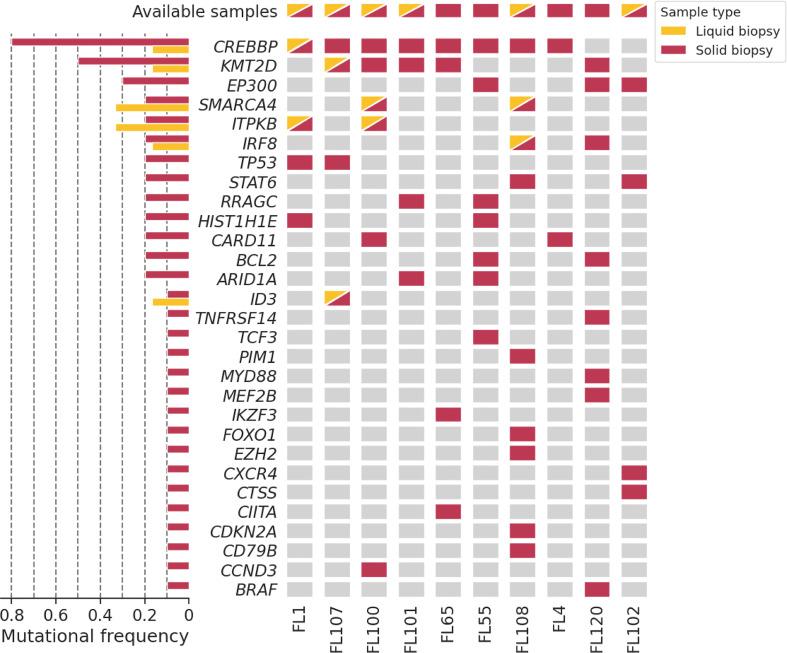
After a median follow-up of 36 months, all patients achieved a CR as the best response. Two patients progressed. The most frequently mutated genes were CREBBP, KMT2D and EP300. Simultaneous analysis of ctDNA and PET/CT was available for 18 time-points. When PET/CT was positive, two out of four ctDNA samples were LiqBio-MRD negative. These two negative samples corresponded to women with a unique mesenteric mass in two evaluations and never relapsed. Meanwhile, 14 PET/CT negative images were mutation-free based on our LiqBio-MRD analysis (100%). None of the patients had a negative LiqBio-MRD test by day +7. Interestingly, all durably responding patients had undetectable ctDNA at or around three months after infusion. Two patients presented discordant results by PET/CT and ctDNA levels. No progression was confirmed in these cases. All the progressing patients were LiqBio-MRD positive before progression.
CONCLUSION
This is a proof-of-principle for using ctDNA to monitor response to CAR T-cell therapy in FL. Our results confirm that a non-invasive liquid biopsy MRD analysis may correlate with response and could be used to monitor response. Harmonized definitions of ctDNA molecular response and pinpointing the optimal timing for assessing ctDNA responses are necessary for this setting. If using ctDNA analysis, we suggest restricting follow-up PET/CT in CR patients to a clinical suspicion of relapse, to avoid false-positive results.
背景
嵌合抗原受体 T 细胞(CART)疗法在复发性滤泡性淋巴瘤(FL)患者的治疗中带来了范式转变。越来越有必要制定策略来优化这些疗法后的疾病监测。本研究探讨了使用创新的个性化可追踪突变特征的 ctDNA 监测的潜在价值。
方法
纳入 11 例接受抗 CD19 CAR T 细胞治疗的 FL 患者。1 例无反应,被排除在外。在开始淋巴细胞清除化疗前进行基因组分析,以鉴定适合 LiqBio-MRD 监测的体细胞突变。进一步分析了 59 份 cfDNA 随访样本中的基线突变(每位患者 4.5 个)的动态。在第 90、180、365 天及第 6 个月进行 PET/CT 检查,直至疾病进展或死亡。
结果
中位随访 36 个月后,所有患者均获得最佳缓解的完全缓解。2 例患者进展。最常突变的基因是 CREBBP、KMT2D 和 EP300。ctDNA 和 PET/CT 的同步分析可获得 18 个时间点。当 PET/CT 阳性时,4 份 ctDNA 样本中有 2 份 LiqBio-MRD 阴性。这两个阴性样本对应于两名女性患者,她们在两次评估中均有独特的肠系膜肿块,且从未复发。同时,根据我们的 LiqBio-MRD 分析,14 个 PET/CT 阴性图像均为无突变(100%)。没有患者在第 7 天的 LiqBio-MRD 检测呈阴性。有趣的是,所有持久缓解的患者在输注后 3 个月左右时均无法检测到 ctDNA。2 例患者 PET/CT 和 ctDNA 水平不一致。这些病例均未确认进展。所有进展的患者在进展前 LiqBio-MRD 均为阳性。
结论
这是使用 ctDNA 监测 FL 中 CAR T 细胞治疗反应的原理验证。我们的结果证实,非侵入性液体活检 MRD 分析可能与反应相关,并可用于监测反应。为了实现这一目标,需要对 ctDNA 分子反应进行统一的定义,并确定评估 ctDNA 反应的最佳时机。如果使用 ctDNA 分析,我们建议将 CR 患者的后续 PET/CT 仅限于对复发的临床怀疑,以避免假阳性结果。



 Zotero 插件