
利用非视觉标记的持久动物识别
Persistent animal identification leveraging non-visual markers.
作者信息
Camilleri Michael P J, Zhang Li, Bains Rasneer S, Zisserman Andrew, Williams Christopher K I
机构信息
School of Informatics, University of Edinburgh, Edinburgh, UK.
School of Data Science, Fudan University, Shanghai, China.
出版信息
Mach Vis Appl. 2023;34(4):68. doi: 10.1007/s00138-023-01414-1. Epub 2023 Jul 13.
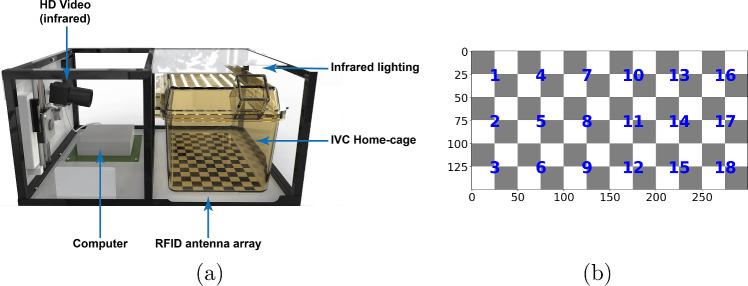
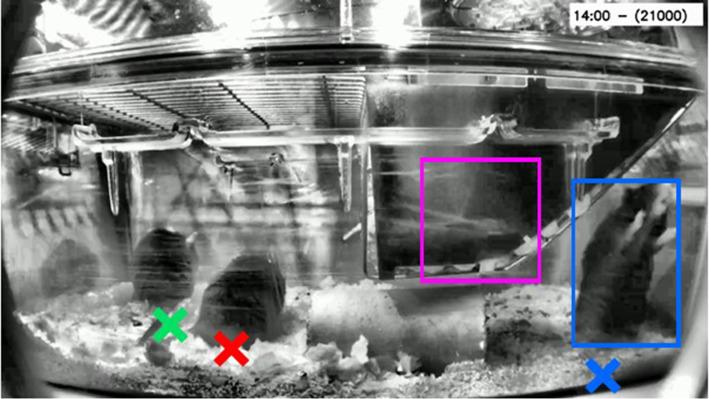
Our objective is to locate and provide a unique identifier for each mouse in a cluttered home-cage environment through time, as a precursor to automated behaviour recognition for biological research. This is a very challenging problem due to (i) the lack of distinguishing visual features for each mouse, and (ii) the close confines of the scene with constant occlusion, making standard visual tracking approaches unusable. However, a coarse estimate of each mouse's location is available from a unique RFID implant, so there is the potential to optimally combine information from (weak) tracking with coarse information on identity. To achieve our objective, we make the following key contributions: (a) the formulation of the problem as an assignment problem (solved using Integer Linear Programming), (b) a novel probabilistic model of the affinity between tracklets and RFID data, and (c) a curated dataset with per-frame BB and regularly spaced ground-truth annotations for evaluating the models. The latter is a crucial part of the model, as it provides a principled probabilistic treatment of object detections given coarse localisation. Our approach achieves 77% accuracy on this animal identification problem, and is able to reject spurious detections when the animals are hidden.
我们的目标是在杂乱的饲养笼环境中,随着时间推移为每只小鼠定位并提供唯一标识符,作为生物研究中自动行为识别的前奏。这是一个极具挑战性的问题,原因如下:(i)每只小鼠缺乏可区分的视觉特征;(ii)场景空间狭小且存在持续遮挡,使得标准视觉跟踪方法无法使用。然而,每只小鼠的大致位置可通过唯一的射频识别(RFID)植入芯片获得,因此有可能将(微弱的)跟踪信息与身份粗略信息进行最优组合。为实现我们的目标,我们做出了以下关键贡献:(a)将该问题表述为分配问题(使用整数线性规划求解);(b)提出一种关于轨迹片段与RFID数据之间关联度的新型概率模型;(c)创建一个经过整理的数据集,其中包含逐帧边界框(BB)以及定期间隔的地面真值注释,用于评估模型。后者是模型的关键部分,因为它在粗略定位的情况下,对目标检测提供了有原则的概率处理。我们的方法在这个动物识别问题上达到了77%的准确率,并且在动物隐藏时能够排除虚假检测。




 Zotero 插件