Department of Pediatrics, Neurology and Public Health, University of Virginia, Charlottesville, Virginia.
Department of Epidemiology, Emory University, Atlanta.
Am J Trop Med Hyg. 2023 Aug 2;109(2):436-442. doi: 10.4269/ajtmh.22-0584.
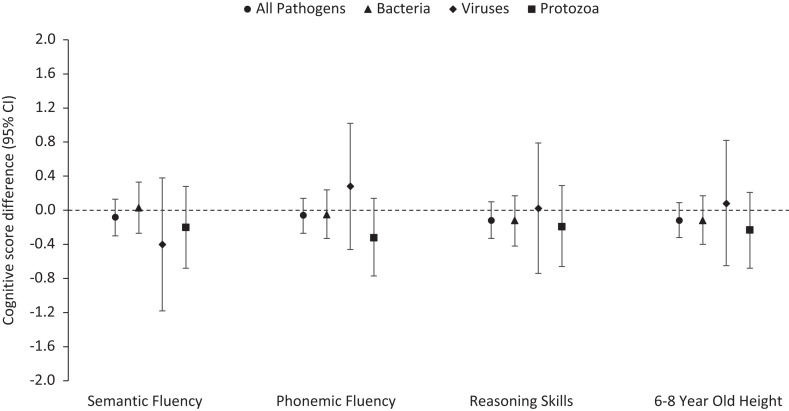
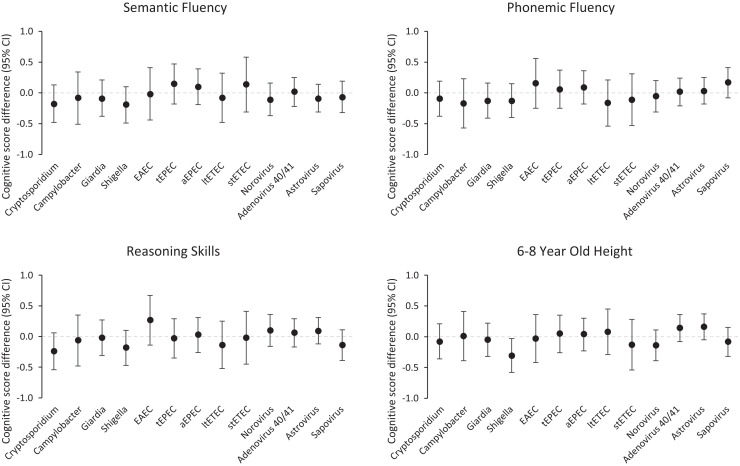
Early-life experiences of enteric infections and diarrheal illness are common in low-resource settings and are hypothesized to affect child development. However, longer-term associations of enteric infections with school-age cognitive outcomes are difficult to estimate due to lack of long-term studies. The objective of this study was to examine the relationship between enteropathogen exposure in the first 2 years of life with school-age cognitive skills in a cohort of children followed from birth until 6 to 8 years in low-resource settings in Brazil, Tanzania, and South Africa. The study included participants from three sites from the Etiology, Risk Factors, and Interactions of Enteric Infections and Malnutrition and the Consequences for Child Health Study who were enrolled just after birth and followed for enteric infections, diarrheal illness, and cognitive development until 2 years of age. When the children were school-age, further data were collected on reasoning skills and semantic/phonemic fluency. We estimated associations between the burden of specific enteric pathogens and etiology-specific diarrhea from 0 to 2 years with cognitive test scores at 6 to 8 years using linear regression and adjusting for confounding variables. In this study, children who carried more enteric pathogens in the first 2 years of life showed overall decreases in school-age cognitive abilities, particularly children who carried protozoa, although this was not statistically significant in this sample. Socioeconomic factors such as maternal education and income were more closely associated with school-age cognitive abilities. Early-life enteric pathogens may have a small, lasting influence on school-age cognitive outcomes, although other socioeconomic factors likely contribute more significantly.
在资源匮乏的环境中,婴幼儿时期发生肠道感染和腹泻的情况较为常见,且据推测这些感染会影响儿童的发育。然而,由于缺乏长期研究,肠道感染与学龄期认知结果之间的长期关联较难评估。本研究的目的是在巴西、坦桑尼亚和南非资源匮乏地区的一个队列中,研究儿童生命最初 2 年内接触肠道病原体与学龄期认知技能之间的关系。该队列中的参与者来自肠道感染的病因、危险因素和相互作用以及营养不良及其对儿童健康后果的研究中的三个地点,他们在出生后立即入组,并在 2 岁前接受肠道感染、腹泻和认知发展的随访。当这些儿童到了学龄期,我们进一步收集了推理技能和语义/语音流畅性的数据。我们使用线性回归估计了从 0 岁到 2 岁时特定肠道病原体和病因特异性腹泻的负担与 6 至 8 岁时认知测试得分之间的关联,并调整了混杂变量。在这项研究中,生命最初 2 年内携带更多肠道病原体的儿童整体上表现出学龄期认知能力下降,特别是携带原生动物的儿童,尽管在这个样本中这并不具有统计学意义。社会经济因素,如母亲的教育和收入,与学龄期认知能力更为密切相关。生命早期的肠道病原体可能对学龄期认知结果产生微小而持久的影响,但其他社会经济因素可能更为重要。