Meyer Rosan, Venter Carina, Bognanni Antonio, Szajewska Hania, Shamir Raanan, Nowak-Wegrzyn Anna, Fiocchi Alessandro, Vandenplas Yvan
Faculty Medicine, Imperial College London, Department Nutrition and Dietetics, Winchester University, UK and Faculty Medicine, KU Leuven, Belgium.
Children's Hospital Colorado, University of Colorado, Denver, CO, USA.
World Allergy Organ J. 2023 Jul 24;16(7):100785. doi: 10.1016/j.waojou.2023.100785. eCollection 2023 Jul.
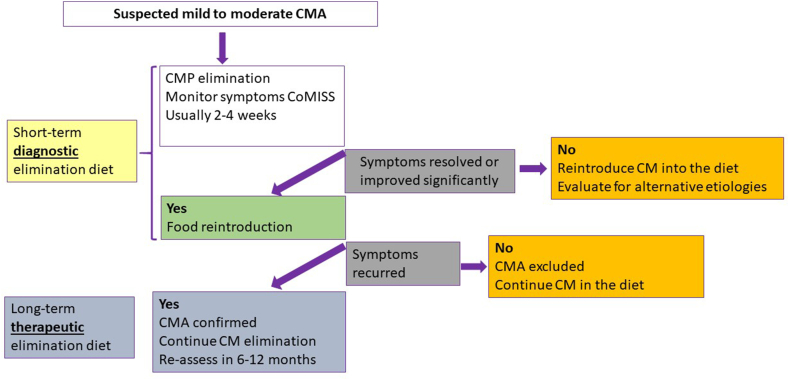
The diagnosis of cow's milk allergy (CMA) in infants and young children remains a challenge because many of the presenting symptoms are similar to those experienced in other diagnoses. Both over- and under-diagnosis occur frequently. Misdiagnosis carries allergic and nutritional risks, including acute reactions, growth faltering, micronutrient deficiencies and a diminished quality of life for infants and caregivers. An inappropriate diagnosis may also add a financial burden on families and on the healthcare system. Elimination and reintroduction of cow's milk (CM) and its derivatives is essential for diagnosing CMA as well as inducing tolerance to CM. In non-IgE mediated CMA, the diagnostic elimination diet typically requires 2-4 weeks before reintroduction, while for IgE mediated allergy the time window may be shorter (1-2 weeks). An oral food challenge (OFC) under medical supervision remains the most reliable diagnostic method for IgE mediated and more severe types of non-IgE mediated CMA such as food protein induced enterocolitis syndrome (FPIES). Conversely, for other forms of non-IgE mediated CMA, reintroduction can be performed at home. The OFC cannot be replaced by the milk ladder after a diagnostic elimination diet. The duration of the therapeutic elimination diet, once a diagnosis was confirmed, can only be established through testing changes in sensitization status, OFCs or home reintroduction, which are directed by local protocols and services' availability. Prior non-evidence-based recommendations suggest that the first therapeutic elimination diet should last for at least 6 months or up to the age of 9-12 months, whichever is reached first. After a therapeutic elimination diet, a milk-ladder approach can be used for non-IgE mediated allergies to determine tolerance. Whilst some centers use the milk ladder also for IgE mediated allergies, there are concerns about the risk of having immediate-type reactions at home. Milk ladders have been adapted to local dietary habits, and typically start with small amounts of baked milk which then step up in the ladder to less heated and fermented foods, increasing the allergenicity. This publication aims to narratively review the risks associated with under- and over-diagnosis of CMA, therefore stressing the necessity of an appropriate diagnosis and management.
婴幼儿牛奶过敏(CMA)的诊断仍然是一项挑战,因为许多呈现出的症状与其他诊断中出现的症状相似。过度诊断和诊断不足的情况都很常见。误诊会带来过敏和营养风险,包括急性反应、生长发育迟缓、微量营养素缺乏以及婴儿和照顾者生活质量下降。不恰当的诊断还可能给家庭和医疗保健系统增加经济负担。排除和重新引入牛奶(CM)及其衍生物对于诊断CMA以及诱导对CM的耐受性至关重要。在非IgE介导的CMA中,诊断性排除饮食通常需要2 - 4周才能重新引入,而对于IgE介导的过敏,时间窗口可能更短(1 - 2周)。在医学监督下进行的口服食物激发试验(OFC)仍然是IgE介导的以及更严重类型的非IgE介导的CMA(如食物蛋白诱导的小肠结肠炎综合征(FPIES))最可靠的诊断方法。相反,对于其他形式的非IgE介导的CMA,可以在家中进行重新引入。在诊断性排除饮食后,OFC不能被牛奶阶梯法取代。一旦确诊,治疗性排除饮食的持续时间只能通过检测致敏状态的变化、OFC或家庭重新引入来确定,这由当地的方案和服务可用性指导。先前基于非证据的建议表明,首次治疗性排除饮食应持续至少6个月或直至9 - 12个月龄,以先达到者为准。经过治疗性排除饮食后,对于非IgE介导的过敏可以采用牛奶阶梯法来确定耐受性。虽然一些中心也将牛奶阶梯法用于IgE介导的过敏,但人们担心在家中出现速发型反应的风险。牛奶阶梯法已根据当地饮食习惯进行了调整,通常从少量烘焙牛奶开始,然后在阶梯中逐步增加到加热程度较低和发酵程度较低的食物,增加了致敏性。本出版物旨在叙述性地综述与CMA诊断不足和过度诊断相关的风险,从而强调适当诊断和管理的必要性。