Vardavas Constantine, Nikitara Katerina, Aslanoglou Katerina, Lagou Ioanna, Marou Valia, Phalkey Revati, Leonardi-Bee Jo, Fernandez Esteve, Vivilaki Victoria, Kamekis Apostolos, Symvoulakis Emmanouil, Noori Teymur, Wuerz Andrea, Suk Jonathan E, Deogan Charlotte
School of Medicine, University of Crete, Heraklion, Crete, Greece.
Department of Oral Health Policy and Epidemiology, Harvard School of Dental Medicine, Harvard University, Boston, MA, USA.
Prev Med Rep. 2023 Jul 16;35:102319. doi: 10.1016/j.pmedr.2023.102319. eCollection 2023 Oct.
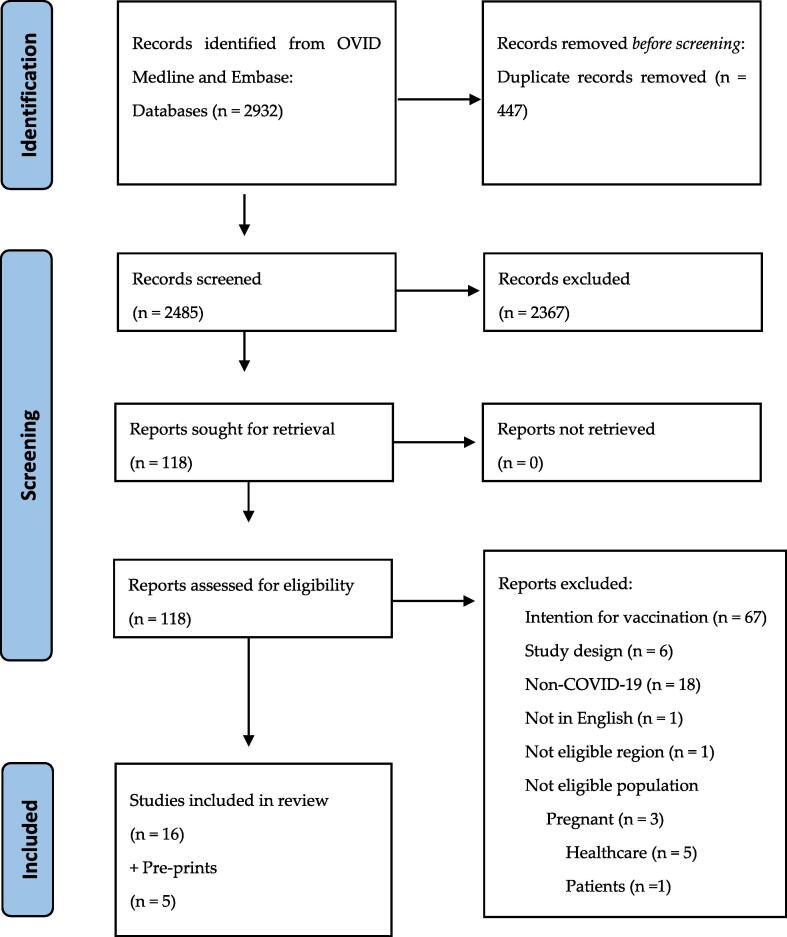
Social determinants of health significantly impact population health status. The aim of this systematic review was to examine which social vulnerability factors or determinants of health at the individual or county level affected vaccine uptake within the first phase of the vaccination program. We performed a systematic review of peer-reviewed literature published from January 2020 until September 2021 in Medline and Embase (Bagaria et al., 2022) and complemented the review with an assessment of pre-print literature within the same period. We restricted our criteria to studies performed in the EU/UK/EEA/US that report vaccine uptake in the general population as the primary outcome and included various social determinants of health as explanatory variables. This review provides evidence of significant associations between the early phases of vaccination uptake for SARS-CoV-2 and multiple socioeconomic factors including income, poverty, deprivation, race/ethnicity, education and health insurance. The identified associations should be taken into account to increase vaccine uptake in socially vulnerable groups, and to reduce disparities in uptake, in particular within the context of public health preparedness for future pandemics. While further corroboration is needed to explore the generalizability of these findings across the European setting, these results confirm the need to consider vulnerable groups and social determinants of health in the planning and roll-out of SARS-CoV-2 vaccination programs and within the context of future respiratory pandemics.
健康的社会决定因素对人群健康状况有重大影响。本系统评价的目的是研究在疫苗接种计划的第一阶段,哪些个体或县级层面的社会脆弱因素或健康决定因素会影响疫苗接种率。我们对2020年1月至2021年9月期间发表在Medline和Embase上的同行评审文献进行了系统评价(Bagaria等人,2022年),并通过评估同期的预印本进一步补充了该评价。我们将纳入标准限定为在欧盟/英国/欧洲经济区/美国进行的研究,这些研究将普通人群的疫苗接种率作为主要结果,并将各种健康的社会决定因素作为解释变量。本评价提供了证据,表明SARS-CoV-2疫苗接种的早期阶段与多个社会经济因素之间存在显著关联,这些因素包括收入、贫困、匮乏、种族/民族、教育和医疗保险。在提高社会弱势群体的疫苗接种率以及减少接种差异时,尤其是在为未来大流行做公共卫生准备的背景下,应考虑到已确定的这些关联。虽然需要进一步证实这些发现能否在整个欧洲背景下具有普遍性,但这些结果证实了在SARS-CoV-2疫苗接种计划的规划和推广过程中,以及在未来呼吸道大流行的背景下,有必要考虑弱势群体和健康的社会决定因素。