Department of Psychology, School of Health Sciences, Neapolis University Pafos, 8042 Pafos, Cyprus.
Department of Archival, Library and Information Studies, University of West Attica, 122 43 Athens, Greece.
Int J Environ Res Public Health. 2023 Jul 27;20(15):6464. doi: 10.3390/ijerph20156464.
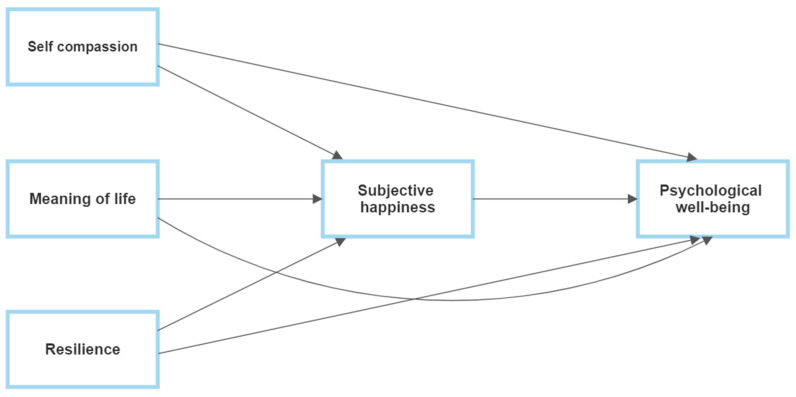
The present study examined the association and complementary effect of self-compassion on the subjective happiness and psychological well-being of adults during the COVID-19 pandemic. The study was based on a concurrent correlational design to examine relationships between self-compassion, subjective happiness, psychological well-being, resilience, and the meaning in life. Data were collected via a battery of questionnaires and analyzed, focusing on the above variables. The sample of this study (N = 526) consisted of Greek professionals in education and university students. The results showed that there is a strong positive relationship between self-compassion and subjective happiness, and between self-compassion and psychological well-being. The findings suggest that an attitude of self-compassion may well influence the development of psychological well-being and increase the subjective happiness of adults during the distressing era of a long-term pandemic. The results also indicated a positive relationship between self-compassion and meaning in life and showed that self-compassion is a prerequisite for resilience, which in turn may serve as a moderator of psychological well-being and subjective happiness.
本研究探讨了自我同情与成年人在 COVID-19 大流行期间的主观幸福感和心理健康之间的关联和互补效应。该研究采用同期相关设计,检验了自我同情、主观幸福感、心理健康、韧性和生活意义之间的关系。数据通过一系列问卷收集并进行了分析,重点关注上述变量。本研究的样本(N=526)由希腊教育专业人士和大学生组成。研究结果表明,自我同情与主观幸福感以及自我同情与心理健康之间存在着强烈的正相关关系。研究结果表明,自我同情的态度可能会影响心理健康的发展,并在长期大流行的痛苦时期增加成年人的主观幸福感。研究结果还表明自我同情与生活意义之间存在正相关关系,并表明自我同情是韧性的前提,而韧性反过来又可以作为心理健康和主观幸福感的调节因素。