Sasaki Takaaki, Yoshida Ryohei, Nitanai Kiichi, Watanabe Takashi, Tenma Toshiyuki, Kida Ryotaro, Mori Chie, Umekage Yasuhiro, Hirai Noriko, Minami Yoshinori, Okumura Shunsuke
Respiratory Center, Asahikawa Medical University Hospital, Asahikawa, Japan.
Transl Lung Cancer Res. 2023 Jul 31;12(7):1445-1453. doi: 10.21037/tlcr-22-671. Epub 2023 Jul 20.
Tyrosine kinase inhibitors (TKIs) significantly improve clinical outcomes in patients with non-small cell lung cancer due to anaplastic lymphoma kinase () gene rearrangement. However, the rate of relapse with TKIs is high owing to the development of resistance mutations during treatment. Repeated biopsies during disease progression are crucial for elucidating the molecular mechanisms underlying the development of resistance to ALK inhibitors. Analysis of cell-free DNA (cfDNA) obtained from plasma is a novel approach for tumor genotyping.
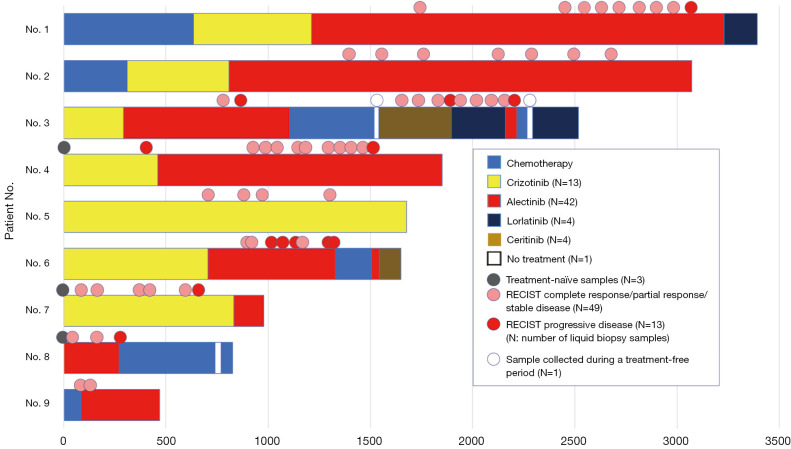
In this mixed prospective and retrospective observational cohort study, we investigated the clinical feasibility of continuous quantitative monitoring of -acquired mutations in plasma obtained from patients with ALK non-small cell lung cancer by using a highly sensitive and specific droplet digital polymerase chain reaction (ddPCR) assay. We enrolled nine patients, including three treatment-naïve patients recently diagnosed with ALK non-small cell lung cancer via tissue biopsy and expected to receive ALK TKIs and six patients already receiving ALK TKIs. Plasma samples were collected from these patients every 3 months. cfDNA was extracted from 66 samples during the study period, and 10 mutations were simultaneously evaluated.
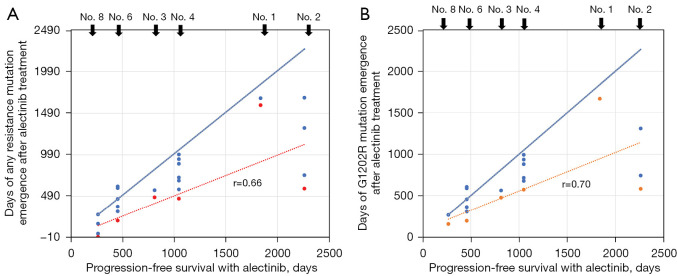
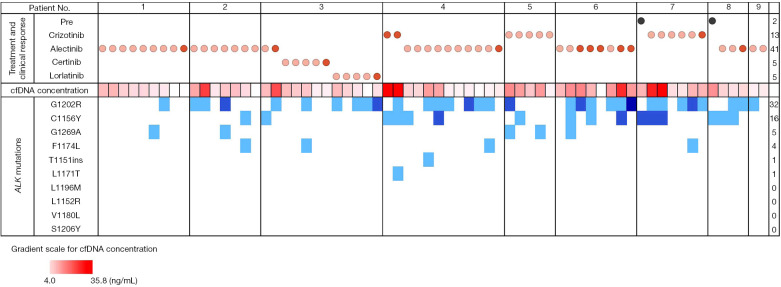
The numbers of samples showing the G1202R, C1156Y, G1269A, F1174L, T1151ins, and I1171T mutations were 32, 16, 5, 4, 1, and 1, respectively. The L1196M, L1152R, V1180L, and S1206Y mutations were not detected. Correlation analyses between progression-free survival and the time from treatment initiation (or treatment modification) to the detection of resistance mutations revealed that although resistance mutations may occur before a drug change becomes necessary, there is a duration during which the disease does not progress.
Our findings suggest that real-time quantitative monitoring of resistance mutations during the response period could provide a time course of changes while acquiring resistance mutations. This information would be beneficial for designing an appropriate treatment strategy.
酪氨酸激酶抑制剂(TKIs)可显著改善因间变性淋巴瘤激酶(ALK)基因重排所致非小细胞肺癌患者的临床结局。然而,由于治疗期间耐药突变的出现,TKIs的复发率很高。疾病进展期间的重复活检对于阐明对ALK抑制剂耐药的分子机制至关重要。分析从血浆中获取的游离DNA(cfDNA)是一种肿瘤基因分型的新方法。
在这项前瞻性与回顾性混合观察性队列研究中,我们使用高度灵敏且特异的液滴数字聚合酶链反应(ddPCR)检测法,研究了对ALK非小细胞肺癌患者血浆中ALK获得性突变进行连续定量监测的临床可行性。我们纳入了9例患者,其中包括3例经组织活检新诊断为ALK非小细胞肺癌且预计接受ALK TKIs治疗的初治患者,以及6例已接受ALK TKIs治疗的患者。每3个月从这些患者采集血浆样本。在研究期间从66份样本中提取cfDNA,并同时评估10种ALK突变。
显示G1202R、C1156Y、G1269A、F1174L、T1151ins和I1171T突变的样本数分别为32、16、5、4、1和1。未检测到L1196M、L1152R、V1180L和S1206Y突变。无进展生存期与从开始治疗(或更改治疗方案)至检测到耐药突变的时间之间的相关性分析显示,尽管耐药突变可能在需要更换药物之前就已出现,但疾病在一段时间内不会进展。
我们的研究结果表明,在反应期对ALK耐药突变进行实时定量监测可提供获得耐药突变时变化的时间过程。这些信息将有助于设计合适的治疗策略。