
树枝状聚集体姜黄素与柔红霉素联合治疗协同抑制A549肺癌细胞的增殖、迁移并诱导其凋亡。
Combined Treatment of Dendrosomal-Curcumin and Daunorubicin Synergistically Inhibit Cell Proliferation, Migration and Induce Apoptosis in A549 Lung Cancer Cells.
作者信息
Eslami Seyed Sadegh, Jafari Davod, Ghotaslou Abbas, Amoupour Moein, Asri Kojabad Amir, Jafari Rasool, Mousazadeh Navid, Tarighi Parastoo, Sadeghizadeh Majid
机构信息
Student Research Committee, Faculty of Allied Medicine, Iran University of Medical Sciences, Tehran, Iran.
Department of Medical Biotechnology, Faculty of Allied Medicine, Iran University of Medical Sciences, Tehran, Iran.
出版信息
Adv Pharm Bull. 2023 Jul;13(3):539-550. doi: 10.34172/apb.2023.050. Epub 2022 Jul 2.
PURPOSE
Chemotherapy drugs used to treat lung cancer are associated with drug resistance and severe side effects. There have been rising demands for new therapeutic candidates and novel approaches, including combination therapy. Here, we aimed to investigate the combinatorial effect of a dendrosomal formulation of curcumin (DNC) and daunorubicin (DNR) on the A549 lung cancer cell line.
METHODS
We performed cytotoxicity, apoptosis, cell migration, colony-formation capacity, and gene expression analysis to interpret the mechanism of action for a combination of DNC and DNR on A549 cells.
RESULTS
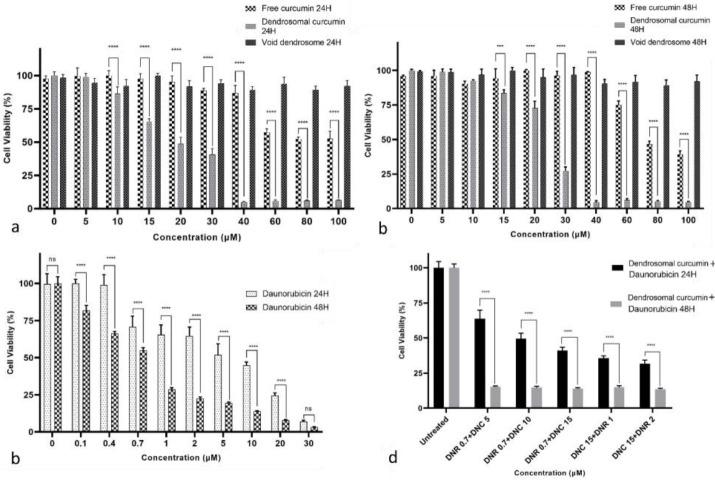
Our results revealed that the combination of DNC and DNR could synergistically inhibit the A549 cells' growth. This synergistic cytotoxicity was further approved by flow cytometry, migration assessment, colony-forming capacity and gene expression analysis. DNR combination with DNC resulted in increased apoptosis to necrosis ratio compared to DNR alone. In addition, the migration and colony-forming capacity were at the minimal range when DNC was combined with DNR. Combined treatment decreased the expression level of and genes significantly. In addition, the ratio of gene expression significantly increased. Our analysis by free curcumin, dendrosomes and DNC also showed that dendrosomes do not have any significant cytotoxic effect on the A549 cells, suggesting that this carrier has a high potential for enhancing the curcumin's biological effects.
CONCLUSION
Our observations suggest that the DNC formulation of curcumin synergistically enhances the antineoplastic effect of DNR on the A549 cell line through the modulation of apoptosis/necrosis ratio, as well as ratio, and gene expression.
目的
用于治疗肺癌的化疗药物存在耐药性和严重副作用。对新的治疗候选药物和新方法(包括联合治疗)的需求不断增加。在此,我们旨在研究姜黄素(DNC)和柔红霉素(DNR)的树枝状体制剂对A549肺癌细胞系的联合作用。
方法
我们进行了细胞毒性、凋亡、细胞迁移、集落形成能力和基因表达分析,以解释DNC和DNR联合作用于A549细胞的作用机制。
结果
我们的结果表明,DNC和DNR的联合可协同抑制A549细胞的生长。这种协同细胞毒性通过流式细胞术、迁移评估、集落形成能力和基因表达分析得到进一步证实。与单独使用DNR相比,DNR与DNC联合导致凋亡与坏死比率增加。此外,当DNC与DNR联合时,迁移和集落形成能力处于最低水平。联合治疗显著降低了 和 基因的表达水平。此外, 基因表达的比率显著增加。我们对游离姜黄素、树枝状体和DNC的分析还表明,树枝状体对A549细胞没有任何显著的细胞毒性作用,这表明这种载体具有增强姜黄素生物学效应的高潜力。
结论
我们的观察结果表明,姜黄素的DNC制剂通过调节凋亡/坏死比率以及 比率、 和 基因表达,协同增强了DNR对A549细胞系的抗肿瘤作用。




 Zotero 插件