
鉴定 FAM53C 为激酶 DYRK1A 的细胞质锚定抑制结合蛋白。
Identification of FAM53C as a cytosolic-anchoring inhibitory binding protein of the kinase DYRK1A.
机构信息
https://ror.org/02kpeqv85 Department of Cell and Developmental Biology, Graduate School of Biostudies, Kyoto University, Kyoto, Japan
https://ror.org/02kpeqv85 Department of Cell and Developmental Biology, Graduate School of Biostudies, Kyoto University, Kyoto, Japan.
出版信息
Life Sci Alliance. 2023 Oct 6;6(12). doi: 10.26508/lsa.202302129. Print 2023 Dec.
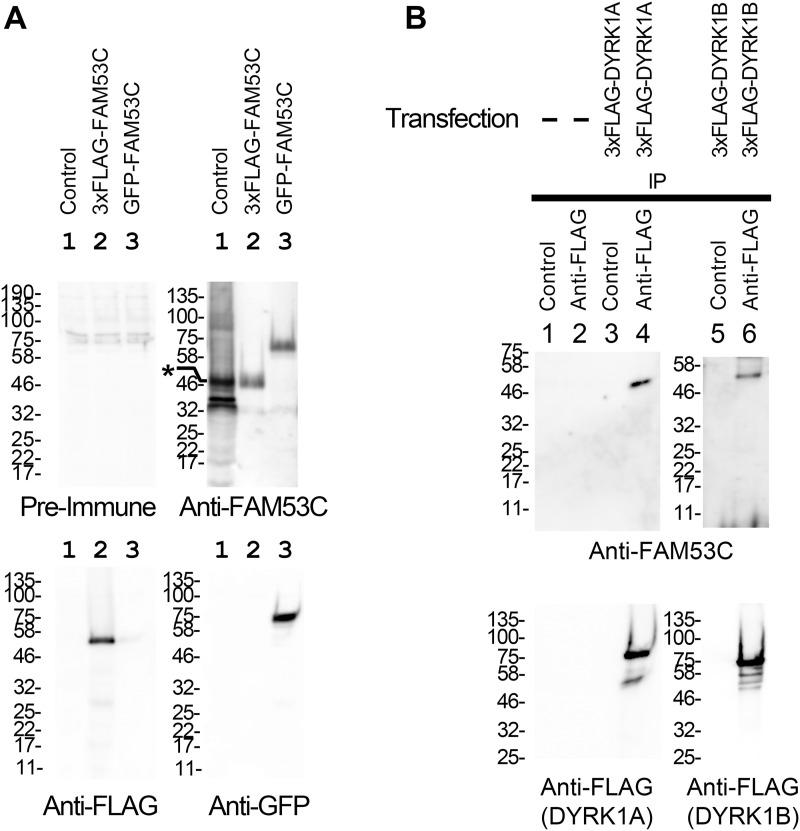
The protein kinase DYRK1A encoded in human chromosome 21 is the major contributor to the multiple symptoms observed in Down syndrome patients. In addition, DYRK1A malfunction is associated with various other neurodevelopmental disorders such as autism spectrum disorder. Here, we identified FAM53C with no hitherto known biological function as a novel suppressive binding partner of DYRK1A. FAM53C is bound to the catalytic protein kinase domain of DYRK1A, whereas DCAF7/WDR68, the major DYRK1A-binding protein, binds to the N-terminal domain of DYRK1A. The binding of FAM53C inhibited autophosphorylation activity of DYRK1A and its kinase activity to an exogenous substrate, MAPT/Tau. FAM53C did not bind directly to DCAF7/WDR68, whereas DYRK1A tethered FAM53C and DCAF7/WDR68 by binding concurrently to both of them, forming a tri-protein complex. DYRK1A possesses an NLS and accumulates in the nucleus when overexpressed in cells. Co-expression of FAM53C induced cytoplasmic re-localization of DYRK1A, revealing the cytoplasmic anchoring function of FAM53C to DYRK1A. Moreover, the binding of FAM53C to DYRK1A suppressed the DYRK1A-dependent nuclear localization of DCAF7/WDR68. All the results show that FAM53C binds to DYRK1A, suppresses its kinase activity, and anchors it in the cytoplasm. In addition, FAM53C is bound to the DYRK1A-related kinase DYRK1B with an Hsp90/Cdc37-independent manner. The results explain for the first time why endogenous DYRK1A is distributed in the cytoplasm in normal brain tissue. FAM53C-dependent regulation of the kinase activity and intracellular localization of DYRK1A may play a significant role in gene expression regulation caused by normal and aberrant levels of DYRK1A.
在人类 21 号染色体上编码的蛋白激酶 DYRK1A 是唐氏综合征患者多种症状的主要贡献者。此外,DYRK1A 功能障碍与各种其他神经发育障碍有关,如自闭症谱系障碍。在这里,我们确定了 FAM53C,它没有已知的生物学功能,是 DYRK1A 的一种新型抑制性结合伴侣。FAM53C 与 DYRK1A 的催化蛋白激酶结构域结合,而 DCAF7/WDR68,主要的 DYRK1A 结合蛋白,与 DYRK1A 的 N 端结构域结合。FAM53C 的结合抑制了 DYRK1A 的自身磷酸化活性及其对外部底物 MAPT/Tau 的激酶活性。FAM53C 不直接与 DCAF7/WDR68 结合,而 DYRK1A 通过同时与两者结合将 FAM53C 和 DCAF7/WDR68 束缚在一起,形成三蛋白复合物。DYRK1A 具有核定位信号,在细胞中转录过度表达时会在核内积累。FAM53C 的共表达诱导 DYRK1A 的细胞质再定位,揭示了 FAM53C 对 DYRK1A 的细胞质锚定功能。此外,FAM53C 与 DYRK1A 的结合抑制了 DYRK1A 依赖的 DCAF7/WDR68 的核定位。所有结果表明,FAM53C 与 DYRK1A 结合,抑制其激酶活性,并将其锚定在细胞质中。此外,FAM53C 以一种 HSP90/Cdc37 非依赖性的方式与 DYRK1A 相关激酶 DYRK1B 结合。这些结果首次解释了为什么内源性 DYRK1A 在正常脑组织中分布在细胞质中。FAM53C 对 DYRK1A 激酶活性和细胞内定位的调节可能在由正常和异常水平的 DYRK1A 引起的基因表达调节中发挥重要作用。




 Zotero 插件