
不同脂蛋白(a)浓度的接受侵入性治疗的急性冠脉综合征患者的延长双联抗血小板治疗
Prolonged dual antiplatelet therapy in invasively treated acute coronary syndrome patients with different lipoprotein(a) concentrations.
作者信息
Cui Kongyong, Wu Shaoyu, Yin Dong, Song Weihua, Wang Hongjian, Zhu Chenggang, Feng Lei, Yang Yuejin, Fu Rui, Dou Kefei
机构信息
Department of Cardiology, Cardiometabolic Medicine Center, Fuwai Hospital, National Center for Cardiovascular Diseases, Chinese Academy of Medical Sciences and Peking Union Medical College, Beijing, China.
State Key Laboratory of Cardiovascular Disease, Beijing, China.
出版信息
Cardiol J. 2024;31(1):32-44. doi: 10.5603/cj.93062. Epub 2023 Oct 19.
BACKGROUND
Lipoprotein(a) [Lp(a)] was positively associated with recurrent ischemic events in patients with acute coronary syndrome (ACS). This study was performed to investigate the effect of Lp(a) levels on outcomes of dual antiplatelet therapy (DAPT) > 1 year versus DAPT ≤ 1 year after percutaneous coronary intervention (PCI) in this population.
METHODS
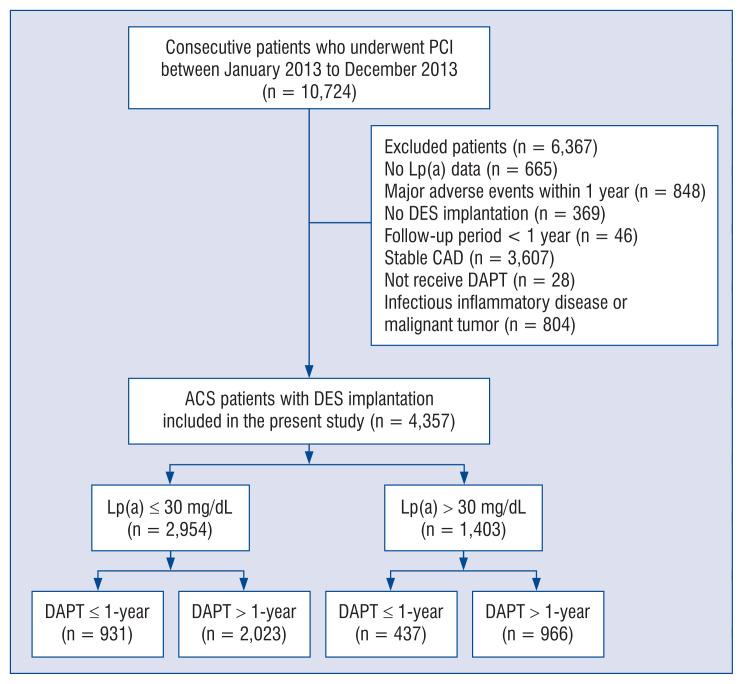
A total of 4,357 ACS patients who were event-free at 1 year after PCI were selected from the Fuwai PCI Registry, and patients were stratified into four groups according to DAPT duration (≤ 1 year vs. > 1 year) and Lp(a) levels (≤ 30 mg/dL vs. > 30 mg/dL). The primary endpoint was major adverse cardiovascular and cerebrovascular event (MACCE), defined as a composite of cardiac death, myocardial infarction or stroke.
RESULTS
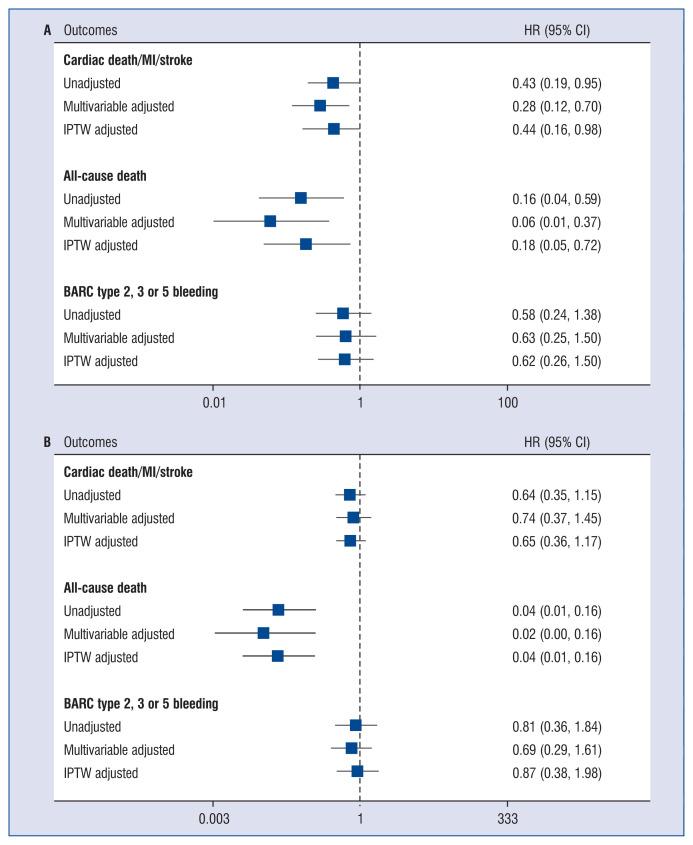
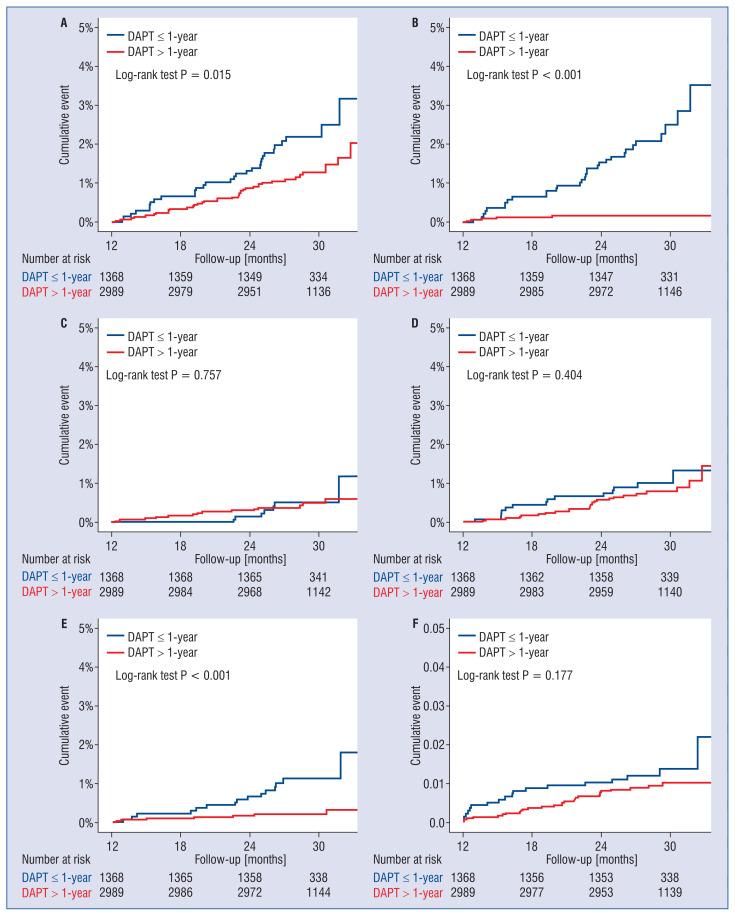
After 2.4-year follow-up, the incidence of MACCE (HRadjusted 0.284, 95% CI 0.115-0.700; HRIPTW 0.351, 95% CI 0.164-0.751) were significantly reduced in DAPT > 1 year group than that in DAPT ≤ 1 year group in individuals with elevated Lp(a) levels. However, in individuals with normal Lp(a) levels, no statistically difference was found between these two groups in terms of MACCE, although the risks of all-cause death and definite/probable stent thrombosis were lower in DAPT > 1 year group. Notably, the risk of clinically relevant bleeding did not statistically differ between these two groups in individuals with different Lp(a) levels.
CONCLUSIONS
This study firstly demonstrated that extended DAPT (> 1 year) was statistically associated with lower risk of ischemic events in ACS patients with elevated Lp(a) levels after PCI, whereas this association was not found in individuals with normal Lp(a) levels.
背景
脂蛋白(a)[Lp(a)]与急性冠状动脉综合征(ACS)患者的复发性缺血事件呈正相关。本研究旨在探讨在该人群中,经皮冠状动脉介入治疗(PCI)后Lp(a)水平对双联抗血小板治疗(DAPT)>1年与DAPT≤1年的疗效的影响。
方法
从阜外PCI注册研究中选取4357例PCI术后1年无事件的ACS患者,根据DAPT持续时间(≤1年与>1年)和Lp(a)水平(≤30mg/dL与>30mg/dL)将患者分为四组。主要终点是主要不良心血管和脑血管事件(MACCE),定义为心脏死亡、心肌梗死或中风的复合事件。
结果
经过2.4年的随访,Lp(a)水平升高的个体中,DAPT>1年组的MACCE发生率(校正后HR为0.284,95%CI为0.115-0.700;IPTW校正后HR为0.351,95%CI为0.164-0.751)显著低于DAPT≤1年组。然而,在Lp(a)水平正常的个体中,两组在MACCE方面无统计学差异,尽管DAPT>1年组的全因死亡和明确/可能的支架血栓形成风险较低。值得注意的是,在Lp(a)水平不同的个体中,两组的临床相关出血风险无统计学差异。
结论
本研究首次表明,延长DAPT(>1年)与PCI术后Lp(a)水平升高的ACS患者缺血事件风险降低具有统计学相关性,而在Lp(a)水平正常的个体中未发现这种相关性。
 Zotero 插件