Chen Pengzhao, Abeywickrama Pranami D, Ji Shuxian, Zhou Yueyan, Li Xinghong, Zhang Wei, Yan Jiye
Beijing Key Laboratory of Environment-Friendly Management on Fruit Diseases and Pests in North China, Institute of Plant Protection, Beijing Academy of Agriculture and Forestry Sciences, Beijing 100097, China.
Center of Excellence in Fungal Research, Mae Fah Luang University, Chiang Rai 57100, Thailand.
Microorganisms. 2023 Sep 26;11(10):2400. doi: 10.3390/microorganisms11102400.
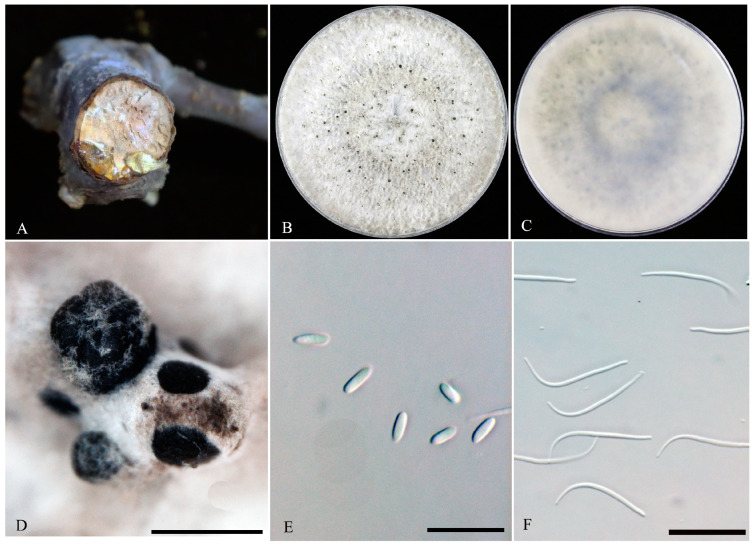
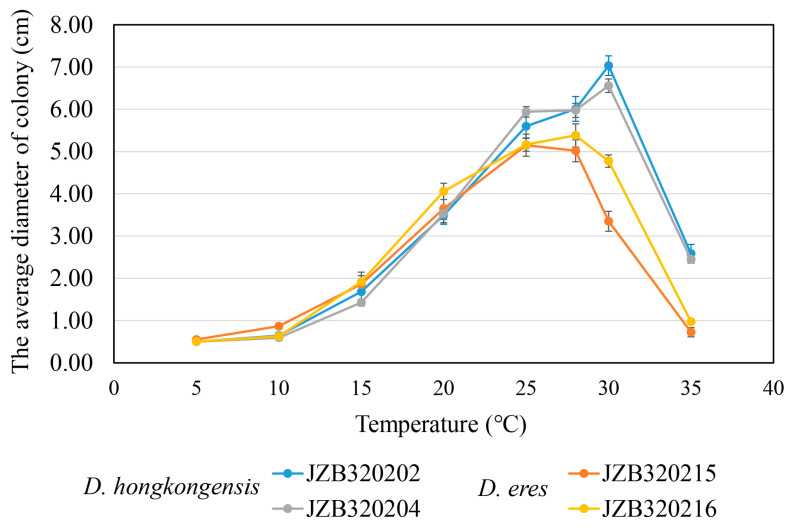
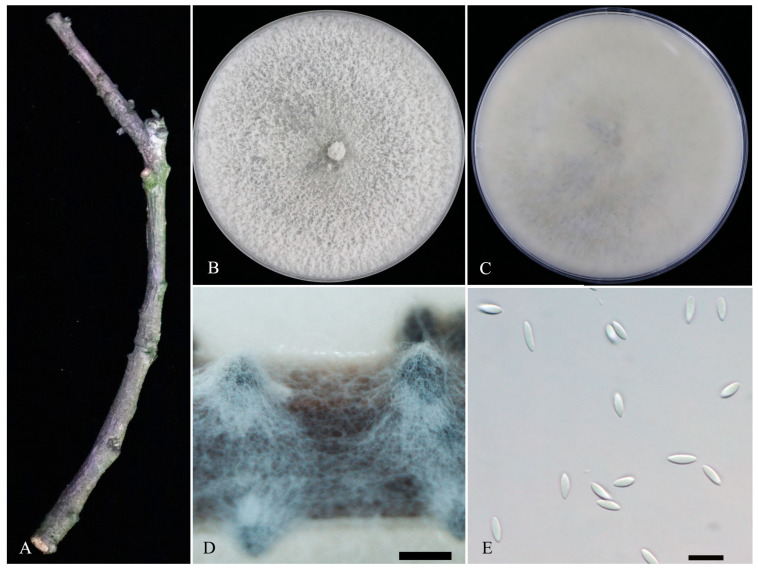
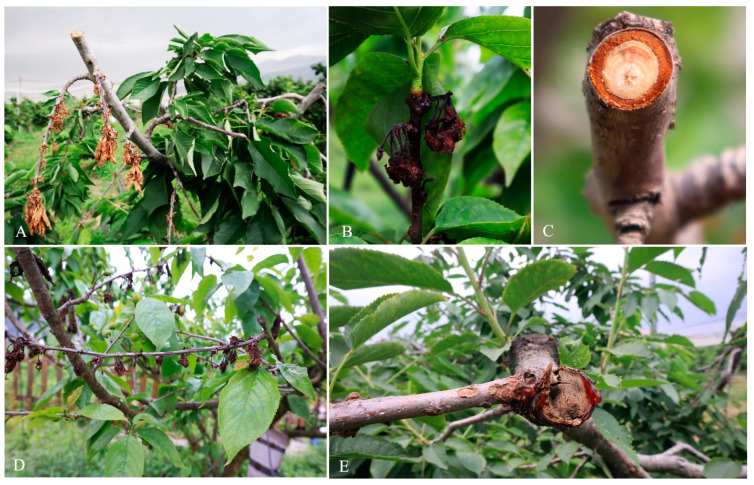
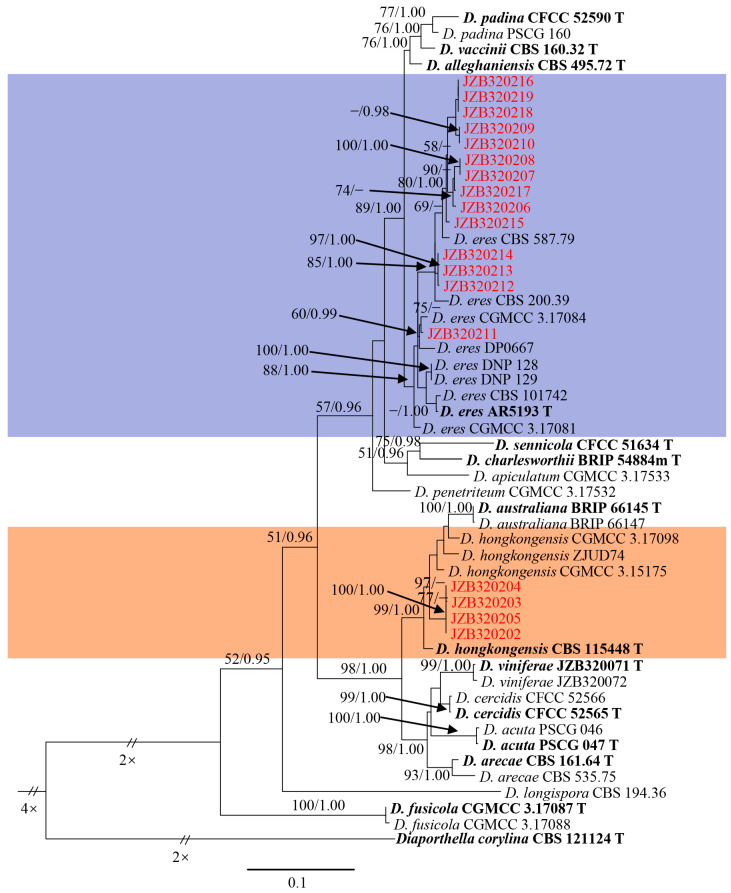
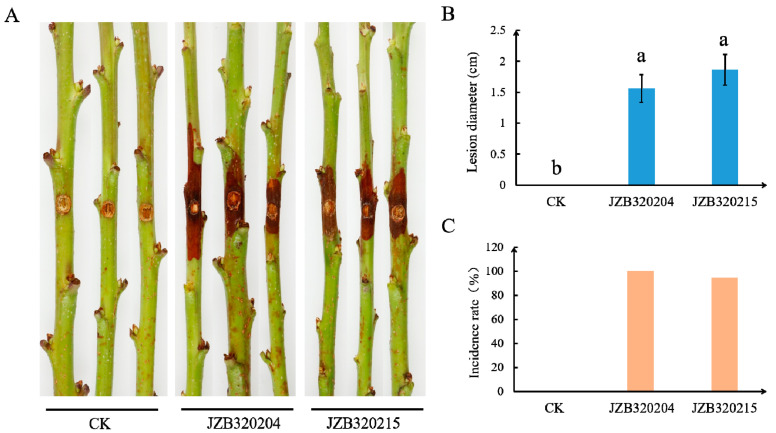
This study aimed to identify fungal species associated with trunk diseases of sweet cherries () in several commercial cherry orchards in Beijing, Guizhou and Shandong provinces, China. In total, eighteen fungal strains that fitted well into the species concept of were isolated. Based on both morphological and multi-locus phylogenetic analyses of internal transcribed spacer region (ITS), beta-tubulin (), calmodulin () and translation elongation factor 1-α () sequencing data, fourteen isolates were identified as , while four isolates were classified as . Here, we report causing sweet cherry branch dieback disease and, further, we confirmed the host association of with sweet cherries in China. A pathogenicity assay revealed the ability of both and to cause shoot necrosis and stem lesions on cv. 'Brooks' (mean lesion lengths of 1.86 cm and 1.56 cm, respectively). The optimal temperature for the growth of both species was tested. The optimal growth temperature for was 30 °C, and the 25-28 °C temperatures were the most favorable for the growth of strains. This research advances the understanding of fungal trunk diseases in fruit crops, particularly gummosis and branch dieback disease in Chinese cherry orchards, and will aid growers in making decisions about cultural practices and disease management.
本研究旨在鉴定中国北京、贵州和山东几个商业樱桃果园中与甜樱桃()树干病害相关的真菌种类。共分离出18株符合该物种概念的真菌菌株。基于内部转录间隔区(ITS)、β-微管蛋白()、钙调蛋白()和翻译延伸因子1-α()测序数据的形态学和多位点系统发育分析,14株分离物被鉴定为,4株分离物被归类为。在此,我们报道了引起甜樱桃枝条枯死病,此外,我们在中国证实了与甜樱桃的寄主关联。致病性测定揭示了和在‘布鲁克斯’甜樱桃品种上引起嫩枝坏死和茎部病斑的能力(平均病斑长度分别为1.86厘米和1.56厘米)。测试了两种真菌生长的最适温度。的最适生长温度为30℃,25 - 28℃的温度最有利于菌株的生长。本研究增进了对果树真菌性树干病害的理解,特别是中国樱桃果园中的流胶病和枝条枯死病,并将有助于种植者做出栽培措施和病害管理的决策。