
充血性心力衰竭的血液透析患者的临床结局
Clinical Outcomes in Patients on Hemodialysis with Congestive Heart Failure.
作者信息
Zhao Xinju, Gan Liangying, Niu Qingyu, Hou Fan Fan, Liang Xinling, Chen Xiaonong, Chen Yuqing, Zhao Junhui, McCullough Keith, Ni Zhaohui, Zuo Li
机构信息
Department of Nephrology, Peking University People's Hospital, Beijing, China.
Division of Nephrology, National Clinical Research Center of Kidney Disease, State Key Laboratory of Organ Failure Research, Nanfang Hospital, Southern Medical University, Guangzhou, China.
出版信息
Kidney Dis (Basel). 2023 Mar 3;9(4):306-316. doi: 10.1159/000529802. eCollection 2023 Aug.
INTRODUCTION
Congestive heart failure (CHF) is one of the common complications in patients with end-stage kidney disease. In the general population, CHF increases the risk of the death. However, there is no well-designed relevant study in the Chinese hemodialysis (HD) population addressing the risks associated with CHF. The aim of this study was to explore the impact of CHF on clinical outcomes in HD patients.
METHODS
Data from a prospective cohort study, the China Dialysis Outcomes and Practice Patterns Study (DOPPS) 5 (2012-2015), were analyzed. Demographic data, comorbidities, lab data, and death records were extracted. CHF was defined by the diagnosis records upon study inclusion. Our primary outcome was all-cause and cardiovascular (CV) mortality; secondary outcomes were all-cause and cause-specific hospitalization risk. Associations between CHF and outcomes were evaluated using Cox regression models. Stepwise multivariate logistic regression was used to identify the related risk factors, and subgroup analyses were carried out.
RESULTS
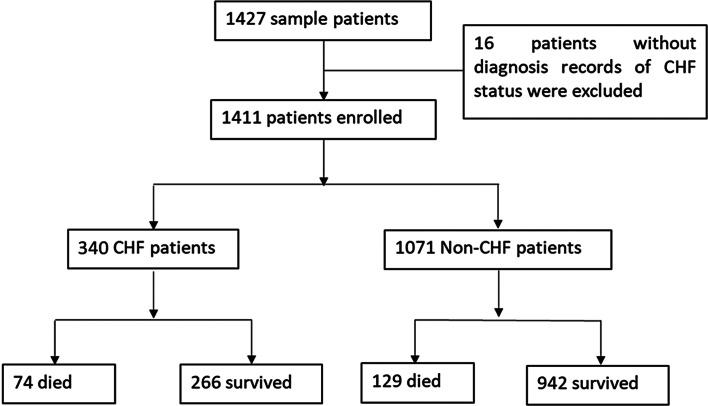
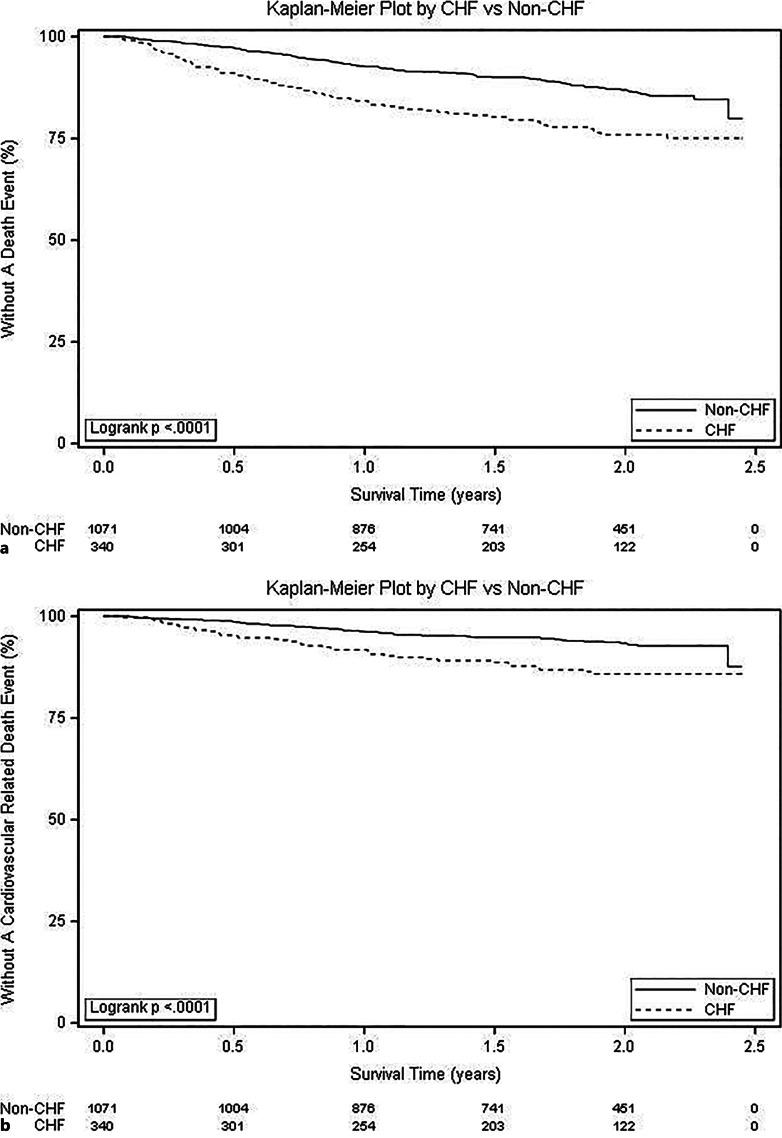
Of 1,411 patients without missing CHF history information, 24.1% (340) had CHF diagnosis at enrollment. The overall mortality rates were 21.8% versus 12.0% ( < 0.001) in patients with and without CHF during follow-up, respectively. CHF was associated with higher all-cause mortality (adjusted HR: 1.72, 95% confidence interval [CI]: 1.17-2.53, = 0.006), and the association with CV death was of similar magnitude (HR: 1.60, 95% CI: 0.91-2.81, = 0.105). CHF patients had more episodes of hospitalization due to heart failure (HR: 2.93, 95% CI: 1.49-5.76, < 0.01). However, compared with patients without CHF, the all-cause hospitalization risk was not much higher in CHF patients (HR: 1.09, 95% CI: 0.90-1.33, = 0.39). Subgroup analysis found that the effect of CHF on all-cause mortality was stronger for male patients, patients with residual renal function, the elderly (≥60 years of age), patients with arteriovenous fistulae vascular accesses, nondiabetic patients, low-flux dialyzer users, and inadequately dialyzed patients (standardized Kt/V <2).
CONCLUSION
In HD patients, CHF was found to be associated with a higher risk of all-cause mortality and cause-specific hospitalization risk. Further research is needed to identify opportunities to improve care for HD patients combined with CHF.
引言
充血性心力衰竭(CHF)是终末期肾病患者常见的并发症之一。在普通人群中,CHF会增加死亡风险。然而,针对中国血液透析(HD)人群中与CHF相关风险的相关研究设计并不完善。本研究旨在探讨CHF对HD患者临床结局的影响。
方法
分析了一项前瞻性队列研究——中国透析结局和实践模式研究(DOPPS)5(2012 - 2015年)的数据。提取了人口统计学数据、合并症、实验室数据和死亡记录。CHF根据研究纳入时的诊断记录进行定义。我们的主要结局是全因死亡率和心血管(CV)死亡率;次要结局是全因住院风险和特定病因住院风险。使用Cox回归模型评估CHF与结局之间的关联。采用逐步多因素逻辑回归来识别相关风险因素,并进行亚组分析。
结果
在1411例无CHF病史缺失信息的患者中,24.1%(340例)在入组时被诊断为CHF。随访期间,有CHF和无CHF患者的总死亡率分别为21.8%和12.0%(P < 0.001)。CHF与较高的全因死亡率相关(调整后HR:1.72,95%置信区间[CI]:1.17 - 2.53,P = 0.006),与CV死亡的关联程度相似(HR:1.60,95% CI:0.91 - 2.81,P = 0.105)。CHF患者因心力衰竭住院的次数更多(HR:2.93,95% CI:1.49 - 5.76,P < 0.01)。然而,与无CHF患者相比,CHF患者的全因住院风险并没有高太多(HR:1.09,95% CI:0.90 - 1.33,P = 0.39)。亚组分析发现,CHF对全因死亡率的影响在男性患者、有残余肾功能的患者、老年人(≥60岁)、使用动静脉内瘘血管通路的患者、非糖尿病患者、使用低通量透析器的患者以及透析不充分的患者(标准化Kt/V < 2)中更强。
结论
在HD患者中,发现CHF与更高的全因死亡率风险和特定病因住院风险相关。需要进一步研究以确定改善合并CHF的HD患者护理的机会。

 Zotero 插件