
在对健侧运动皮层 1Hz rTMS 和物理疗法进行干预前后,测试慢性中风的痉挛机制。
Testing spasticity mechanisms in chronic stroke before and after intervention with contralesional motor cortex 1 Hz rTMS and physiotherapy.
机构信息
Institute for Clinical Psychology and Behavioral Neurobiology, University of Tübingen, Tübingen, Germany.
Department of Neurology & Stroke, University of Tübingen, Tübingen, Germany.
出版信息
J Neuroeng Rehabil. 2023 Nov 8;20(1):150. doi: 10.1186/s12984-023-01275-9.
BACKGROUND
Previous studies showed that repetitive transcranial magnetic stimulation (rTMS) reduces spasticity after stroke. However, clinical assessments like the modified Ashworth scale, cannot discriminate stretch reflex-mediated stiffness (spasticity) from passive stiffness components of resistance to muscle stretch. The mechanisms through which rTMS might influence spasticity are also not understood.
METHODS
We measured the effects of contralesional motor cortex 1 Hz rTMS (1200 pulses + 50 min physiotherapy: 3×/week, for 4-6 weeks) on spasticity of the wrist flexor muscles in 54 chronic stroke patients using a hand-held dynamometer for objective quantification of the stretch reflex response. In addition, we measured the excitability of three spinal mechanisms thought to be related to post-stroke spasticity: post-activation depression, presynaptic inhibition and reciprocal inhibition before and after the intervention. Effects on motor impairment and function were also assessed using standardized stroke-specific clinical scales.
RESULTS
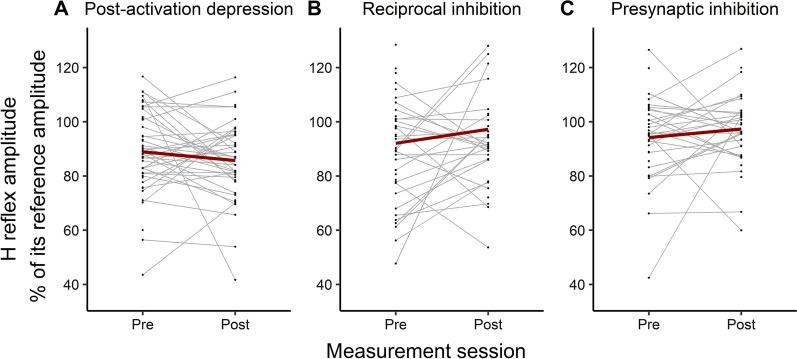
The stretch reflex-mediated torque in the wrist flexors was significantly reduced after the intervention, while no change was detected in the passive stiffness. Additionally, there was a significant improvement in the clinical tests of motor impairment and function. There were no significant changes in the excitability of any of the measured spinal mechanisms.
CONCLUSIONS
We demonstrated that contralesional motor cortex 1 Hz rTMS and physiotherapy can reduce the stretch reflex-mediated component of resistance to muscle stretch without affecting passive stiffness in chronic stroke. The specific physiological mechanisms driving this spasticity reduction remain unresolved, as no changes were observed in the excitability of the investigated spinal mechanisms.
背景
先前的研究表明,重复经颅磁刺激(rTMS)可降低脑卒中后的痉挛程度。然而,改良 Ashworth 量表等临床评估方法无法区分伸展反射介导的僵硬(痉挛)与肌肉拉伸的被动阻力成分。rTMS 影响痉挛的机制也尚不清楚。
方法
我们使用手持测力计对手腕屈肌的痉挛进行客观定量测量,评估了对侧运动皮层 1Hz rTMS(1200 脉冲+50 分钟物理治疗:每周 3 次,持续 4-6 周)对 54 例慢性脑卒中患者的影响。此外,我们还在干预前后测量了三种被认为与脑卒中后痉挛有关的脊髓机制的兴奋性:后激活抑制、突触前抑制和交互抑制。使用标准化的脑卒中特定临床量表评估运动障碍和功能的改善情况。
结果
干预后,手腕屈肌的伸展反射介导的扭矩显著降低,而被动硬度无变化。此外,运动障碍和功能的临床测试也有显著改善。所测量的脊髓机制的兴奋性均无显著变化。
结论
我们证明了对侧运动皮层 1Hz rTMS 和物理治疗可以降低肌肉拉伸的伸展反射介导的阻力成分,而不会影响慢性脑卒中患者的被动硬度。导致这种痉挛减轻的具体生理机制仍不清楚,因为所研究的脊髓机制的兴奋性没有变化。


 Zotero 插件