• 文献检索
  • 文档翻译
  • 深度研究
  • 学术资讯
  • Suppr Zotero 插件Zotero 插件
  • 邀请有礼
  • 套餐&价格
  • 历史记录
应用&插件
Suppr Zotero 插件Zotero 插件浏览器插件Mac 客户端Windows 客户端微信小程序
定价
高级版会员购买积分包购买API积分包
服务
文献检索文档翻译深度研究API 文档MCP 服务
关于我们
关于 Suppr公司介绍联系我们用户协议隐私条款
关注我们

Suppr 超能文献

核心技术专利:CN118964589B侵权必究
粤ICP备2023148730 号-1Suppr @ 2026

文献检索

告别复杂PubMed语法,用中文像聊天一样搜索,搜遍4000万医学文献。AI智能推荐,让科研检索更轻松。

立即免费搜索

文件翻译

保留排版,准确专业,支持PDF/Word/PPT等文件格式,支持 12+语言互译。

免费翻译文档

深度研究

AI帮你快速写综述,25分钟生成高质量综述,智能提取关键信息,辅助科研写作。

立即免费体验

在埃及北部上埃及的阿西尤特省发现了一种新记录的 Deudorix livia(鳞翅目:蛱蝶科)的形态发生鉴定。

Morphogenetic identification of a new record Deudorix livia (Lepidoptera: Lycaenidae) in Assiut Governorate of Northern Upper Egypt.

机构信息

Plant Protection Department, Faculty of Agriculture, Assiut University, Assiut, 71526, Egypt.

Department of Biochemistry, College of Sciences, University of Jeddah, 21959, Jeddah, Saudi Arabia.

出版信息

Sci Rep. 2023 Nov 16;13(1):20009. doi: 10.1038/s41598-023-46231-8.

DOI:10.1038/s41598-023-46231-8
PMID:37974014
原文链接:https://pmc.ncbi.nlm.nih.gov/articles/PMC10654914/
Abstract

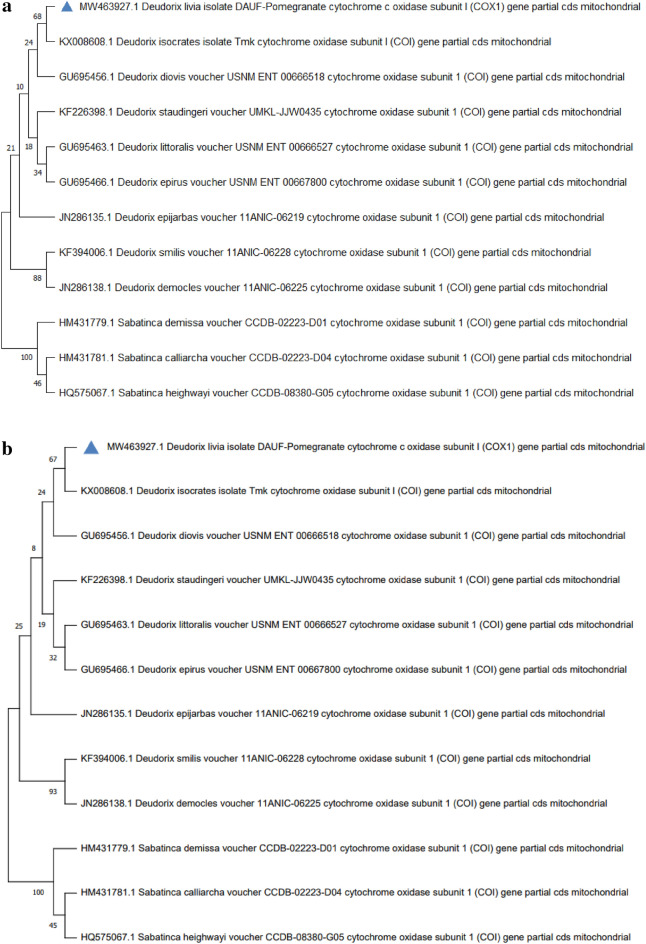
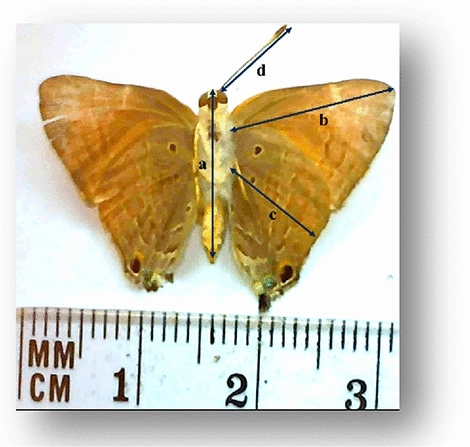
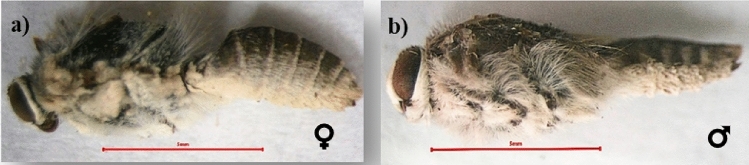
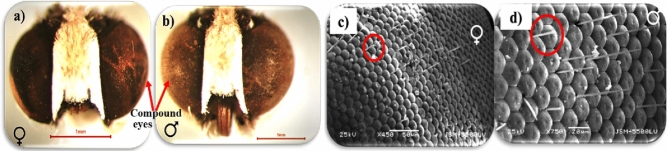
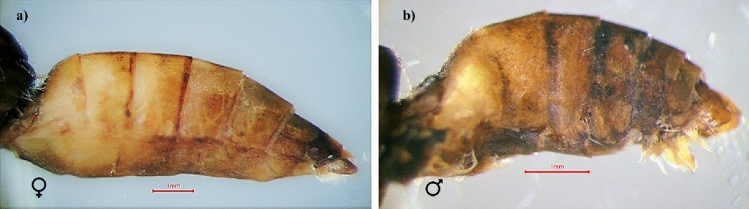
Deudorix livia (Klug, 1834) (Lepidoptera: Lycaenidae) is one of the most serious lepidopteran insect pests attacking pomegranate fruit around the world, including Egypt (Assiut Governorate, Upper Egypt). To create an effective program (IPM) to control such harmful pests, accurate identification of the pest morphology and genetic structure is essential. Studies on the morphogenetics of this pest are scarce. So, the goal of this research is to identify it both morphologically and genetically. Pomegranate butterfly immature stages were collected from infested pomegranate fruits and reared in the laboratory until the adult's emergence. By using light and scanning electron microscopy, some morphological structures of males and females were studied. DNA was extracted from the legs of a pomegranate butterfly adult. Also, PCR was conducted by using the mitochondrial CO1 gene for sequencing and phylogenetic tests. The results show that the body scales are a mixture of dark and light gray on the dorsal side and white on the ventral side in both sexes. The average male body length (BL) was 11.674 ± 0.299 mm and was 11.458 ± 1.001 mm for the females. The wing venation is similar in both sexes. For the first time, a partial sequence of the mitochondrial CO1 gene in D. livia was deposited in GenBank (MW463927).

摘要

石榴蛱蝶(Deudorix livia)(鳞翅目:蛱蝶科)是全世界石榴果实最严重的鳞翅目害虫之一,包括埃及(上埃及的阿斯尤特省)。为了创建一个有效的有害生物综合治理(IPM)计划来控制这种有害生物,准确识别害虫的形态和遗传结构是必不可少的。对这种害虫的形态遗传学研究很少。因此,本研究的目的是对其进行形态学和遗传学鉴定。从受感染的石榴果实中收集石榴蛱蝶幼虫,并在实验室中饲养,直到成虫出现。利用光镜和扫描电子显微镜研究了雌雄成虫的一些形态结构。从石榴蛱蝶成虫的腿中提取 DNA。还使用线粒体 CO1 基因进行 PCR 测序和系统发育测试。结果表明,雌雄体背侧的体鳞片是深灰色和浅灰色的混合物,腹侧是白色的。雄性平均体长(BL)为 11.674±0.299mm,雌性为 11.458±1.001mm。雌雄翅脉相似。首次在石榴蛱蝶的线粒体 CO1 基因的部分序列在 GenBank(MW463927)中被保存。

https://cdn.ncbi.nlm.nih.gov/pmc/blobs/6386/10654914/00405b36cd08/41598_2023_46231_Fig12_HTML.jpg
https://cdn.ncbi.nlm.nih.gov/pmc/blobs/6386/10654914/9a4542e9ab52/41598_2023_46231_Fig1_HTML.jpg
https://cdn.ncbi.nlm.nih.gov/pmc/blobs/6386/10654914/81ae94954595/41598_2023_46231_Fig2_HTML.jpg
https://cdn.ncbi.nlm.nih.gov/pmc/blobs/6386/10654914/86ef76a04566/41598_2023_46231_Fig3_HTML.jpg
https://cdn.ncbi.nlm.nih.gov/pmc/blobs/6386/10654914/87af80fbd7a9/41598_2023_46231_Fig4_HTML.jpg
https://cdn.ncbi.nlm.nih.gov/pmc/blobs/6386/10654914/839513664dc8/41598_2023_46231_Fig5_HTML.jpg
https://cdn.ncbi.nlm.nih.gov/pmc/blobs/6386/10654914/d9c513500bfa/41598_2023_46231_Fig6_HTML.jpg
https://cdn.ncbi.nlm.nih.gov/pmc/blobs/6386/10654914/26883f754e48/41598_2023_46231_Fig7_HTML.jpg
https://cdn.ncbi.nlm.nih.gov/pmc/blobs/6386/10654914/f98750da3c0c/41598_2023_46231_Fig8_HTML.jpg
https://cdn.ncbi.nlm.nih.gov/pmc/blobs/6386/10654914/666e5025817c/41598_2023_46231_Fig9_HTML.jpg
https://cdn.ncbi.nlm.nih.gov/pmc/blobs/6386/10654914/dd766d545cb9/41598_2023_46231_Fig10_HTML.jpg
https://cdn.ncbi.nlm.nih.gov/pmc/blobs/6386/10654914/5634317c5280/41598_2023_46231_Fig11_HTML.jpg
https://cdn.ncbi.nlm.nih.gov/pmc/blobs/6386/10654914/00405b36cd08/41598_2023_46231_Fig12_HTML.jpg
https://cdn.ncbi.nlm.nih.gov/pmc/blobs/6386/10654914/9a4542e9ab52/41598_2023_46231_Fig1_HTML.jpg
https://cdn.ncbi.nlm.nih.gov/pmc/blobs/6386/10654914/81ae94954595/41598_2023_46231_Fig2_HTML.jpg
https://cdn.ncbi.nlm.nih.gov/pmc/blobs/6386/10654914/86ef76a04566/41598_2023_46231_Fig3_HTML.jpg
https://cdn.ncbi.nlm.nih.gov/pmc/blobs/6386/10654914/87af80fbd7a9/41598_2023_46231_Fig4_HTML.jpg
https://cdn.ncbi.nlm.nih.gov/pmc/blobs/6386/10654914/839513664dc8/41598_2023_46231_Fig5_HTML.jpg
https://cdn.ncbi.nlm.nih.gov/pmc/blobs/6386/10654914/d9c513500bfa/41598_2023_46231_Fig6_HTML.jpg
https://cdn.ncbi.nlm.nih.gov/pmc/blobs/6386/10654914/26883f754e48/41598_2023_46231_Fig7_HTML.jpg
https://cdn.ncbi.nlm.nih.gov/pmc/blobs/6386/10654914/f98750da3c0c/41598_2023_46231_Fig8_HTML.jpg
https://cdn.ncbi.nlm.nih.gov/pmc/blobs/6386/10654914/666e5025817c/41598_2023_46231_Fig9_HTML.jpg
https://cdn.ncbi.nlm.nih.gov/pmc/blobs/6386/10654914/dd766d545cb9/41598_2023_46231_Fig10_HTML.jpg
https://cdn.ncbi.nlm.nih.gov/pmc/blobs/6386/10654914/5634317c5280/41598_2023_46231_Fig11_HTML.jpg
https://cdn.ncbi.nlm.nih.gov/pmc/blobs/6386/10654914/00405b36cd08/41598_2023_46231_Fig12_HTML.jpg