
血清睾酮与主动脉瓣狭窄之间的关联:一项前瞻性队列研究。
Association between Serum Testosterone and Aortic Valve Stenosis: A Prospective Cohort Study.
作者信息
Laukkanen Jari A, Lavie Carl J, Kunutsor Setor K
机构信息
Institute of Public Health and Clinical Nutrition, University of Eastern Finland, P.O. Box 1627 Kuopio, Finland.
Institute of Clinical Medicine, Department of Medicine, University of Eastern Finland, P.O. Box 100 Kuopio, Finland.
出版信息
J Cardiovasc Dev Dis. 2023 Nov 9;10(11):454. doi: 10.3390/jcdd10110454.
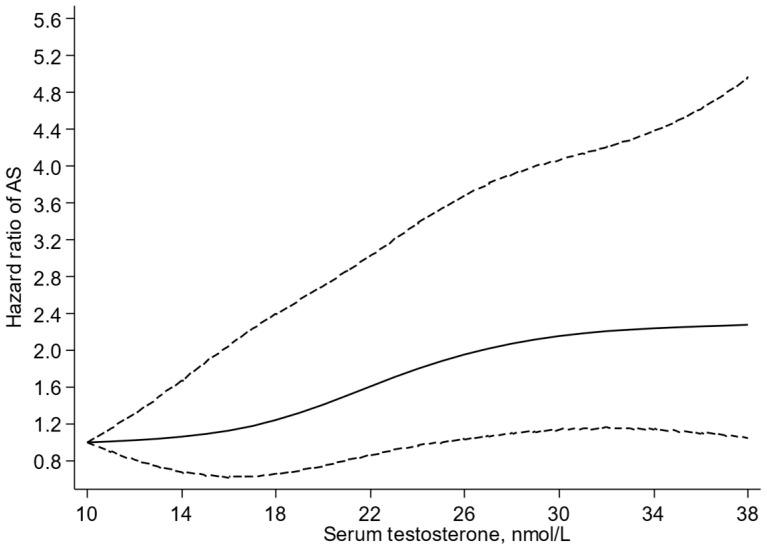
Serum testosterone is associated with atherosclerotic cardiovascular disease, which shares risk factors with aortic stenosis (AS). The association between serum testosterone and AS has not been previously investigated. We aimed to assess the prospective association between serum testosterone and risk of AS. Serum testosterone was determined at baseline using a radioimmunoassay kit in 2577 men aged 42-61 years recruited into the Kuopio Ischemic Heart Disease prospective cohort study. Hazard ratios (HRs) with 95% confidence intervals (Cis) were estimated for AS. After a median follow-up of 27.2 years, 119 cases of AS were recorded. The risk of AS increased continuously with increasing serum testosterone across the range 25-39 nmol/L (-value for nonlinearity = 0.49). In an analysis adjusted for age, body mass index, systolic blood pressure, total cholesterol, high-density lipoprotein cholesterol, smoking status, history of type 2 diabetes, history of coronary heart disease, and alcohol consumption, the HR (95% CI) for AS was 1.39 (1.10-1.76) per 10 nmol/L increase in serum testosterone. When alcohol consumption was replaced with physical activity, the HR (95% CI) was 1.38 (1.09-1.74). Comparing the bottom versus top third of serum testosterone, the corresponding (adjusted) risk estimates were 1.76 (1.11-2.81) and 1.76 (1.10-2.80), respectively. In middle-aged and older Finnish men, elevated levels of serum testosterone were associated with an increased risk of AS. Further research is needed to replicate these findings and assess any potential relevance of serum testosterone in AS prevention.
血清睾酮与动脉粥样硬化性心血管疾病相关,后者与主动脉瓣狭窄(AS)有共同的危险因素。血清睾酮与AS之间的关联此前尚未得到研究。我们旨在评估血清睾酮与AS风险之间的前瞻性关联。在库奥皮奥缺血性心脏病前瞻性队列研究中,使用放射免疫分析试剂盒对招募的2577名年龄在42 - 61岁的男性进行了基线血清睾酮测定。估计了AS的风险比(HRs)及95%置信区间(Cis)。经过27.2年的中位随访,记录了119例AS病例。在25 - 39 nmol/L范围内,AS风险随着血清睾酮水平升高而持续增加(非线性检验P值 = 0.49)。在对年龄、体重指数、收缩压、总胆固醇、高密度脂蛋白胆固醇、吸烟状况、2型糖尿病病史、冠心病病史和饮酒情况进行校正的分析中,血清睾酮每增加10 nmol/L,AS的HR(95% CI)为1.39(1.10 - 1.76)。当用体力活动替代饮酒情况时,HR(95% CI)为1.38(1.09 -
 Zotero 插件