
用于稀有事件搜索的双相氙时间投影室。
Dual-phase xenon time projection chambers for rare-event searches.
作者信息
Baudis Laura
机构信息
Physik-Institut, University of Zürich, Winterthurerstrasse 190, Zürich 8057, Switzerland.
出版信息
Philos Trans A Math Phys Eng Sci. 2024 Feb 5;382(2266):20230083. doi: 10.1098/rsta.2023.0083. Epub 2023 Dec 18.
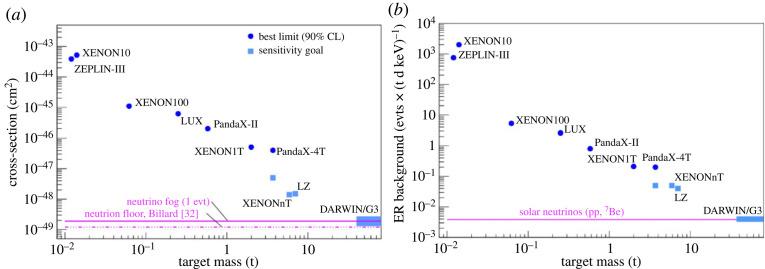
In the past decade, dual-phase xenon time projection chambers (Xe-TPCs) have emerged as some of the most powerful detectors in the fields of astroparticle physics and rare-event searches. Developed primarily towards the direct detection of dark matter particles, experiments presently operating deep underground have reached target masses at the multi-tonne scale, energy thresholds of approximately 1 keV and radioactivity-induced background rates similar to those from solar neutrinos. These unique properties, together with demonstrated stable operation over several years, allow for the exploration of new territory via high-sensitivity searches for a plethora of ultra-rare interactions. These include searches for particle dark matter, for second-order weak decays, and the observation of astrophysical neutrinos. We first review some properties of xenon as a radiation detection medium and the operation principles of dual-phase Xe-TPCs together with their energy calibration and resolution. We then discuss the status of currently running experiments and of proposed next-generation projects, describing some of the technological challenges. We end by looking at their sensitivity to dark matter candidates, to second-order weak decays and to solar and supernova neutrinos. Experiments based on dual-phase Xe-TPCs are difficult and, like all good experiments, they are constantly pushed to their limits. Together with many other endeavours in astroparticle physics and cosmology they will continue to push at the borders of the unknown, hopefully to reveal profound new knowledge about our cosmos. This article is part of the theme issue 'The particle-gravity frontier'.
在过去十年中,双相氙时间投影室(Xe-TPC)已成为天体粒子物理学和稀有事件搜索领域中最强大的探测器之一。主要为直接探测暗物质粒子而开发的实验,目前在地下深处运行,已达到多吨级的目标质量、约1 keV的能量阈值以及与太阳中微子相似的放射性诱导背景率。这些独特的特性,再加上多年来已证明的稳定运行,使得通过对大量超稀有相互作用进行高灵敏度搜索来探索新领域成为可能。这些搜索包括对粒子暗物质、二阶弱衰变的搜索以及对天体物理中微子的观测。我们首先回顾氙作为辐射探测介质的一些特性以及双相Xe-TPC的工作原理,以及它们的能量校准和分辨率。然后,我们讨论当前正在运行的实验和拟议的下一代项目的现状,描述一些技术挑战。最后,我们看看它们对暗物质候选者、二阶弱衰变以及太阳和超新星中微子的灵敏度。基于双相Xe-TPC的实验难度很大,而且像所有优秀的实验一样,它们不断被推向极限。与天体粒子物理学和宇宙学中的许多其他努力一起,它们将继续在未知的边界上探索,有望揭示有关我们宇宙的深刻新知识。本文是主题为“粒子-引力前沿”的一部分。




 Zotero 插件