
不同硒源和水平对产蛋鸡生理状态、硒蛋白表达以及富硒蛋生产和保存的影响。
Effects of different selenium sources and levels on the physiological state, selenoprotein expression, and production and preservation of selenium-enriched eggs in laying hens.
机构信息
Key Laboratory of Animal Nutrition and Feed Science (Eastern of China), College of Animal Science, Zhejiang University, Hangzhou 310058, China.
Key Laboratory of Animal Nutrition and Feed Science (Eastern of China), College of Animal Science, Zhejiang University, Hangzhou 310058, China.
出版信息
Poult Sci. 2024 Feb;103(2):103347. doi: 10.1016/j.psj.2023.103347. Epub 2023 Dec 4.
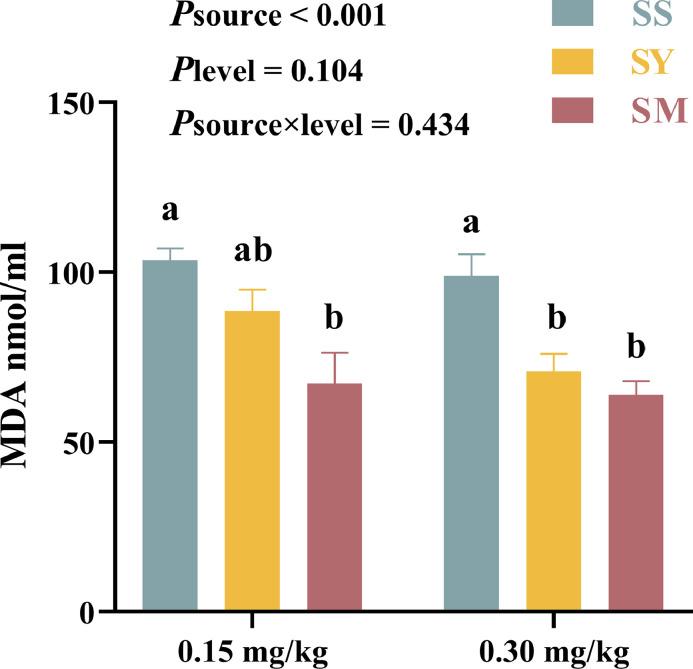
Selenium (i.e., Se) is a trace element that is vital in poultry nutrition, and optimal forms and levels of Se are critical for poultry productivity and health. This study aimed to compare the effects of sodium selenite (SS), yeast selenium (SY), and methionine selenium (SM) at selenium levels of 0.15 mg/kg and 0.30 mg/kg on production performance, egg quality, egg selenium content, antioxidant capacity, immunity and selenoprotein expression in laying hens. The trial was conducted in a 3 × 2 factorial arrangement, and a total of 576 forty-three-wk-old Hyland Brown laying hens were randomly assigned into 6 treatment groups, with diets supplemented with 0.15 mg Se/kg and 0.3 mg Se/kg of SS, SY and SM for 8 wk, respectively. Results revealed that SM increased the laying rate compared to SS and SY (P < 0.05), whereas different selenium levels had no effect. Organic selenium improved egg quality, preservation performance, and selenium deposition compared to SS (P < 0.05), while SY and SM had different preferences for Se deposition in the yolk and albumen. Also, organic selenium enhanced the antioxidant capacity and immune functions of laying hens at 0.15 mg Se/kg, whereas no obvious improvement was observed at 0.30 mg Se/kg. Moreover, SY and SM increased the mRNA expression of most selenoproteins compared to SS (P < 0.05), with SM exhibiting a more pronounced effect. Correlation analysis revealed a strong positive association between glutathione peroxidase 2 (GPx2), thioredoxin reductases (TrxRs), selenoprotein K (SelK), selenoprotein S (SelS), and antioxidant and immune properties. In conclusion, the use of low-dose organic selenium is recommended as a more effective alternative to inorganic selenium, and a dosage of 0.15 mg Se/kg from SM is recommended based on the trail conditions.
硒(即 Se)是家禽营养中必不可少的微量元素,硒的最佳形式和水平对家禽的生产力和健康至关重要。本研究旨在比较亚硒酸钠(SS)、酵母硒(SY)和蛋氨酸硒(SM)在 0.15 毫克/千克和 0.30 毫克/千克硒水平下对产蛋性能、蛋品质、蛋硒含量、抗氧化能力、免疫力和产蛋鸡硒蛋白表达的影响。试验采用 3×2 因子设计,将 576 只 43 周龄海兰褐蛋鸡随机分为 6 个处理组,分别在日粮中添加 0.15 毫克硒/千克和 0.3 毫克硒/千克的 SS、SY 和 SM,试验持续 8 周。结果表明,SM 组的产蛋率高于 SS 和 SY 组(P<0.05),而不同硒水平对产蛋率没有影响。与 SS 相比,有机硒提高了蛋品质、保存性能和硒沉积(P<0.05),而 SY 和 SM 对蛋黄和蛋清中硒的沉积有不同的偏好。此外,在 0.15 毫克硒/千克时,有机硒增强了产蛋鸡的抗氧化能力和免疫功能,而在 0.30 毫克硒/千克时则没有明显改善。此外,SY 和 SM 提高了大多数硒蛋白的 mRNA 表达量(P<0.05),SM 的效果更为明显。相关性分析表明,谷胱甘肽过氧化物酶 2(GPx2)、硫氧还蛋白还原酶(TrxRs)、硒蛋白 K(SelK)、硒蛋白 S(SelS)与抗氧化和免疫特性之间存在很强的正相关关系。综上所述,低剂量有机硒是无机硒的更有效替代品,根据试验条件,建议使用 SM 时的硒添加量为 0.15 毫克硒/千克。



 Zotero 插件