Albee Malorie E
Department of Sociology and Anthropology, Northern Michigan University, Marquette, MI, USA.
Evol Med Public Health. 2023 Dec 23;11(1):485-501. doi: 10.1093/emph/eoad041. eCollection 2023.
Modern biocultural environments continue to place selective pressures on our skeletons. In the past century, a major cultural pressure has been the rise in sedentism. However, studies considering the effects of sedentism on the foot have largely considered pathological changes to the gross foot without particular regard for the pedal skeleton. To address this gap in the literature, temporal trends in the development of osteoarthritis and entheseal changes on the tarsals and metatarsals were analyzed in the context of biodemographic data for recent modern humans.
The sample utilized for this project is comprised of 71 individuals from the William M. Bass Donated Skeletal Collection, with birth years ranging from 1909 to 1993. Temporal trends in osteoarthritis and entheseal changes were determined via ANCOVA, using year of birth as the explanatory variable and biodemographic variables (age, sex, stature, body mass index and tibial robusticity) as covariates.
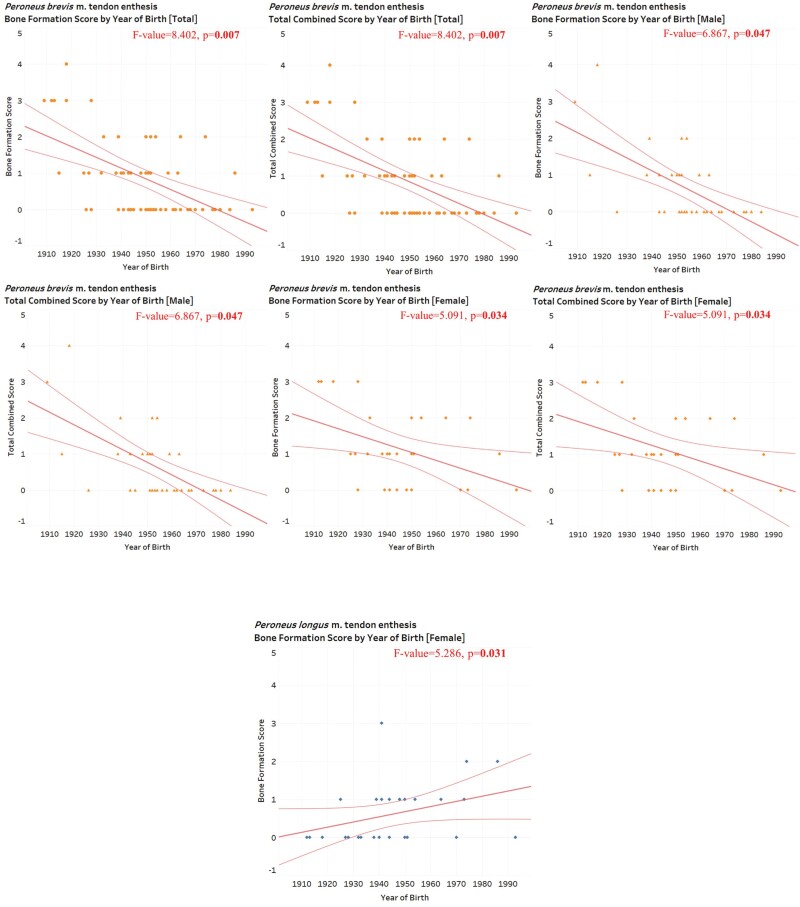
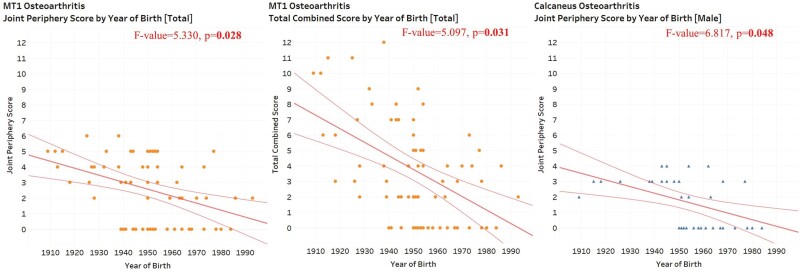
Results indicate that entheseal changes and osteoarthritis have decreased over time, and these trends are statistically significant. Temporal trends in pedal entheseal changes and osteoarthritis vary by sex.
The increase in sedentary behavior over time has usually been framed as a net negative for human health and well-being. However, considered in isolation, the decrease in entheseal changes and osteoarthritis presented here might be considered a positive development as they suggest overall less stress on the modern human foot. This study also has the potential to inform the health sciences and general public about biocultural contributors to modern foot health.
现代生物文化环境持续对我们的骨骼施加选择压力。在过去的一个世纪里,一种主要的文化压力是久坐行为的增加。然而,考虑久坐行为对足部影响的研究大多关注足部整体的病理变化,而没有特别关注足部骨骼。为了填补这一文献空白,我们结合近代现代人的生物人口学数据,分析了跗骨和跖骨上骨关节炎发展及附着点变化的时间趋势。
本项目使用的样本由来自威廉·M·巴斯捐赠骨骼收藏的71名个体组成,出生年份从1909年到1993年。通过协方差分析确定骨关节炎和附着点变化的时间趋势,以出生年份作为解释变量,以生物人口学变量(年龄、性别、身高、体重指数和胫骨粗壮度)作为协变量。
结果表明,附着点变化和骨关节炎随时间减少,且这些趋势具有统计学意义。足部附着点变化和骨关节炎的时间趋势因性别而异。
随着时间的推移,久坐行为的增加通常被视为对人类健康和幸福的净负面影响。然而,单独来看,这里呈现的附着点变化和骨关节炎的减少可能被视为一种积极的发展,因为它们表明现代人足部的整体压力较小。这项研究还有可能让健康科学领域和普通公众了解影响现代足部健康的生物文化因素。