
MAVS 信号对脂多糖诱导的小鼠急性肾损伤的保护作用。
Protective Role of MAVS Signaling for Murine Lipopolysaccharide-Induced Acute Kidney Injury.
机构信息
Department of Nephrology and Rheumatology, Kanazawa University, Kanazawa, Japan.
Division of Infection Control, Kanazawa University Hospital, Kanazawa, Japan.
出版信息
Immunohorizons. 2024 Jan 1;8(1):1-18. doi: 10.4049/immunohorizons.2300069.
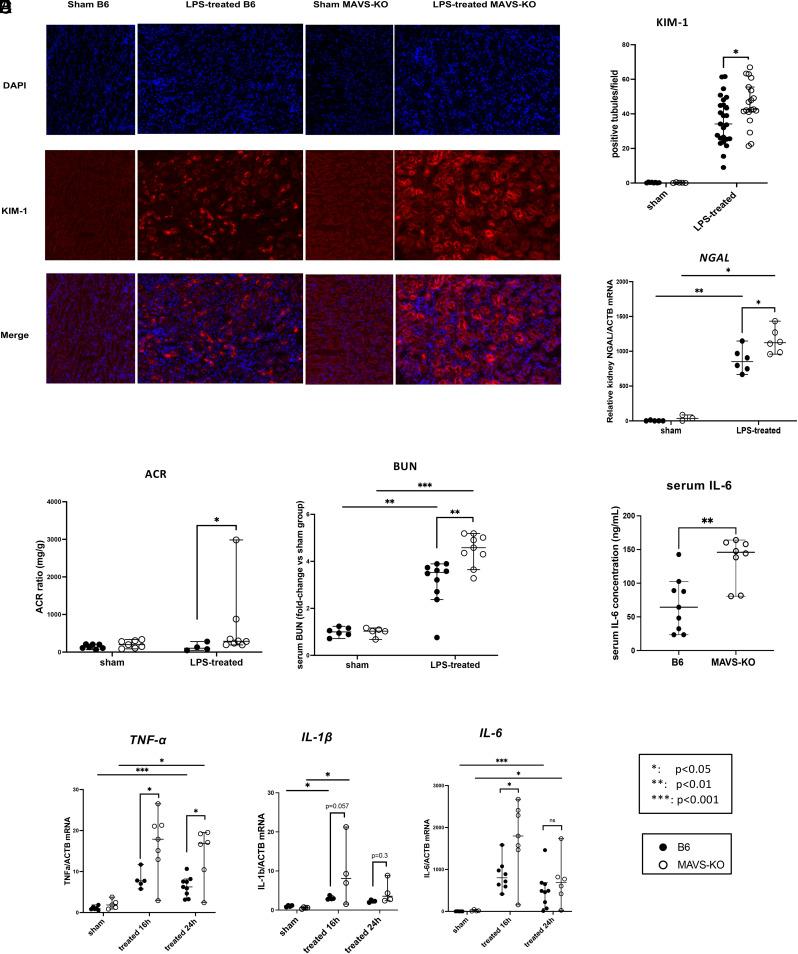
Despite treatment advances, acute kidney injury (AKI)-related mortality rates are still high in hospitalized adults, often due to sepsis. Sepsis and AKI could synergistically worsen the outcomes of critically ill patients. TLR4 signaling and mitochondrial antiviral signaling protein (MAVS) signaling are innate immune responses essential in kidney diseases, but their involvement in sepsis-associated AKI (SA-AKI) remains unclear. We studied the role of MAVS in kidney injury related to the TLR4 signaling pathway using a murine LPS-induced AKI model in wild-type and MAVS-knockout mice. We confirmed the importance of M1 macrophage in SA-AKI through in vivo assessment of inflammatory responses. The TLR4 signaling pathway was upregulated in activated bone marrow-derived macrophages, in which MAVS helped maintain the LPS-suppressed TLR4 mRNA level. MAVS regulated redox homeostasis via NADPH oxidase Nox2 and mitochondrial reverse electron transport in macrophages to alleviate the TLR4 signaling response to LPS. Hypoxia-inducible factor 1α (HIF-1α) and AP-1 were key regulators of TLR4 transcription and connected MAVS-dependent reactive oxygen species signaling with the TLR4 pathway. Inhibition of succinate dehydrogenase could partly reduce inflammation in LPS-treated bone marrow-derived macrophages without MAVS. These findings highlight the renoprotective role of MAVS in LPS-induced AKI by regulating reactive oxygen species generation-related genes and maintaining redox balance. Controlling redox homeostasis through MAVS signaling may be a promising therapy for SA-AKI.
尽管治疗方法有所进步,但住院成人的急性肾损伤(AKI)相关死亡率仍然很高,这通常是由于败血症引起的。败血症和 AKI 可能协同作用,使重症患者的预后恶化。TLR4 信号和线粒体抗病毒信号蛋白(MAVS)信号是肾脏疾病中必需的先天免疫反应,但它们在与败血症相关的 AKI(SA-AKI)中的作用仍不清楚。我们使用野生型和 MAVS 敲除小鼠的 LPS 诱导的 AKI 模型研究了 MAVS 在 TLR4 信号通路相关肾损伤中的作用。我们通过体内评估炎症反应证实了 M1 巨噬细胞在 SA-AKI 中的重要性。TLR4 信号通路在激活的骨髓来源巨噬细胞中上调,其中 MAVS 有助于维持 LPS 抑制的 TLR4 mRNA 水平。MAVS 通过 NADPH 氧化酶 Nox2 和巨噬细胞中的线粒体逆向电子传递来调节氧化还原稳态,以减轻 TLR4 信号对 LPS 的反应。缺氧诱导因子 1α(HIF-1α)和 AP-1 是 TLR4 转录的关键调节剂,并将 MAVS 依赖性活性氧信号与 TLR4 途径连接起来。抑制琥珀酸脱氢酶可以部分减少 LPS 处理的骨髓来源巨噬细胞中的炎症,而无需 MAVS。这些发现强调了 MAVS 通过调节与活性氧生成相关的基因和维持氧化还原平衡,在 LPS 诱导的 AKI 中发挥肾保护作用。通过 MAVS 信号控制氧化还原稳态可能是治疗 SA-AKI 的一种有前途的方法。



 Zotero 插件