
热灌注腹腔化疗(HIPEC)、新辅助化疗后胃癌合并局限性腹膜疾病进展患者的肿瘤学结局及长期生存情况
Hyperthermic Intraperitoneal Chemotherapy (HIPEC), Oncological Outcomes and Long-Term Survival among Patients with Gastric Cancer and Limited Peritoneal Disease Progression after Neoadjuvant Chemotherapy.
作者信息
Kobiałka Sebastian, Sędłak Katarzyna, Pelc Zuzanna, Mlak Radosław, Endo Yutaka, Bogacz Paweł, Kurylcio Andrzej, Polkowski Wojciech P, Pawlik Timothy M, Rawicz-Pruszyński Karol
机构信息
Department of Surgical Oncology, Medical University of Lublin, 20-080 Lublin, Poland.
Department of Laboratory Diagnostics, Medical University of Lublin, 20-080 Lublin, Poland.
出版信息
J Clin Med. 2023 Dec 27;13(1):161. doi: 10.3390/jcm13010161.
INTRODUCTION
The role of surgery in stage IV gastric cancer with peritoneal metastasis (PM) remains unclear. The objective of the current single-center study was to define the impact of gastrectomy with cytoreductive surgery (CRS) and hyperthermic intraperitoneal chemotherapy (HIPEC) on outcomes among Central European GC patients with limited peritoneal disease progression after neoadjuvant chemotherapy (NAC).
METHODS
Patients with histologically confirmed GC who underwent curative-intent multimodal treatment between 2013 and 2023 were included. Patients without adenocarcinoma, who did not undergo gastrectomy, had early (cT1) or metastatic GC at the time of initial diagnosis, who underwent multivisceral resection, incomplete cytoreduction or palliative care, died before planned curative-intent treatment, or had incomplete clinical or pathological missing information were excluded.
RESULTS
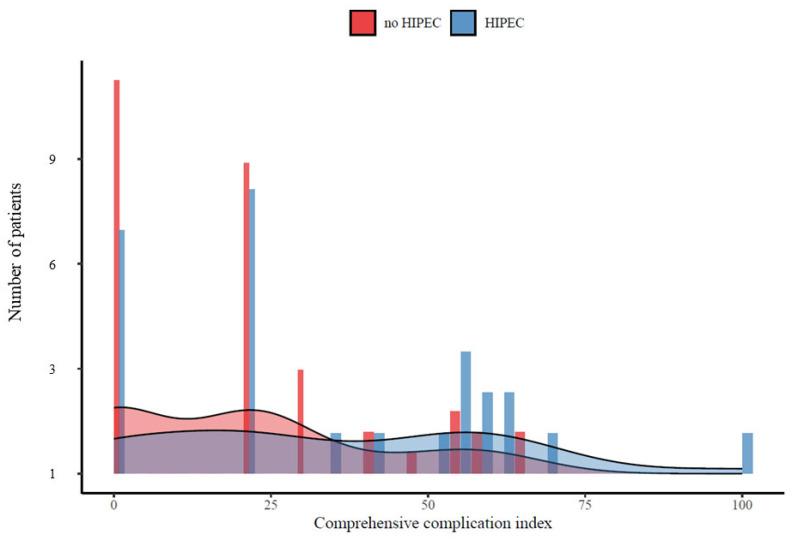
A total of 74 patients who underwent curative-intent treatment for GC with PM were included in the final analytic cohort. Patients who underwent gastrectomy with CRS+HIPEC were less likely to achieve TOO (CRS+HIPEC: 28% vs. CRS: 57.1%, = 0.033) compared with individuals after CRS alone. Specifically, patients who underwent gastrectomy with CRS+HIPEC had a higher likelihood of postoperative complications (CRS+HIPEC: 48% vs. CRS: 20.4%, = 0.018) and longer hospital LOS (median, CRS+HIPEC: 12 vs. CRS: 10, = 0.019). While administration of HIPEC did not impact long-term survival (median OS, CRS+HIPEC: 16 months vs. CRS: 12 months, = 0.55), postoperative complications (median OS, CCI < 30:16 months vs. CCI > 30:5 months, = 0.024) and ICU stay (median OS, no ICU stay: 16 months vs. ICU stay: 5 months, = 0.008) were associated with worsened long-term survival among GC patients with PM.
CONCLUSIONS
Data from the current study demonstrated a lack of survival benefit among advanced GC patients with PM undergoing gastrectomy with CRS+HIPEC when compared with individuals after gastrectomy with CRS alone. Administration of perioperative chemotherapy and achievement of TO failed to withstand the peritoneal disease progression during NAC.
引言
手术在伴有腹膜转移(PM)的IV期胃癌中的作用仍不明确。本单中心研究的目的是确定胃切除术联合细胞减灭术(CRS)和腹腔热灌注化疗(HIPEC)对新辅助化疗(NAC)后腹膜疾病进展有限的中欧胃癌患者预后的影响。
方法
纳入2013年至2023年间接受根治性多模式治疗且组织学确诊为胃癌的患者。排除非腺癌患者、未接受胃切除术的患者、初诊时为早期(cT1)或转移性胃癌的患者、接受多脏器切除术的患者、细胞减灭不完全或接受姑息治疗的患者、在计划的根治性治疗前死亡的患者,以及临床或病理信息缺失不全的患者。
结果
最终分析队列纳入了74例接受根治性治疗的伴有PM的胃癌患者。与仅接受CRS的患者相比,接受CRS+HIPEC胃切除术的患者实现无肉眼可见肿瘤残留(RO0)的可能性较小(CRS+HIPEC:28% 对CRS:57.1%,P = 0.033)。具体而言,接受CRS+HIPEC胃切除术的患者术后并发症的可能性更高(CRS+HIPEC:48% 对CRS:20.4%,P = 0.018),住院时间更长(中位数,CRS+HIPEC:12天对CRS:十天,P = 0.019)。虽然HIPEC的应用对长期生存没有影响(中位总生存期,CRS+HIPEC:16个月对CRS:12个月,P = 0.55),但术后并发症(中位总生存期;Charlson合并症指数(CCI)<30:16个月对CCI>30:5个月,P = 0.024)和入住重症监护病房(ICU)时间(中位总生存期,未入住ICU:16个月对入住ICU:5个月,P = 0.008)与伴有PM的胃癌患者长期生存恶化相关。
结论
本研究数据表明,与仅接受CRS胃切除术的患者相比,接受CRS+HIPEC胃切除术的晚期伴有PM的胃癌患者缺乏生存获益。围手术期化疗的应用和RO0的实现未能抵御NAC期间的腹膜疾病进展。


 Zotero 插件