
面部表面肌电图:前庭神经鞘瘤手术后面神经功能评估的新方法。
Facial Surface Electromyography: A Novel Approach to Facial Nerve Functional Evaluation after Vestibular Schwannoma Surgery.
作者信息
Franz Leonardo, Marioni Gino, Daloiso Antonio, Biancoli Elia, Tealdo Giulia, Cazzador Diego, Nicolai Piero, de Filippis Cosimo, Zanoletti Elisabetta
机构信息
Phoniatrics and Audiology Unit, Department of Neuroscience (DNS), University of Padova, 31100 Treviso, Italy.
Otolaryngology Unit, Department of Neuroscience (DNS), University of Padova, 35128 Padova, Italy.
出版信息
J Clin Med. 2024 Jan 19;13(2):590. doi: 10.3390/jcm13020590.
BACKGROUND
Vestibular schwannoma (VS) surgery may cause facial nerve damage. However, a comprehensive evaluation of post-operative facial outcomes may be difficult to achieve. Surface electromyography (sEMG) is a promising non-invasive evaluation tool. However, its use in the follow-up after VS surgery has not been reported yet. The main objective was to develop and validate a new sEMG application specifically for the post-VS surgery setting. Secondary goals were to provide a systematic description of facial muscle activity after VS surgery and assess the association between sEMG parameters and Sunnybrook scale scores.
METHODS
Thirty-three patients with facial palsy following VS surgery were included. The clinical outcomes (Sunnybrook symmetry, movement, and synkinesis scores) and sEMG parameters (signal amplitude normalized by the maximal voluntary contraction (NEMG) and sEMG synkinesis score (ESS, number of synkinesis per movement sequence)) were evaluated at the end of the follow-up.
RESULTS
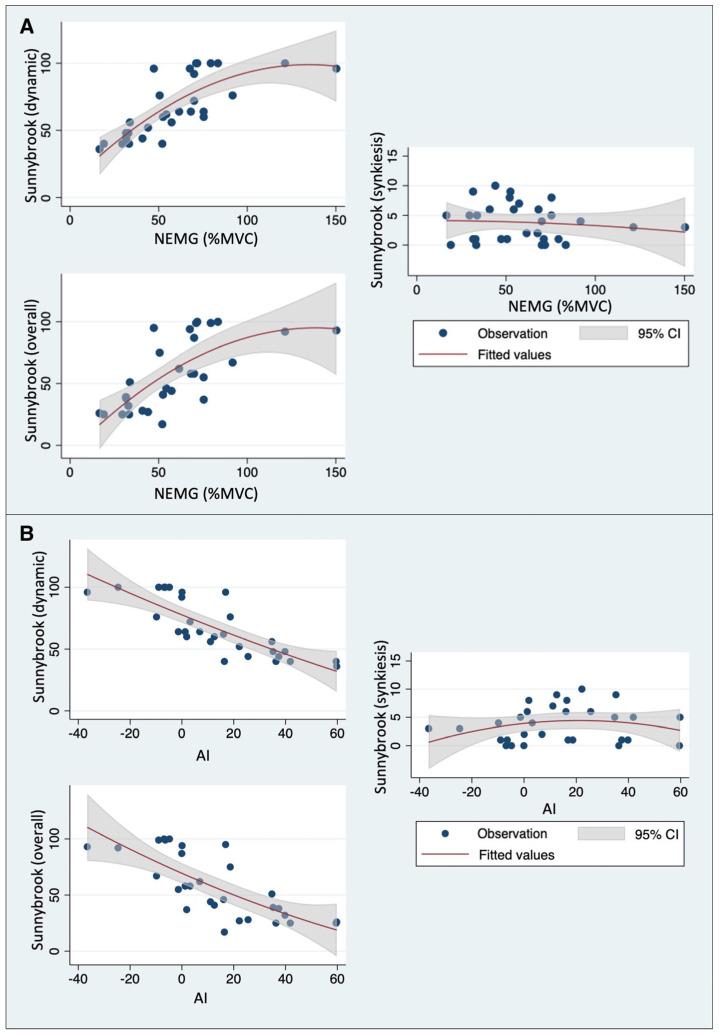
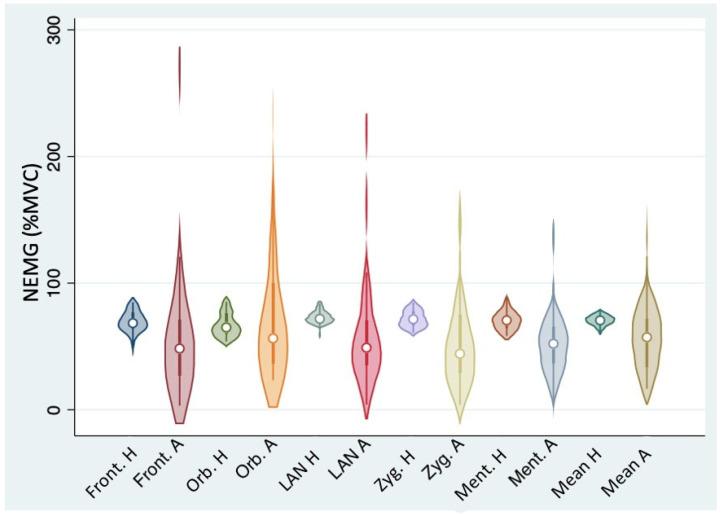
In all tested muscles, NEMG variance was significantly higher on the affected side than the contralateral (variance ratio test, < 0.00001 for each muscle). In total, 30 out of 33 patients (90.9%) showed an ESS ≥ 1 (median: 2.5, IQR: 1.5-3.0). On the affected side, NEMG values positively correlated with both dynamic and overall Sunnybrook scores (Spearman's model, < 0.05 for each muscle, except orbicularis oculi). ESS significantly correlated with the Sunnybrook synkinesis score (Spearman's rho: 0.8268, < 0.0001).
CONCLUSIONS
We described and preliminarily validated a novel multiparametric sEMG approach based on both signal amplitude and synkinesis evaluation specifically for oto-neurosurgery. Large-scale studies are mandatory to further characterize the semiological and prognostic value of facial sEMG.
背景
前庭神经鞘瘤(VS)手术可能导致面神经损伤。然而,术后对面部结果进行全面评估可能难以实现。表面肌电图(sEMG)是一种很有前景的非侵入性评估工具。然而,其在VS手术后随访中的应用尚未见报道。主要目的是开发并验证一种专门用于VS手术后情况的新型sEMG应用。次要目标是系统描述VS手术后面部肌肉活动,并评估sEMG参数与桑尼布鲁克量表评分之间的关联。
方法
纳入33例VS手术后出现面瘫的患者。在随访结束时评估临床结果(桑尼布鲁克对称性、运动和联带运动评分)和sEMG参数(通过最大自主收缩标准化的信号幅度(NEMG)和sEMG联带运动评分(ESS,每个运动序列的联带运动数量))。
结果
在所有测试肌肉中,患侧的NEMG方差显著高于对侧(方差比检验,每块肌肉的P<0.00001)。33例患者中有30例(90.9%)的ESS≥1(中位数:2.5,四分位间距:1.5 - 3.0)。在患侧,NEMG值与动态和总体桑尼布鲁克评分均呈正相关(斯皮尔曼模型,除眼轮匝肌外,每块肌肉的P<0.05)。ESS与桑尼布鲁克联带运动评分显著相关(斯皮尔曼相关系数:0.8268,P<0.0001)。
结论
我们描述并初步验证了一种基于信号幅度和联带运动评估的新型多参数sEMG方法,专门用于耳神经外科手术。需要进行大规模研究以进一步明确面部sEMG的症状学和预后价值。


 Zotero 插件