
TCDD 和 CH223191 改变 T 细胞平衡,但不能诱导成年狼疮小鼠产生抗炎反应。
TCDD and CH223191 Alter T Cell Balance but Fail to Induce Anti-Inflammatory Response in Adult Lupus Mice.
机构信息
Department of Biomedical Sciences and Pathobiology, Virginia-Maryland College of Veterinary Medicine, Virginia Polytechnic Institute and State University, Blacksburg, VA.
Department of Mathematics, Virginia Polytechnic Institute and State University, Blacksburg, VA.
出版信息
Immunohorizons. 2024 Feb 1;8(2):172-181. doi: 10.4049/immunohorizons.2300023.
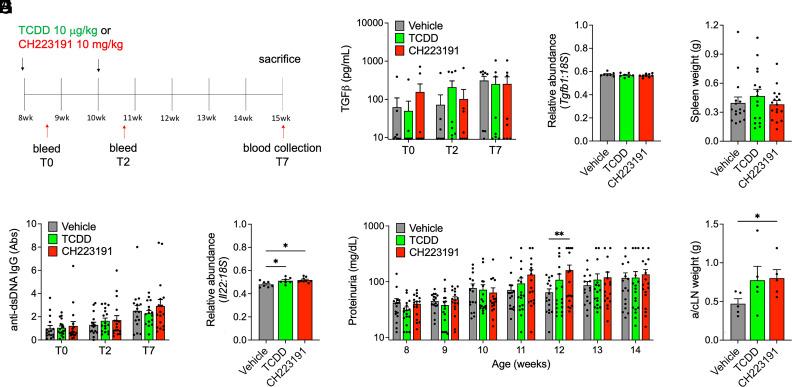
Aryl hydrocarbon receptor (AhR) responds to endogenous and exogenous ligands as a cytosolic receptor, transcription factor, and E3 ubiquitin ligase. Several studies support an anti-inflammatory effect of AhR activation. However, exposure to the AhR agonist 2,3,7,8-tetrachlorodibenzo-p-dioxin (TCDD) during early stages of development results in an autoimmune phenotype and exacerbates lupus. The effects of TCDD on lupus in adults with pre-existing autoimmunity have not been described. We present novel evidence that AhR stimulation by TCDD alters T cell responses but fails to impact lupus-like disease using an adult mouse model. Interestingly, AhR antagonist CH223191 also changed T cell balance in our model. We next developed a conceptual framework for identifying cellular and molecular factors that contribute to physiological outcomes in lupus and created models that describe cytokine dynamics that were fed into a system of differential equations to predict the kinetics of T follicular helper (Tfh) and regulatory T (Treg) cell populations. The model predicted that Tfh cells expanded to larger values following TCDD exposure compared with vehicle and CH223191. Following the initial elevation, both Tfh and Treg cell populations continuously decayed over time. A function based on the ratio of predicted Treg/Tfh cells showed that Treg cells exceed Tfh cells in all groups, with TCDD and CH223191 showing lower Treg/Tfh cell ratios than the vehicle and that the ratio is relatively constant over time. We conclude that AhR ligands did not induce an anti-inflammatory response to attenuate autoimmunity in adult lupus mice. This study challenges the dogma that TCDD supports an immunosuppressive phenotype.
芳香烃受体 (AhR) 作为胞质受体、转录因子和 E3 泛素连接酶,对内源性和外源性配体作出响应。有几项研究支持 AhR 激活的抗炎作用。然而,在发育早期暴露于 AhR 激动剂 2,3,7,8-四氯二苯并对二恶英 (TCDD) 会导致自身免疫表型,并使狼疮恶化。关于 TCDD 对已有自身免疫的成人狼疮的影响尚未有描述。我们提出了新的证据,表明 TCDD 通过 AhR 刺激改变 T 细胞反应,但未能使用成人小鼠模型影响狼疮样疾病。有趣的是,AhR 拮抗剂 CH223191 也改变了我们模型中的 T 细胞平衡。接下来,我们为确定导致狼疮中生理结果的细胞和分子因素开发了一个概念框架,并建立了描述细胞因子动态的模型,这些模型被输入到微分方程系统中,以预测滤泡辅助性 T 细胞 (Tfh) 和调节性 T (Treg) 细胞群的动力学。该模型预测,与载体和 CH223191 相比,TCDD 暴露后 Tfh 细胞会扩张到更大的值。初始升高后,Tfh 和 Treg 细胞群随时间连续衰减。基于预测的 Treg/Tfh 细胞比值的函数表明,在所有组中 Treg 细胞均超过 Tfh 细胞,TCDD 和 CH223191 显示的 Treg/Tfh 细胞比值低于载体,并且该比值随时间相对恒定。我们得出结论,AhR 配体并未诱导抗炎反应来减轻成年狼疮小鼠的自身免疫。这项研究挑战了 TCDD 支持免疫抑制表型的观点。



 Zotero 插件