
内皮和壁层 laminin-α5 有助于维持神经血管完整性。
Endothelial and mural laminin-α5 contributes to neurovascular integrity maintenance.
机构信息
Department of Molecular Pharmacology and Physiology, Morsani College of Medicine, University of South Florida, 12901 Bruce B. Downs Blvd., MDC 8, 33612, Tampa, FL, USA.
出版信息
Fluids Barriers CNS. 2024 Feb 21;21(1):18. doi: 10.1186/s12987-024-00521-z.
BACKGROUND
Laminin-α5, a major component of the basal lamina, is predominantly synthesized by endothelial and mural cells (pericytes and vascular smooth muscle cells) in the CNS. Loss of laminin-α5 in either population fails to induce any abnormalities due to functional redundancy. Thus, the functional significance of laminin-α5 in neurovascular integrity remains unknown. Here, we hypothesize that ablation of laminin-α5 in both endothelial and mural cells increases neurovascular permeability.
METHODS
The compound knockout mice were generated by crossing laminin-α5 floxed mice with Tie2-Cre and PDGFRβ-Cre, which target endothelial cells and mural cells, respectively. Neurovascular permeability in these mutants was determined with both exogenous and endogenous tracers. Endothelial paracellular and transcellular permeability was assessed by examining the expression of tight junction proteins and transcytosis-associated proteins. In addition, transmission electron microscopy (TEM) was used to visualize tight junction ultrastructure and endothelial caveolae vesicles. Defects in pericytes and astrocytes were investigated by examining pericyte coverage/contact and astrocyte polarity.
RESULTS
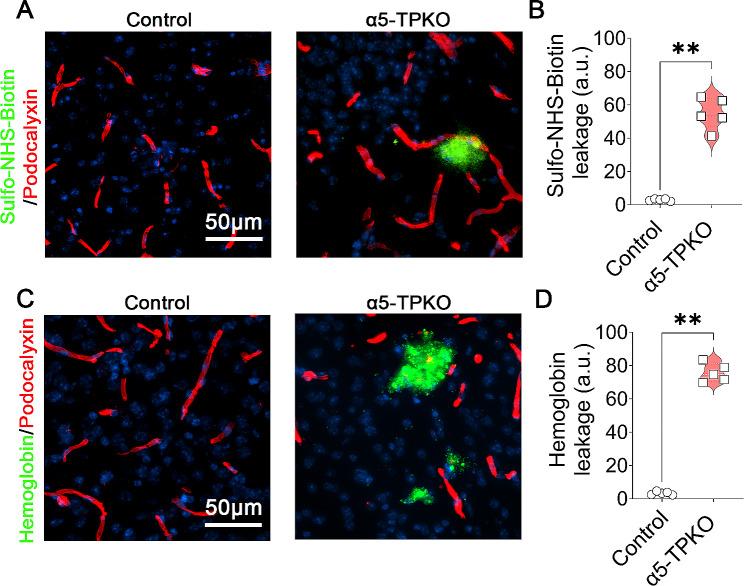
Elevated neurovascular permeability was observed in the mutants. Subsequent studies found increased Caveolin-1 and decreased major facilitator superfamily domain-containing protein 2a (MFSD2A) expression, but unaltered Claudin-5 or zonula occludens-1 (ZO-1) expression. Consistent with these results, mutant mice exhibited increased endothelial caveolae vesicle number with intact tight junction structure under TEM. Additionally, pericyte coverage and contact were also decreased in the mutant mice, while astrocyte polarity was unaffected.
CONCLUSIONS
These results strongly indicate that endothelial and mural cell-derived laminin-α5 actively maintains neurovascular integrity via the transcellular rather than paracellular mechanism.
背景
层粘连蛋白-α5 是基底膜的主要成分,主要由中枢神经系统的内皮细胞和壁细胞(周细胞和血管平滑肌细胞)合成。由于功能冗余,层粘连蛋白-α5 在这两种细胞群体中的缺失都不会导致任何异常。因此,层粘连蛋白-α5 在神经血管完整性中的功能意义尚不清楚。在这里,我们假设内皮细胞和壁细胞中层粘连蛋白-α5 的缺失会增加神经血管通透性。
方法
通过将层粘连蛋白-α5 基因敲除小鼠与分别靶向内皮细胞和壁细胞的 Tie2-Cre 和 PDGFRβ-Cre 进行杂交,生成了复合基因敲除小鼠。使用外源性和内源性示踪剂来确定这些突变体的神经血管通透性。通过检查紧密连接蛋白和转胞吞作用相关蛋白的表达来评估内皮细胞旁通透性和跨细胞通透性。此外,还使用透射电子显微镜(TEM)来观察紧密连接的超微结构和内皮 caveolae 囊泡。通过检查周细胞和星形胶质细胞的覆盖/接触和星形胶质细胞极性来研究周细胞和星形胶质细胞的缺陷。
结果
在突变体中观察到神经血管通透性升高。随后的研究发现 Caveolin-1 表达增加,而主要易化剂超家族结构域包含蛋白 2a(MFSD2A)表达减少,但 Claudin-5 或 zonula occludens-1(ZO-1)表达不变。与这些结果一致,在 TEM 下,突变小鼠表现出完整紧密连接结构下内皮 caveolae 囊泡数量增加。此外,突变小鼠的周细胞覆盖和接触也减少,而星形胶质细胞极性不受影响。
结论
这些结果强烈表明,内皮细胞和壁细胞衍生的层粘连蛋白-α5 通过跨细胞而非旁细胞机制积极维持神经血管完整性。




 Zotero 插件