
20-HETE 介导的 TRPV1 激活通过 MrgprA3 神经元驱动慢性皮炎中的趋化运动。
20-HETE mediated TRPV1 activation drives allokinesis via MrgprA3 neurons in chronic dermatitis.
机构信息
Jiangsu Collaborative Innovation Center of Chinese Medicinal Resources Industrialization, Jiangsu Key Laboratory for High Technology Research of TCM Formulae, Nanjing University of Chinese Medicine, Nanjing, China.
Key Laboratory for Chinese Medicine of Prevention and Treatment in Neurological Diseases, School of Medicine, Nanjing University of Chinese Medicine, Nanjing, China.
出版信息
Theranostics. 2024 Feb 4;14(4):1615-1630. doi: 10.7150/thno.85214. eCollection 2024.
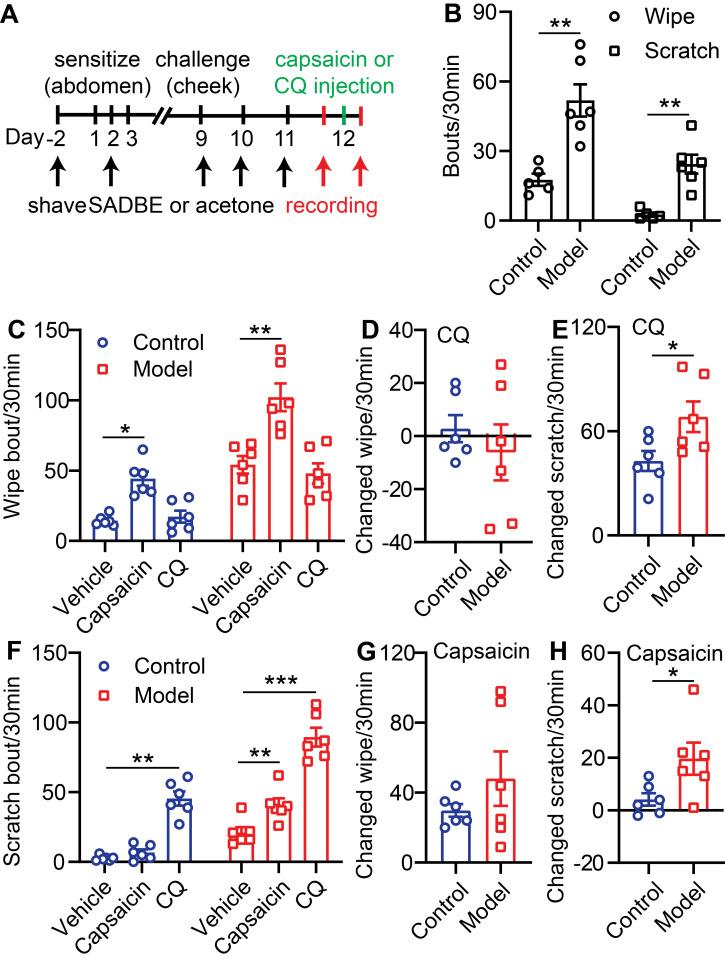
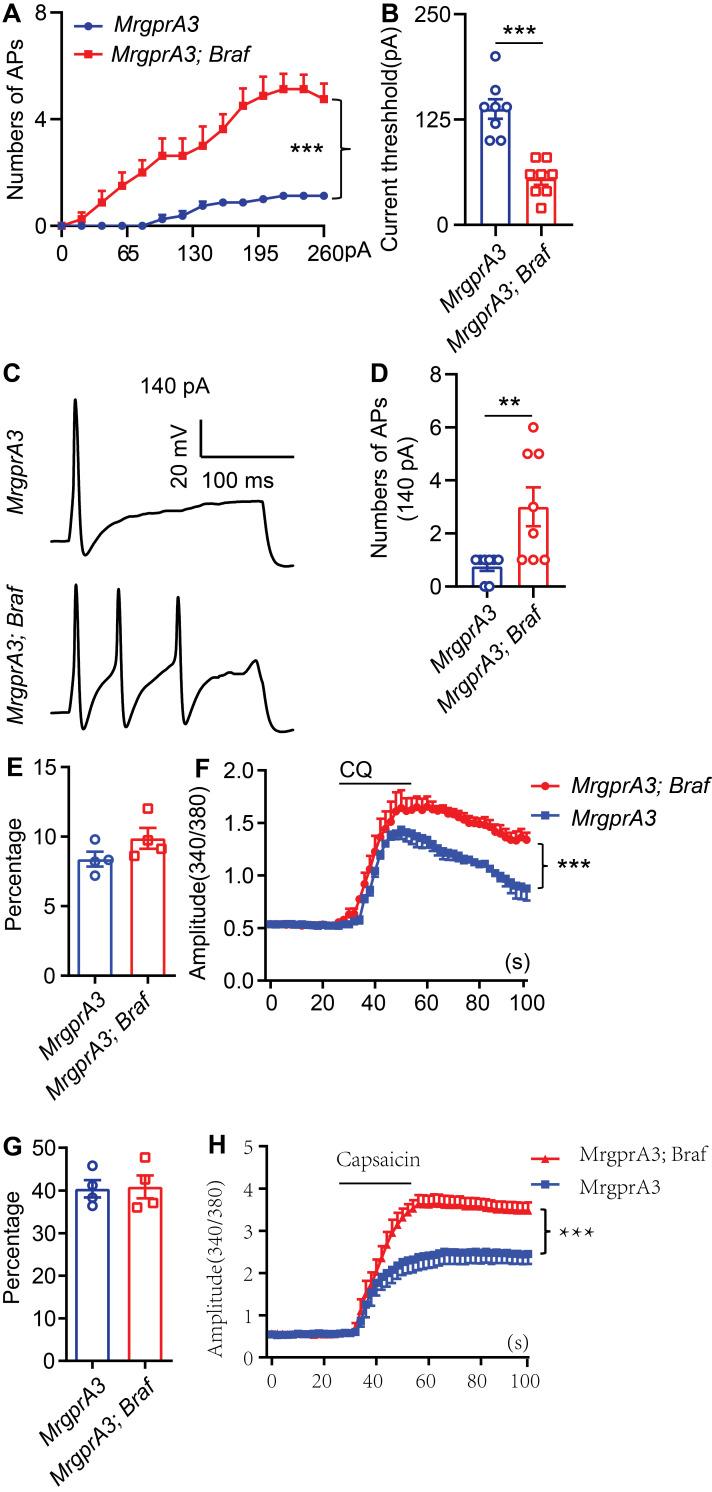
Noxious stimuli are often perceived as itchy in patients with chronic dermatitis (CD); however, itch and pain mechanisms of CD are not known. TRPV1 involvement in CD was analyzed using a SADBE induced CD-like mouse model, and several loss- and gain-of-function mouse models. Trigeminal TRPV1 channel and MrgprA3 neuron functions were analyzed by calcium imaging and whole-cell patch-clamp recordings. Lesional CD-like skin from mice were analyzed by unbiased metabolomic analysis. 20-HETE availability in human and mouse skin were determined by LC/MS and ELISA. And finally, HET0016, a selective 20-HETE synthase inhibitor, was used to evaluate if blocking skin TRPV1 activation alleviates CD-associated chronic itch or pain. While normally a pain inducing chemical, capsaicin induced both itch and pain in mice with CD condition. DREADD silencing of MrgprA3 primary sensory neurons in these mice selectively decreased capsaicin induced scratching, but not pain-related wiping behavior. In the mice with CD condition, MrgprA3 neurons showed elevated ERK phosphorylation. Further experiments showed that MrgprA3 neurons from mice, which have constitutively active BRAF in MrgprA3 neurons, were significantly more excitable and responded more strongly to capsaicin. Importantly, capsaicin induced both itch and pain in mice in an MrgprA3 neuron dependent manner. Finally, the arachidonic acid metabolite 20-HETE, which can activate TRPV1, was significantly elevated in the lesional skin of mice and patients with CD. Treatment with the selective 20-HETE synthase inhibitor HET0016 alleviated itch in mice with CD condition. Our results demonstrate that 20-HETE activates TRPV1 channels on sensitized MrgprA3 neurons, and induces allokinesis in lesional CD skin. Blockade of 20-HETE synthesis or silencing of TRPV1-MrgprA3 neuron signaling offers promising therapeutic strategies for alleviating CD-associated chronic itch.
有害刺激通常会被患有慢性皮炎 (CD) 的患者感知为瘙痒;然而,CD 的瘙痒和疼痛机制尚不清楚。我们使用 SADBE 诱导的 CD 样小鼠模型和几种失活和激活功能的小鼠模型来分析 TRPV1 在 CD 中的作用。通过钙成像和全细胞膜片钳记录分析三叉神经 TRPV1 通道和 MrgprA3 神经元功能。通过无偏代谢组学分析分析来自小鼠的皮损 CD 样皮肤。通过 LC/MS 和 ELISA 测定人类和小鼠皮肤中的 20-HETE 含量。最后,使用选择性 20-HETE 合酶抑制剂 HET0016 来评估阻断皮肤 TRPV1 激活是否可缓解与 CD 相关的慢性瘙痒或疼痛。虽然通常是一种引起疼痛的化学物质,但辣椒素在患有 CD 条件的小鼠中既引起瘙痒又引起疼痛。在这些小鼠中,通过 DREADD 沉默 MrgprA3 初级感觉神经元选择性地减少了辣椒素诱导的搔抓,但没有减少与疼痛相关的擦拭行为。在 CD 条件下的小鼠中,MrgprA3 神经元显示出升高的 ERK 磷酸化。进一步的实验表明,具有 BRAF 在 MrgprA3 神经元中组成性激活的小鼠的 MrgprA3 神经元显著更兴奋,并且对辣椒素的反应更强烈。重要的是,辣椒素在依赖 MrgprA3 神经元的方式下在 小鼠中既引起瘙痒又引起疼痛。最后,可激活 TRPV1 的花生四烯酸代谢物 20-HETE 在小鼠和 CD 患者皮损皮肤中显著升高。用选择性 20-HETE 合酶抑制剂 HET0016 治疗可缓解 CD 条件下的瘙痒。我们的研究结果表明,20-HETE 激活致敏的 MrgprA3 神经元上的 TRPV1 通道,并在皮损 CD 皮肤中诱导同种运动。阻断 20-HETE 合成或沉默 TRPV1-MrgprA3 神经元信号传递为缓解与 CD 相关的慢性瘙痒提供了有前途的治疗策略。





 Zotero 插件