Kim Yoon-Vin, Song Joo-Hyoun, Lim Young-Wook, Jo Woo-Lam, Ha Seung-Hun, Lee Kee-Haeng
Department of Orthopedic Surgery, College of Medicine, The Catholic University of Korea, Seoul, Korea.
Hip Pelvis. 2024 Mar 1;36(1):47-54. doi: 10.5371/hp.2024.36.1.47.
Venous thromboembolism (VTE) is a major complication for hip fracture patients, and may exist preoperatively. This study aimed to examine the prevalence of VTE after immediate screening in hip fracture patients.
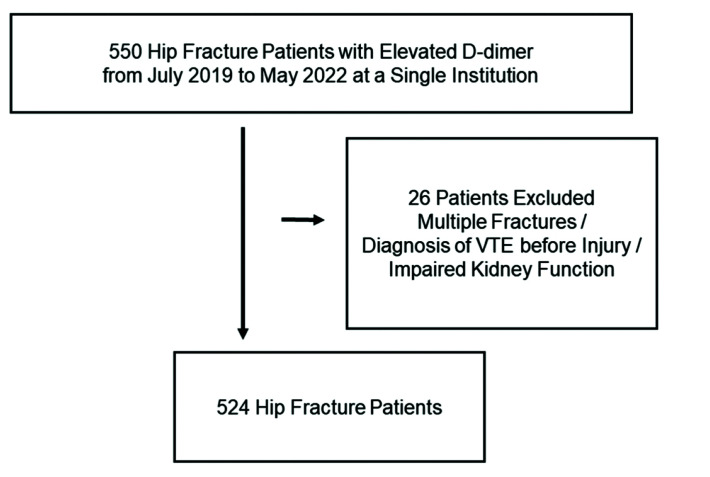
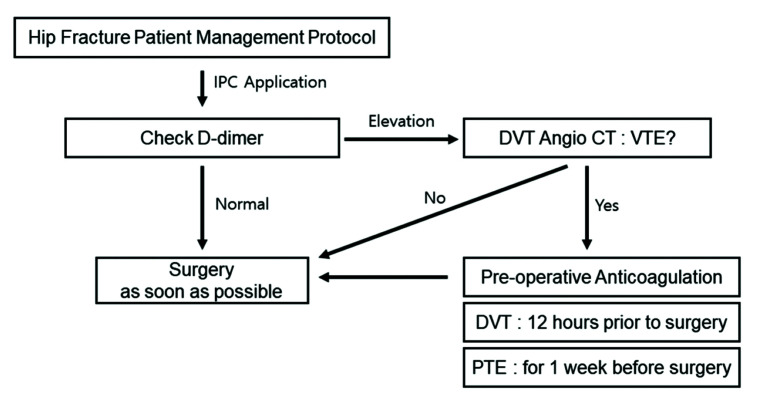
Hip fracture patients with an elevated level of D-dimer underwent screening for VTE using computed tomography (CT) angiography. Anticoagulation treatments were administered preoperatively to patients diagnosed with VTE, followed by administration of additional anticoagulation postoperatively. Medical records were reviewed to identify risk factors for preoperative VTE and determine the prognosis of the patients.
Among 524 hip fracture patients, 66 patients (12.6%) were diagnosed with VTE, including 42 patients with deep vein thrombosis (DVT), 17 patients with pulmonary thromboembolism (PTE), and 7 patients with both DVT and PTE. Of the patients with VTE, 68.2% were diagnosed within 24 hours of injury, and 33.3% of these patients had PTE. VTE patients showed a tendency toward being overweight (<0.01) and not on anticoagulant medication (=0.02) compared to patients without VTE. The risk of VTE was higher for femur shaft fractures (odds ratio [OR] 4.83, 95% confidence interval [CI] 2.18-10.69) and overweight patients (OR 2.12, 95% CI 1.17-3.85), and lower for patients who were previously on anticoagulants (OR 0.36, 95% CI 0.18-0.74). Patients with preoperatively diagnosed VTE were asymptomatic before and after surgery.
Clinicians should be aware that VTE may be present within 24 hours of injury, and screening for VTE or prophylactic measures should be considered for high-risk patients.
静脉血栓栓塞症(VTE)是髋部骨折患者的主要并发症,且可能在术前就已存在。本研究旨在调查髋部骨折患者在进行即刻筛查后VTE的患病率。
D - 二聚体水平升高的髋部骨折患者接受计算机断层扫描(CT)血管造影筛查VTE。对诊断为VTE的患者在术前给予抗凝治疗,术后再给予额外的抗凝治疗。查阅病历以确定术前VTE的危险因素并评估患者的预后。
在524例髋部骨折患者中,66例(12.6%)被诊断为VTE,其中42例为深静脉血栓形成(DVT),17例为肺血栓栓塞症(PTE),7例同时患有DVT和PTE。在VTE患者中,68.2%在受伤后24小时内被诊断出来,其中33.3%的患者患有PTE。与无VTE的患者相比,VTE患者有超重倾向(<0.01)且未服用抗凝药物(=0.02)。股骨干骨折患者(优势比[OR] 4.83,95%置信区间[CI] 2.18 - 10.69)和超重患者(OR 2.12,95% CI 1.17 - 3.85)发生VTE的风险较高,而既往服用抗凝剂的患者风险较低(OR 0.36,95% CI 0.18 - 0.74)。术前诊断为VTE的患者在手术前后均无症状。
临床医生应意识到VTE可能在受伤后24小时内出现,对于高危患者应考虑进行VTE筛查或采取预防措施。