Cao Wenjing, Wang Juan, Wang Yuhui, Hassan Intan Idiana, Kadir Azidah Abdul
Xiangnan University, Chenzhou, Hunan Province, China.
School of Health Sciences, Universiti Sains Malaysia, Kota Baru, Kelantan, Malaysia.
Digit Health. 2024 Mar 6;10:20552076241236291. doi: 10.1177/20552076241236291. eCollection 2024 Jan-Dec.
Effective medication adherence is vital for older adult stroke survivors, yet 20-33% cease treatment within a year post-discharge, increasing risks of recurrent strokes and mortality. A mobile health (mHealth) app could be a novel tool to improve medication adherence among stroke survivors because of its potential to increase patient empowerment. A few stroke-related apps provide information and support to stroke survivors. However, none have focused on medication adherence and documented their development and evaluation process, particularly those focused on this older population.
This study aims to design and develop a smartphone app called OASapp to improve medication adherence among older adult stroke survivors and evaluate its usability.
OASapp was developed in a three-phase development process. Phase 1 is the exploration phase (including a cross-sectional survey, a systematic review, a search for stroke apps on the app stores of Apple App Store and Google Play Store, and a nominal group technique). In phase 2, a prototype was designed based on the Health Belief Model and Technology Acceptance Model. In phase 3, Alpha and Beta testing was conducted to validate the app.
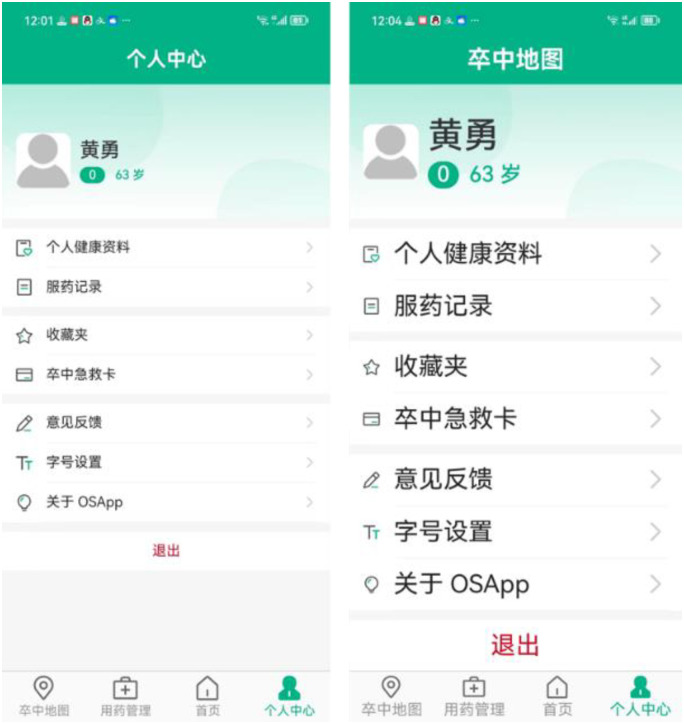
Twenty-five features for inclusion in the app were collected in round one, and 14 features remained and were ranked by the participants during nominal group technique. OASapp included five core components (medication management, risk factor management, health information, communication, and stroke map). Users of OASapp were satisfied based on reports from Alpha and Beta testing. The mean Usability Metric for User Experience (UMUX) score was 71.4 points (SD 14.6 points).
OASapp was successfully developed using comprehensive, robust, and theory-based methods and was found to be highly accepted by users. Further research is needed to establish the clinical efficacy of the app so that it can be utilized to improve clinically relevant outcomes.
有效的药物依从性对老年中风幸存者至关重要,但20%-33%的患者在出院后一年内停止治疗,这增加了中风复发和死亡的风险。移动健康(mHealth)应用程序可能是一种改善中风幸存者药物依从性的新工具,因为它有可能增强患者的自主权。一些与中风相关的应用程序为中风幸存者提供信息和支持。然而,没有一个专注于药物依从性,也没有记录其开发和评估过程,特别是那些针对老年人群体的应用程序。
本研究旨在设计和开发一款名为OASapp的智能手机应用程序,以提高老年中风幸存者的药物依从性,并评估其可用性。
OASapp是通过三个阶段的开发过程开发的。第一阶段是探索阶段(包括横断面调查、系统评价、在苹果应用商店和谷歌Play商店搜索中风应用程序,以及名义群体技术)。在第二阶段,基于健康信念模型和技术接受模型设计了一个原型。在第三阶段,进行了Alpha和Beta测试以验证该应用程序。
在第一轮中收集了25个纳入该应用程序的功能,在名义群体技术过程中,参与者保留了14个功能并对其进行了排序。OASapp包括五个核心组件(药物管理、风险因素管理、健康信息、通信和中风地图)。根据Alpha和Beta测试的报告,OASapp的用户感到满意。用户体验可用性指标(UMUX)的平均得分为71.4分(标准差14.6分)。
OASapp是使用全面、稳健且基于理论的方法成功开发的,并且被发现受到用户的高度接受。需要进一步研究以确定该应用程序的临床疗效,以便它可以用于改善临床相关结果。