Tsukamoto Masaya, Kawasaki Tomoyuki, Vemuri Mohan C, Umezawa Akihiro, Akutsu Hidenori
Center for Regenerative Medicine, National Center for Child Health and Development, 2-10-1 Okura, Setagaya, Tokyo 157-8535, Japan.
Thermo Fisher Scientific, 7335 Executive Way, Frederick, MD 21702, USA.
Regen Ther. 2024 Mar 10;27:39-47. doi: 10.1016/j.reth.2024.02.005. eCollection 2024 Dec.
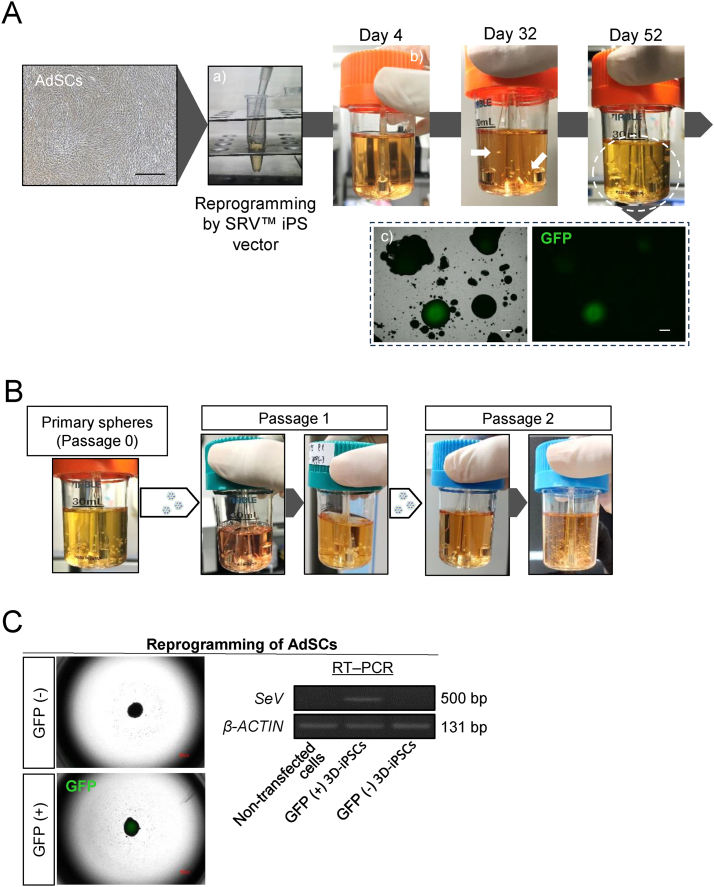
Induced pluripotent stem cells (iPSCs) have immense potential for use in disease modeling, etiological studies, and drug discovery. However, the current workflow for iPSC generation and maintenance poses challenges particularly during the establishment phase when specialized skills are required. Although three-dimensional culture systems offer scalability for maintaining established iPSCs, the enzymatic dissociation step is complex and time-consuming. In this study, a novel approach was developed to address these challenges by enabling iPSC generation, maintenance, and differentiation without the need for two-dimensional culture or enzymatic dissociation. This streamlined method offers a more convenient workflow, reduces variability and labor for technicians, and opens up avenues for advancements in iPSC research and broader applications.
诱导多能干细胞(iPSC)在疾病建模、病因学研究和药物发现方面具有巨大的应用潜力。然而,目前iPSC生成和维持的工作流程存在挑战,尤其是在建立阶段,这需要专业技能。尽管三维培养系统为维持已建立的iPSC提供了可扩展性,但酶解步骤复杂且耗时。在本研究中,开发了一种新方法来应对这些挑战,该方法能够在无需二维培养或酶解的情况下实现iPSC的生成、维持和分化。这种简化的方法提供了更便捷的工作流程,减少了技术人员的变异性和工作量,并为iPSC研究的进展和更广泛的应用开辟了道路。