Psychiatry Unit, Department of Health Sciences, University of Florence, Largo Brambilla, 3, 50134, Florence, Italy.
The Royal's Institute of Mental Health Research & University of Ottawa, Ottawa, ON, Canada.
Eat Weight Disord. 2024 Mar 25;29(1):22. doi: 10.1007/s40519-024-01651-x.
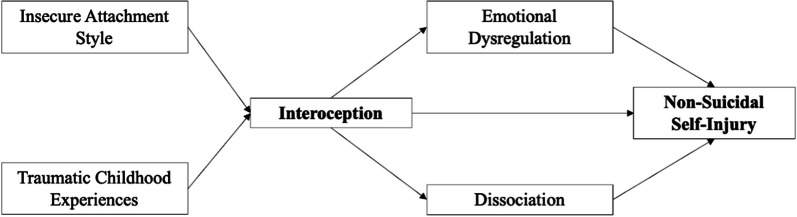
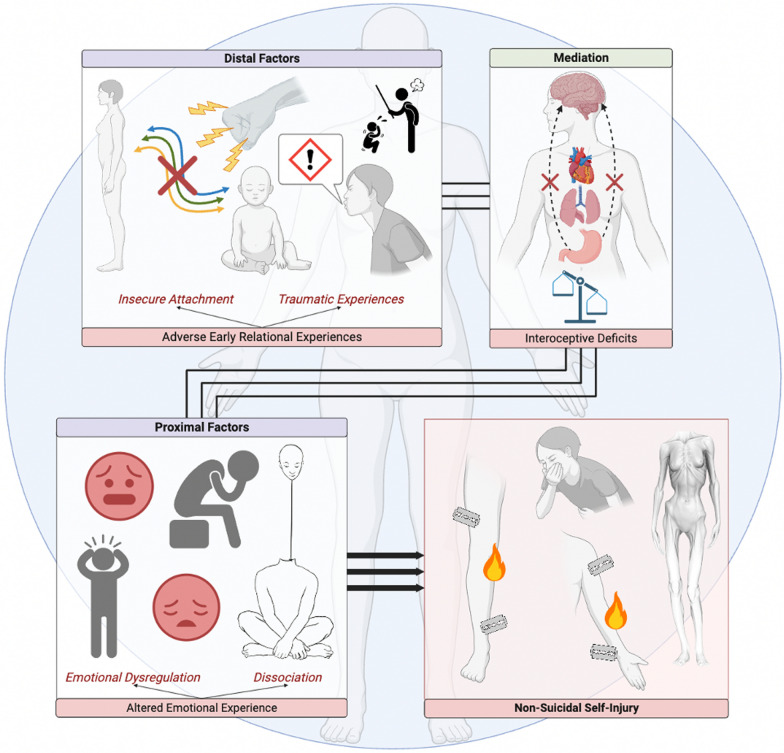
Individuals with anorexia nervosa (AN) and bulimia nervosa (BN) frequently exhibit Non-Suicidal Self-Injury (NSSI), yet their co-occurrence is still unclear. To address this issue, the aim of this study was to elucidate the role of impairments in interoception in explaining the NSSI phenomenon in AN and BN, providing an explanatory model that considers distal (insecure attachment/IA and traumatic childhood experiences/TCEs) and proximal (dissociation and emotional dysregulation) risk factors for NSSI.
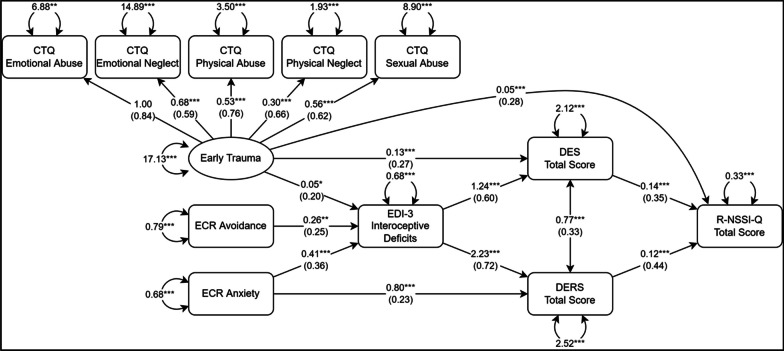
130 patients with AN and BN were enrolled and administered self-report questionnaires to assess the intensity of NSSI behaviors, interoceptive deficits, IA, TCEs, emotional dysregulation and dissociative symptoms.
Results from structural equation modeling revealed that impairments in interoception acted as crucial mediators between early negative relational experiences and factors that contribute to NSSI in AN and BN, particularly emotional dysregulation and dissociation. Precisely, both aspects of IA (anxiety and avoidance) and various forms of TCEs significantly exacerbated interoceptive deficits, which in turn are associated to the emergence of NSSI behaviors through the increase in levels of dissociation and emotional dysregulation.
The proposed model provided a novel explanation of the occurrence of NSSIs in patients with AN and BN by accounting for the significance of interoception.
Level V-Cross-sectional observational study.
厌食症(AN)和贪食症(BN)患者经常出现非自杀性自我伤害(NSSI),但其共病情况仍不清楚。为了解决这个问题,本研究旨在阐明内感受损伤在解释 AN 和 BN 中 NSSI 现象中的作用,提供一个解释模型,该模型考虑了 NSSI 的远端(不安全依恋/IA 和创伤性童年经历/TCEs)和近端(解离和情绪调节障碍)风险因素。
纳入了 130 名 AN 和 BN 患者,并对他们进行了自我报告问卷评估,以评估 NSSI 行为、内感受缺陷、IA、TCEs、情绪调节障碍和解离症状的严重程度。
结构方程模型的结果表明,内感受损伤作为早期负面关系经历和导致 AN 和 BN 中 NSSI 因素之间的关键中介,尤其是情绪调节障碍和解离。确切地说,IA 的两个方面(焦虑和回避)和各种形式的 TCEs 显著加剧了内感受缺陷,而内感受缺陷又通过增加解离和情绪调节障碍的水平与 NSSI 行为的出现相关。
该模型通过考虑内感受的重要性,为 AN 和 BN 患者中 NSSI 的发生提供了一个新的解释。
V 级 - 横断面观察性研究。