Department of Epidemiology, School of Public Health, University of Washington, Seattle, WA, USA.
Department of Epidemiology, School of Public Health, University of Washington, Seattle, WA, USA; Department of Health Systems and Population Health, School of Public Health, University of Washington, Seattle, WA, USA.
Soc Sci Med. 2024 May;348:116793. doi: 10.1016/j.socscimed.2024.116793. Epub 2024 Mar 21.
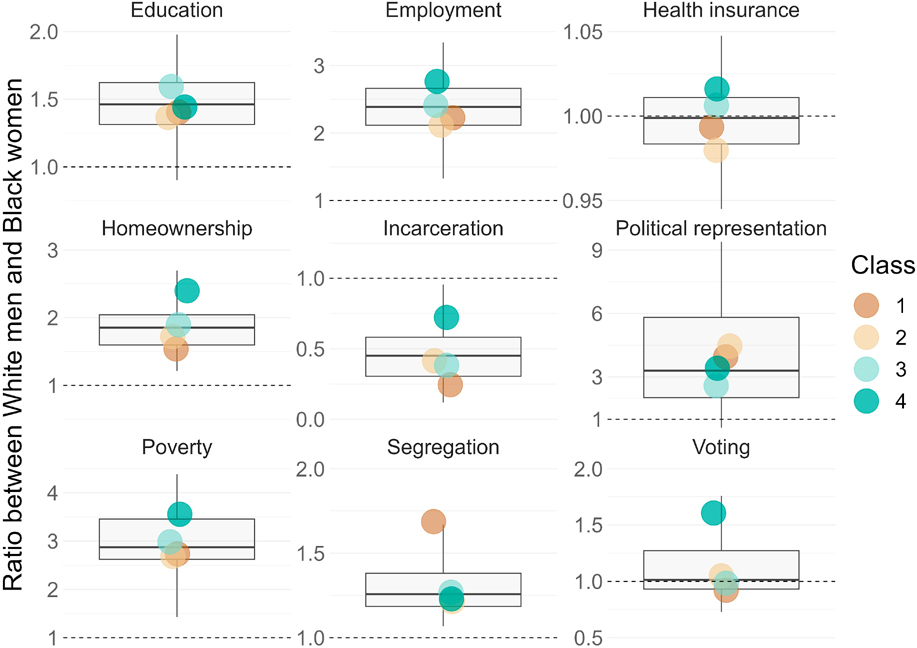
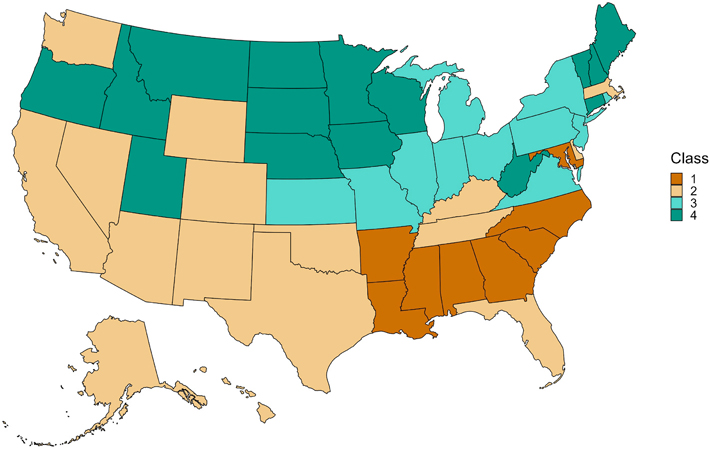
Structural gendered racism - the "totality of interconnectedness between structural racism and sexism" - is conceptualized as a fundamental cause of the persistent preterm birth inequities experienced by Black and Indigenous people in the United States. Our objective was to develop a state-level latent class measure of structural gendered racism and examine its association with preterm birth among all singleton live births in the US in 2019. Using previously-validated inequity indicators between White men and Black women across 9 domains (education, employment, poverty, homeownership, health insurance, segregation, voting, political representation, incarceration), we conducted a latent profile analysis to identify a latent categorical variable with k number of classes that have similar values on the observed continuous input variables. Racialized group-stratified multilevel modified Poisson regression models with robust variance and random effects for state assessed the association between state-level classes and preterm birth. We found four distinct latent classes that were all characterized by higher levels of disadvantage for Black women and advantages for White men, but the magnitude of that difference varied by latent class. We found preterm birth risk among Black birthing people was higher across all state-level latent classes compared to White birthing people, and there was some variation of preterm birth risk across classes among Black but not White birthing people. These findings further emphasize the importance of understanding and interrogating the whole system and the need for multifaceted policy solutions.
结构性性别种族主义——“结构性种族主义和性别歧视之间的相互联系的总和”——被概念化为美国黑人和土著人民持续经历早产不平等现象的根本原因。我们的目的是开发一种州级结构性别种族主义潜在类别衡量标准,并研究其与 2019 年美国所有单胎活产早产之间的关联。使用之前在 9 个领域(教育、就业、贫困、住房拥有率、医疗保险、隔离、投票、政治代表性、监禁)之间验证过的不平等指标,我们进行了潜在剖面分析,以确定具有 k 个类别的潜在分类变量,这些类别在观察到的连续输入变量上具有相似的值。对州评估的种族分层多水平修正泊松回归模型具有稳健的方差和州的随机效应,用于评估州级类别与早产之间的关联。我们发现了四个不同的潜在类别,这些类别都以黑人群体的劣势和白人群体的优势为特征,但这种差异的程度因潜在类别而异。我们发现,与白人生育者相比,所有州级潜在类别中黑人生育者的早产风险都更高,而在黑人生育者中,早产风险在不同类别之间存在差异,但在白人生育者中则没有。这些发现进一步强调了理解和质疑整个系统的重要性,以及需要采取多方面的政策解决方案。