Kwon Jeanny, Kim Byoung Hyuck
Department of Radiation Oncology, Chungnam National University School of Medicine, Daejeon, Republic of Korea.
Department of Radiation Oncology, Seoul National University College of Medicine, Seoul, Republic of Korea.
Radiat Oncol J. 2024 Mar;42(1):50-62. doi: 10.3857/roj.2023.00871. Epub 2024 Jan 16.
To compare long-term toxicity incidences, including secondary cancer (SC) with or without total body irradiation (TBI), in Asian patients receiving allogeneic hematopoietic stem cell transplantation (HSCT) using a nationwide database.
We identified 4,554 patients receiving HSCT for leukemic disease from 2009 to 2016 using the healthcare bigdata system of Korea. Incidence rate ratios (IRRs) for SC, cataracts, hypothyroidism, chronic kidney disease (CKD), myocardial infarction, or strokes were compared, and standardized incidence ratios (SIR) of SC was also estimated.
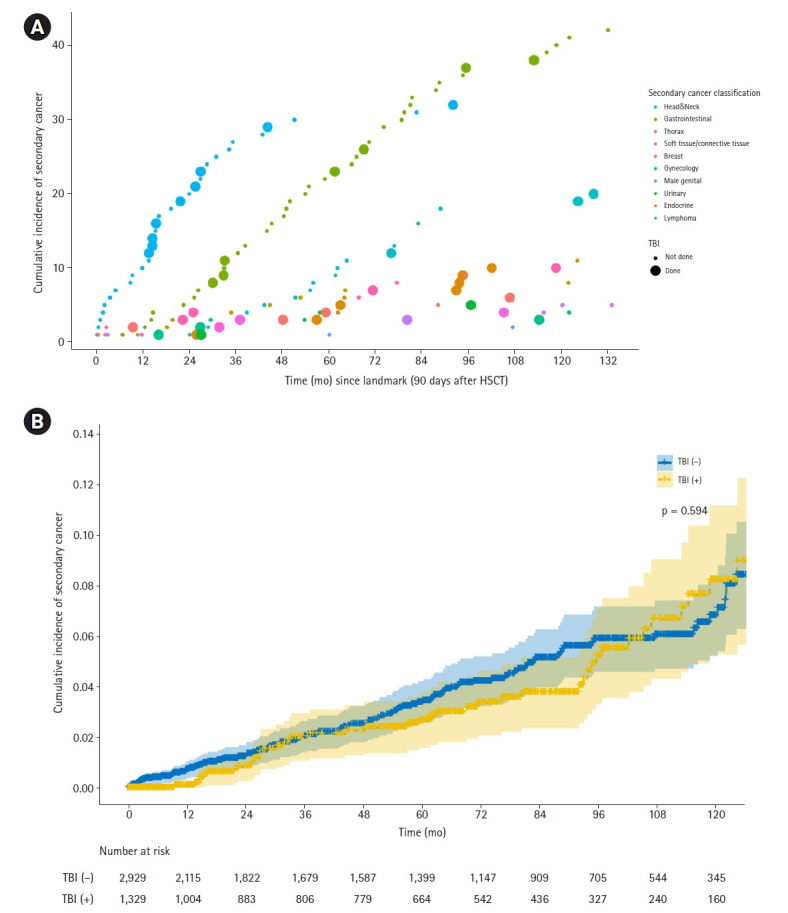
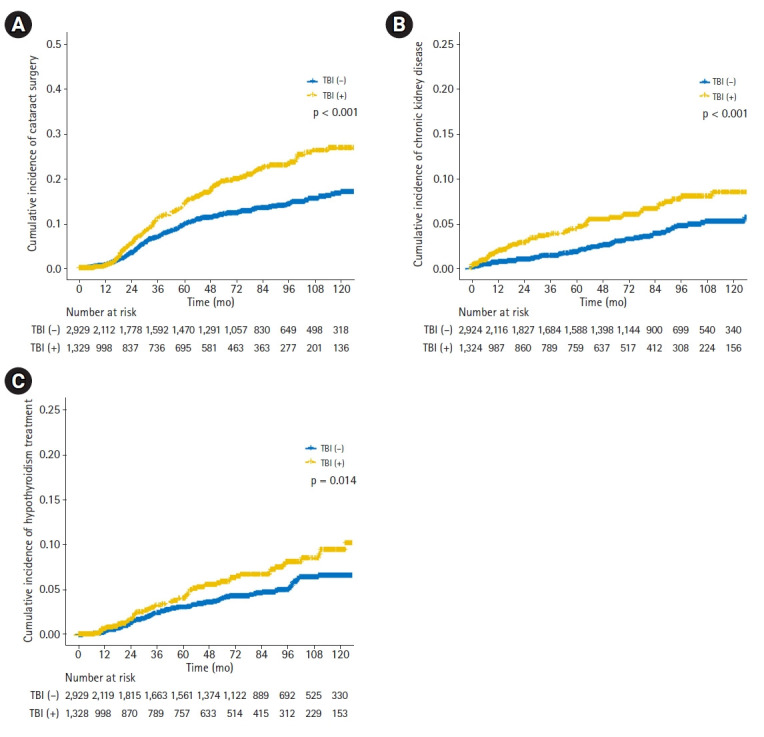
TBI was conducted on 1,409 patients (30.9%). No overall survival differences based on TBI were observed. With a median follow-up duration of 58.2 months, 143 patients were diagnosed with subsequent SC (3.4%). Incidence rates per 1,000 person-year were 6.56 (95% confidence interval [CI], 4.8-8.8) and 7.23 (95% CI, 5.9-8.8) in the TBI and no-TBI groups, respectively (p = 0.594). Also, the SIR (95% CI) was not significantly increased by TBI (1.32 [0.86-1.94] vs. 1.39 [1.08-1.77] in the no-TBI group). In the young age group (0-19 years), SIRs were increased in both groups regardless of TBI (8.60 vs. 11.96). The IRRs of cataracts (1.60; 95% CI, 1.3-2.0), CKD (1.85; 95% CI, 1.3-2.6), and hypothyroidism (1.50; 95% CI, 1.1-2.1) were significantly increased after TBI. However, there were no significant differences in the occurrence of myocardial infarction and stroke according to TBI.
Our results suggest that modern TBI may not additionally increase the risk of SC after allogeneic HSCT, although increased risks of other diseases were noted. Physicians should carefully consider individualized risks and benefits of TBI, with a particular focus by age group.
利用全国性数据库,比较接受异基因造血干细胞移植(HSCT)的亚洲患者中包括有或无全身照射(TBI)情况下的继发性癌症(SC)在内的长期毒性发生率。
我们使用韩国医疗大数据系统,确定了2009年至2016年期间4554例因白血病接受HSCT的患者。比较了SC、白内障、甲状腺功能减退、慢性肾脏病(CKD)、心肌梗死或中风的发病率比(IRR),并估算了SC的标准化发病率比(SIR)。
1409例患者(30.9%)接受了TBI。未观察到基于TBI的总生存差异。中位随访时间为58.2个月,143例患者被诊断为继发性SC(3.4%)。TBI组和非TBI组每1000人年的发病率分别为6.56(95%置信区间[CI],4.8 - 8.8)和7.23(95%CI,5.9 - 8.8)(p = 0.594)。此外,TBI并未使SIR(95%CI)显著升高(非TBI组为1.39[1.08 - 1.77],TBI组为1.32[0.86 - 1.94])。在年轻年龄组(0 - 19岁),无论是否接受TBI,两组的SIR均升高(8.60对11.96)。TBI后白内障(1.60;95%CI,1.3 - 2.0)、CKD(1.85;95%CI,1.3 - 2.6)和甲状腺功能减退(1.50;95%CI,1.1 - 2.1)的IRR显著升高。然而,根据TBI情况,心肌梗死和中风的发生率无显著差异。
我们的结果表明,现代TBI可能不会额外增加异基因HSCT后SC的风险,尽管注意到其他疾病的风险有所增加。医生应仔细考虑TBI的个体化风险和益处,尤其要按年龄组重点关注。