Fan Chenyang, Guo Xiaohong, Zhang Jie, Zheng Wen, Shi Chonglin, Qin Yongwei, Shen Haoliang, Lu Yang, Fan Yihui, Li Yanli, Chen Liuting, Mao Renfang
Department of Pathogenic Biology, School of Medicine, Nantong University, Nantong, China.
The Intensive Care Unit, Affiliated Hospital of Nantong University, Jiangsu, China.
Discov Oncol. 2024 Apr 3;15(1):98. doi: 10.1007/s12672-024-00928-y.
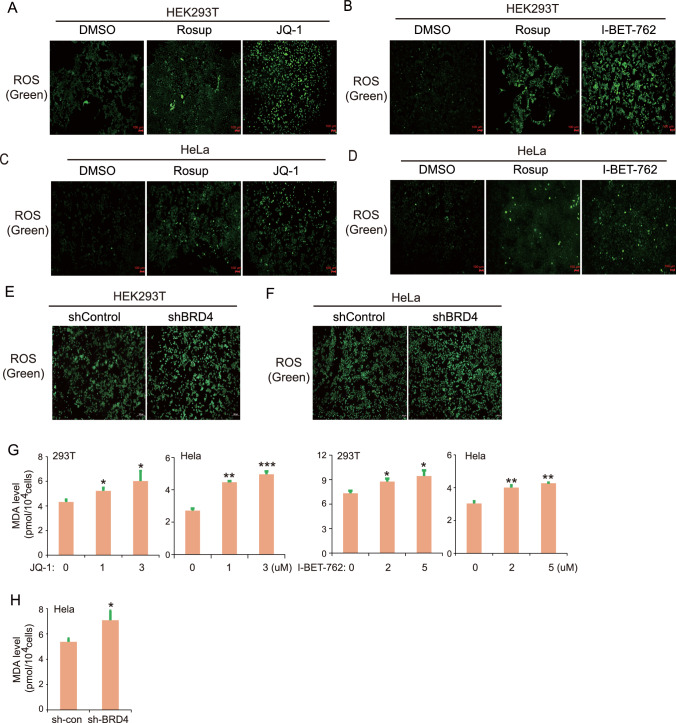
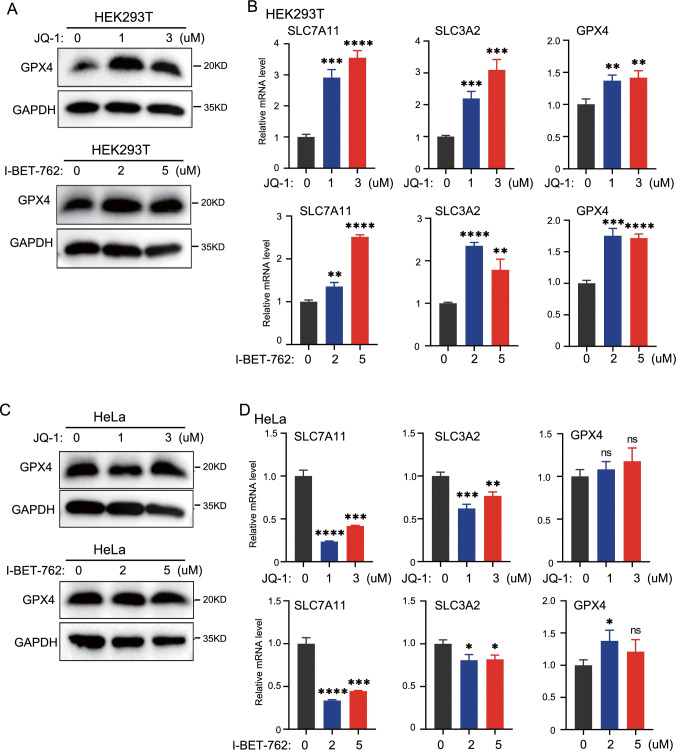
Ferroptosis, an iron-dependent form of programmed cell death, is a promising strategy for cancer treatment. Bromodomain-containing protein 4 (BRD4) is an epigenetic reader and a promising target for cancer therapeutics. However, the role of BRD4 in ferroptosis is controversial and the value of the interaction between BRD4 inhibitors and ferroptosis inducers remains to be explored. Here, we found that BRD4 inhibition greatly enhanced erastin-induced ferroptosis in different types of cells, including HEK293T, HeLa, HepG2, RKO, and PC3 cell lines. Knocking down BRD4 in HEK293T and HeLa cells also promoted erastin-induced cell death. BRD4 inhibition by JQ-1 and I-BET-762 or BRD4 knockdown resulted in substantial accumulation of reactive oxygen species (ROS) in both HEK293T and HeLa cells. The effect of BRD4 inhibition on ferroptosis-associated genes varied in different cells. After using BRD4 inhibitors, the expression of FTH1, Nrf2, and GPX4 increased in HEK293T cells, while the levels of VDAC2, VDAC3, and FSP1 decreased. In HeLa cells, the expression of FTH1, VDAC2, VDAC3, Nrf2, GPX4, and FSP1 was reduced upon treatment with JQ-1 and I-BET-762. Consistently, the level of FSP1 was greatly reduced in HEK293T and HeLa cells with stable BRD4 knockdown compared to control cells. Furthermore, ChIP-sequencing data showed that BRD4 bound to the promoter of FSP1, but the BRD4 binding was greatly reduced upon JQ-1 treatment. Our results suggest that ROS accumulation and FSP1 downregulation are common mechanisms underlying increased ferroptosis with BRD4 inhibitors. Thus, BRD4 inhibitors might be more effective in combination with ferroptosis inducers, especially in FSP1-dependent cancer cells.
铁死亡是一种铁依赖性的程序性细胞死亡形式,是一种很有前景的癌症治疗策略。含溴结构域蛋白4(BRD4)是一种表观遗传阅读器,也是一种很有前景的癌症治疗靶点。然而,BRD4在铁死亡中的作用存在争议,BRD4抑制剂与铁死亡诱导剂之间相互作用的价值仍有待探索。在此,我们发现抑制BRD4能极大地增强不同类型细胞(包括HEK293T、HeLa、HepG2、RKO和PC3细胞系)中erastin诱导的铁死亡。在HEK293T和HeLa细胞中敲低BRD4也能促进erastin诱导的细胞死亡。JQ-1和I-BET-762抑制BRD4或敲低BRD4会导致HEK293T和HeLa细胞中活性氧(ROS)大量积累。BRD4抑制对铁死亡相关基因的影响在不同细胞中有所不同。使用BRD4抑制剂后,HEK293T细胞中FTH1、Nrf2和GPX4的表达增加,而VDAC2、VDAC3和FSP1的水平降低。在HeLa细胞中,用JQ-1和I-BET-762处理后,FTH1、VDAC2、VDAC3、Nrf2、GPX4和FSP1的表达降低。同样,与对照细胞相比,稳定敲低BRD4的HEK293T和HeLa细胞中FSP1的水平大大降低。此外,染色质免疫沉淀测序数据显示BRD4与FSP1的启动子结合,但JQ-1处理后BRD4的结合大大减少。我们的结果表明,ROS积累和FSP1下调是BRD4抑制剂增加铁死亡的共同机制。因此,BRD4抑制剂与铁死亡诱导剂联合使用可能更有效,尤其是在依赖FSP1的癌细胞中。