Gc Sagar, Alarcon-Mendoza Ivan, Harshman David, Khanal Churamani
Department of Plant and Environmental Sciences, College of Agriculture, Forestry and Life Sciences, Clemson University, Clemson, SC 29634, USA.
Plants (Basel). 2024 Mar 12;13(6):803. doi: 10.3390/plants13060803.
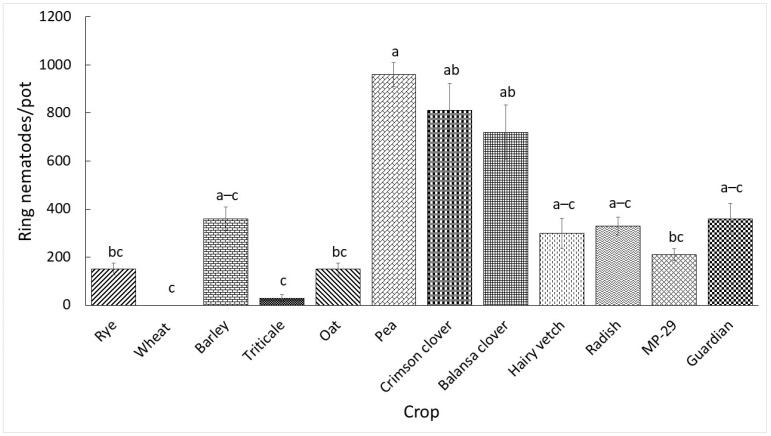
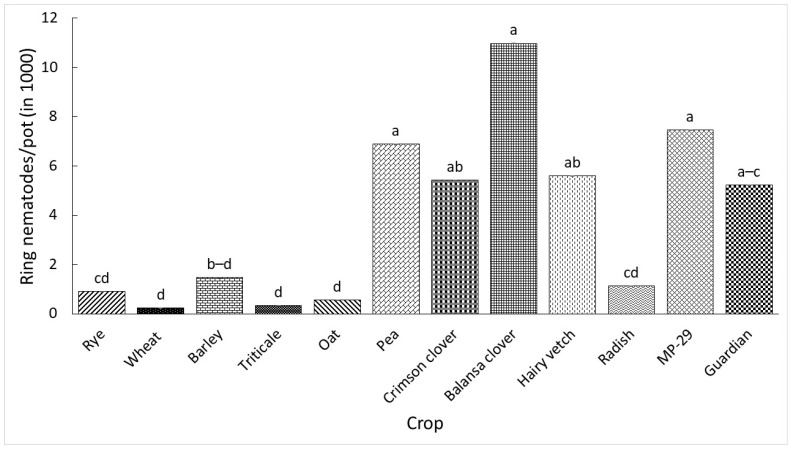
Two peach rootstocks ('Guardian' and 'MP-29') and ten winter cover crops (rye, wheat, barley, triticale, oat, Austrian winter pea, crimson clover, balansa clover, hairy vetch, and daikon radish) were evaluated in a greenhouse environment to determine their suitability to host ring nematode, . Each crop was inoculated with 500 ring nematodes, and the experiments were terminated 60 days after inoculation. The reproduction factor (ratio of final and initial nematode population) ranged from 0 to 13.8, indicating the crops greatly varied in their host suitability to ring nematode. 'Guardian' has been known to tolerate ring nematode; however, results from the current study suggest the tolerance statement is anecdotal. Another peach rootstock, 'MP-29', was also a good host for ring nematode, suggesting an urgency to develop ring nematode-resistant peach rootstocks. Wheat supported the least to no nematode reproduction while pea supported the greatest reproduction. The rest of the cover crops were poor to good hosts to ring nematodes. Although planting cover crops in peach orchards is not common, employing non or poor host crops can help suppress nematodes in addition to having soil health benefits. Furthermore, peach breeding programs should focus on finding and introgressing ring nematode resistance in commercial rootstocks.
在温室环境中对两种桃砧木(“Guardian”和“MP - 29”)以及十种冬季覆盖作物(黑麦、小麦、大麦、小黑麦、燕麦、奥地利冬豌豆、绛三叶、巴兰萨苜蓿、毛苕子和萝卜)进行了评估,以确定它们作为环线虫寄主的适宜性。每种作物接种500条环线虫,接种60天后终止实验。繁殖系数(最终线虫种群与初始线虫种群的比率)在0至13.8之间,表明这些作物对环线虫的寄主适宜性差异很大。已知“Guardian”能耐受环线虫;然而,当前研究结果表明这种耐受性说法只是传闻。另一种桃砧木“MP - 29”也是环线虫的良好寄主,这表明迫切需要培育抗环线虫的桃砧木。小麦对线虫繁殖的支持最少甚至没有,而豌豆对线虫繁殖的支持最大。其余覆盖作物对环线虫而言是从不良到良好的寄主。虽然在桃园种植覆盖作物并不常见,但使用非寄主或不良寄主作物除了对土壤健康有益外,还能帮助抑制线虫。此外,桃树育种计划应专注于在商业砧木中寻找并导入抗环线虫特性。